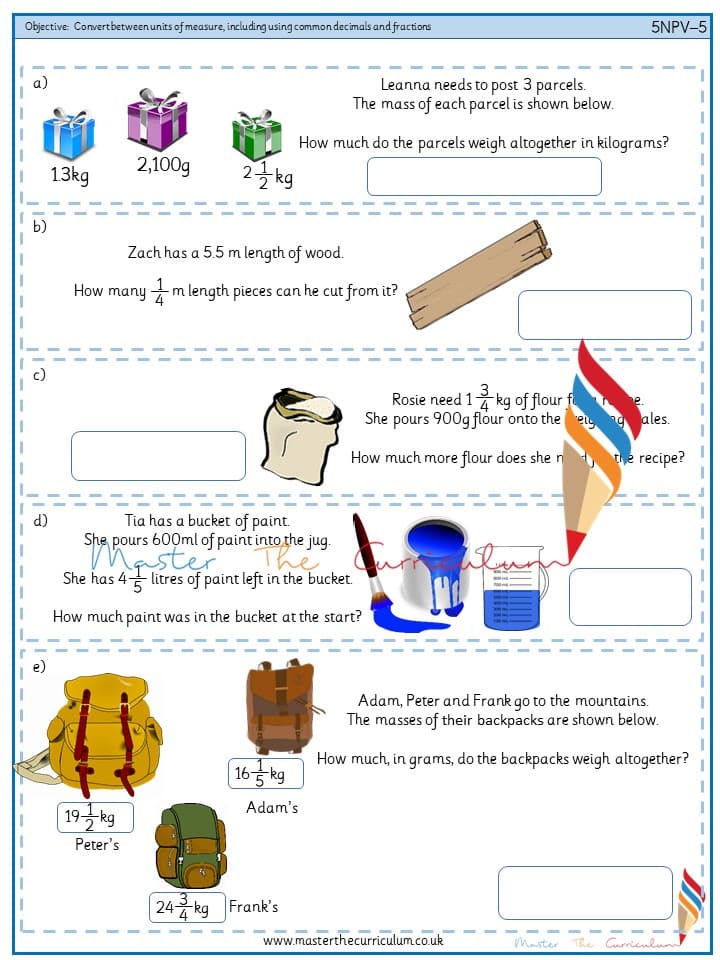
Pupils should first memorise the following unit conversions: 1km = 1,000m 1m = 100cm 1cm = 10mm 1 litre = 1,000ml 1kg = 1,000g £1 = 100p It is essential that enough time is given to this foundational stage before moving on. Practical experience of these conversions will help pupils to avoid common errors in recalling the correct power of 10 for a given conversion. For example, they can walk 1km while counting the number of metres using a trundle measuring wheel. Once pupils can confidently recall these conversions, they should apply them to whole number conversions, from larger to smaller units and vice versa, for example, £4 = 400p and 8,000g = 8kg. Pupils must then learn to convert from and to fraction and decimal-fraction quantities of larger units, within 1, for example 0.25km = 250m. They should be able to carry out conversions that correspond to some of the common 2, 4, 5 and 10 part measures intervals, as exemplified below for kilometre–metre conversions. For finding 3/4 of a unit, pupils should have sufficient fluency in the association between 3/4 and 0.75, 75 and 750 that they should not need to first work out 1/4 and multiply by 3. For all conversions, pupils should begin by stating the single unit conversion rate as a step to the fraction or decimal-fraction conversion. Language focus “1m is 100cm.” “So is 75cm.” Pupils should learn to derive other common conversions over 1. To convert, for example, 3,700 millilitres to litres, they should not need to think about dividing by 1,000 and moving the digits 3 places. Instead they should be able to use single unit conversion rates and their understanding of place value. Language focus “1,000ml is 1 litre.” “So 3,000ml is 3 litres, and 3,700ml is 3.7 litres.” For pounds and pence, and metres and centimetres, pupils should also be able to carry out conversions that correspond to 100 parts, for example, 52p = £0.52, and 43cm = 0.43m. Language focus “100p is £1.” “So 50p is £0.50, and 52p is £0.52.”Read more
Pupils should first memorise the following unit conversions: 1km = 1,000m 1m = 100cm 1cm = 10mm 1 litre = 1,000ml 1kg = 1,000g £1 = 100p It is essential that enough time is given to this foundational stage before moving on. Practical experience of these conversions will help pupils to avoid common errors in recalling the correct power of 10 for a given conversion. For example, they can walk 1km while counting the number of metres using a trundle measuring wheel. Once pupils can confidently recall these conversions, they should apply them to whole number conversions, from larger to smaller units and vice versa, for example, £4 = 400p and 8,000g = 8kg. Pupils must then learn to convert from and to fraction and decimal-fraction quantities of larger units, within 1, for example 0.25km = 250m. They should be able to carry out conversions that correspond to some of the common 2, 4, 5 and 10 part measures intervals, as exemplified below for kilometre–metre conversions. For finding 3/4 of a unit, pupils should have sufficient fluency in the association between 3/4 and 0.75, 75 and 750 that they should not need to first work out 1/4 and multiply by 3. For all conversions, pupils should begin by stating the single unit conversion rate as a step to the fraction or decimal-fraction conversion. Language focus “1m is 100cm.” “So is 75cm.” Pupils should learn to derive other common conversions over 1. To convert, for example, 3,700 millilitres to litres, they should not need to think about dividing by 1,000 and moving the digits 3 places. Instead they should be able to use single unit conversion rates and their understanding of place value. Language focus “1,000ml is 1 litre.” “So 3,000ml is 3 litres, and 3,700ml is 3.7 litres.” For pounds and pence, and metres and centimetres, pupils should also be able to carry out conversions that correspond to 100 parts, for example, 52p = £0.52, and 43cm = 0.43m. Language focus “100p is £1.” “So 50p is £0.50, and 52p is £0.52.”
Show less