
Key Events & Seasonal
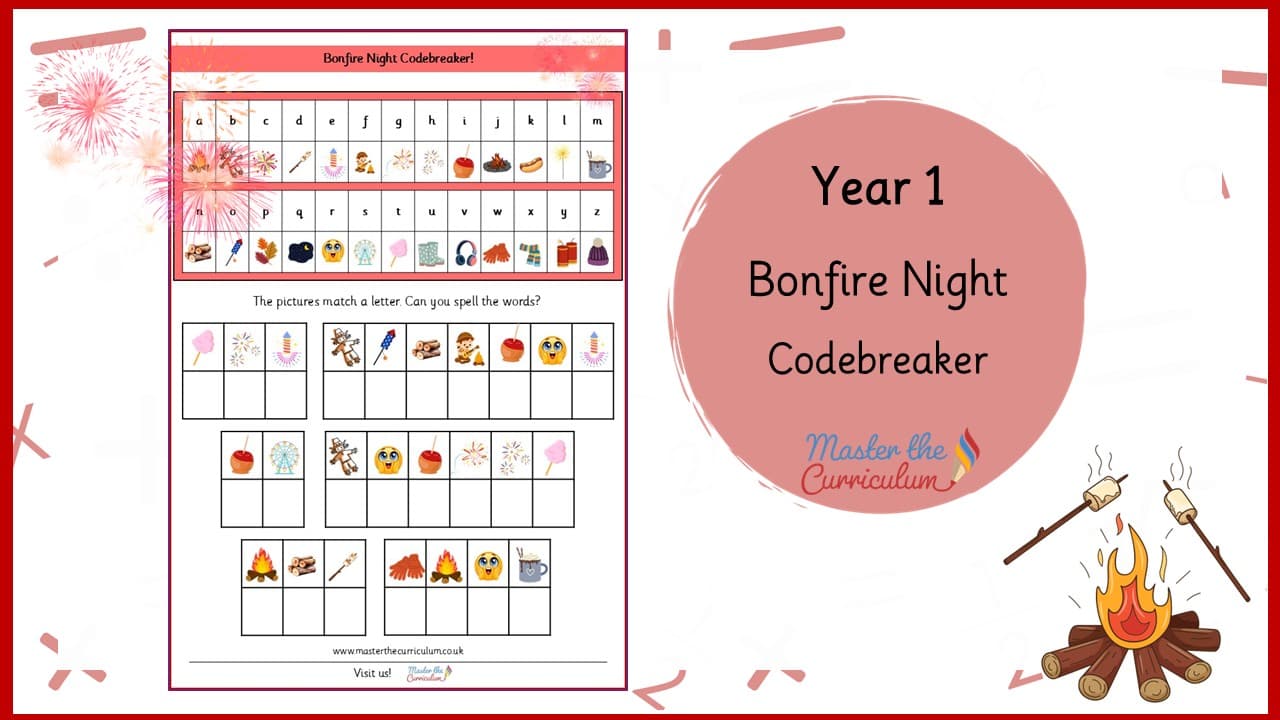
Y1Bonfire Night Codebreaker
masterthecurriculum.co.uk
4.227 reviews
Included with membershipProposed versionTrusted by primary teachers across the UK · New resources every week
Resource
Preview only. The download is a fully editable file.
1 page shown before you download
1CoverThe rest of the pack
Planning, teaching slides and all three worksheet levels come with the download.
Included with membership
Unlock with membershipAlready a member? Sign in and it downloads from this page.
Keep it for later and group it with the rest of the block. No account needed to start.
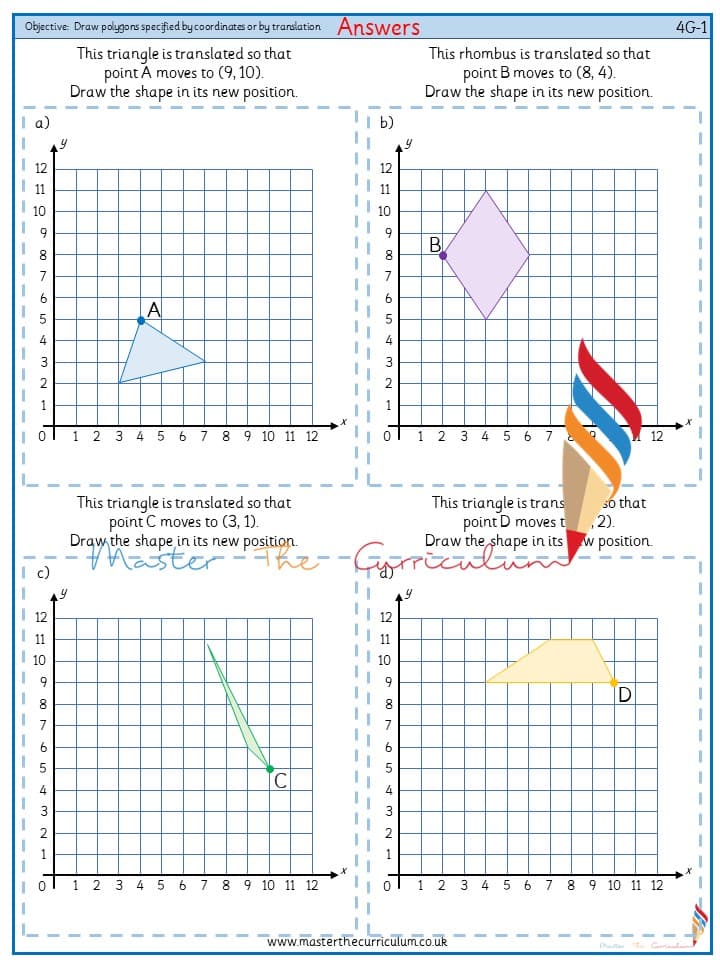
Pupils should already be adept at placing markings at specific points, and joining these accurately with a ruler to draw a polygon (3G–1). Pupils can begin by describing translations of polygons drawn on squared paper, by counting how many units to the left/right and up/down the polygon has been translated. Language focus “The polygon has been translated 4 squares to the right and 3 squares down.” Pupils should then learn to translate polygons on squared paper according to instructions that describe how many units to move the polygon to the left/right and up/down. Pupils can translate each point of the polygon individually, for example, translating each point right 4 and down 3 to mark the new points, and then joining them. Alternatively, pupils can translate and mark one point, then mark the other points of the polygon relative to the translated point. In year 4, pupils must start to use coordinate geometry, beginning with the first quadrant. Initially, pupils can work with axes with no number labels, marking specified points as a translation from the origin, described as above. For example, “Start at the origin and mark a point along 5, and up 4.” Finally, pupils should learn to use coordinate notation with number labels on the axes. They must be able to mark the position of points specified by coordinates, and write coordinates for already marked points. When pupils first start to mark points, they should still start at the origin, moving along and then up as specified by the coordinates. If they do not do this, they are likely to place a point such as (5, 4) by just looking for a 5 and a 4, and possibly end up placing the point at (4, 5). Language focus “First count along the x-axis, then count along the y-axis.” Pupils should then be able to draw polygons by marking and joining specified coordinates.
Show lessThe standard small step pack, as her own modules ship it. We do not print page counts here, because her catalogue does not publish them and a guessed number is worse than none.
Her own system, with the star count repeated in every worksheet header so a child can be handed the right sheet without a word.
Key Events & Seasonal
Y1Key Events & Seasonal
EYFS
Key Events & Seasonal
Y6
Key Events & Seasonal
Y6
Number & Place Value
Y6
One email a week, for the year group you actually teach. Unsubscribe in a click.