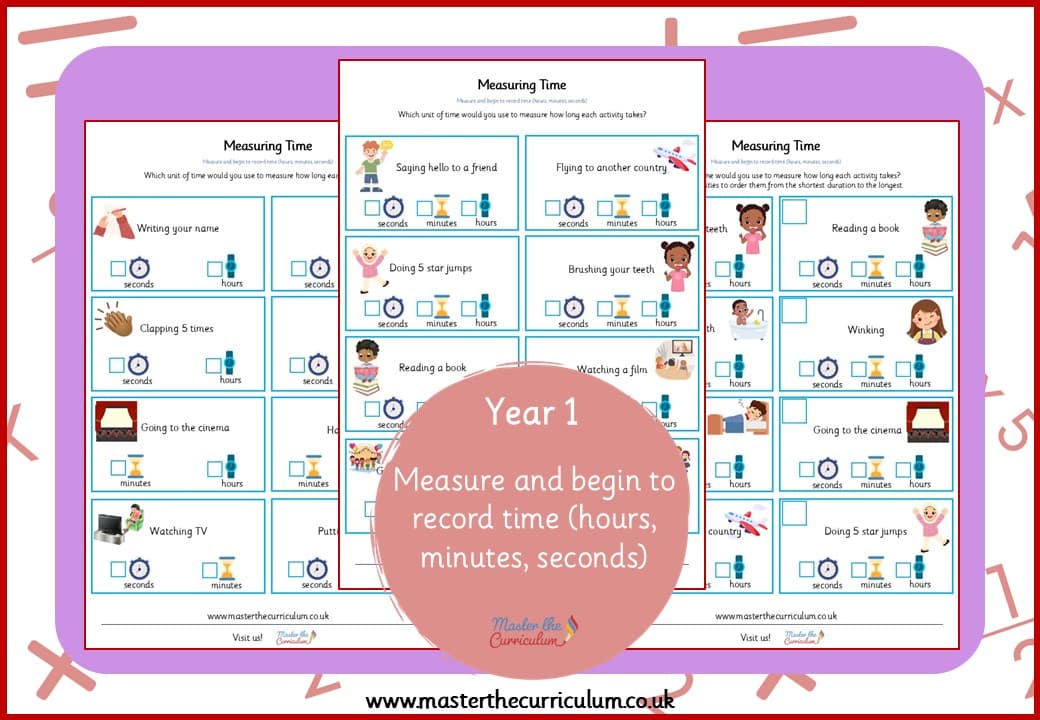
Help children understand and compare durations of time with this engaging Working Without Worksheets lesson for Year 1 Measurement – Time . Designed for classrooms that value active learning and practical discussion over worksheets, this lesson uses songs, movement, and real-world reasoning to explore seconds, minutes, and hours . The lesson begins with a fun song about time (to the tune of Twinkle, Twinkle, Little Star ) that introduces time vocabulary and gets children thinking about how long things take. Pupils then discuss and order everyday activities, deciding whether they take seconds, minutes, or hours . Using a stopwatch , the teacher demonstrates how short or long each duration really feels. During the introduction, pupils share their reasoning about which activities take longer or shorter amounts of time, using comparison language such as faster, slower, longer, and quicker. Misconceptions are addressed through humour and reasoning — for example, “If you only slept for 10 seconds, how would you feel?” In the main activity, pairs work with cut-up time statements to decide whether each is true or false (e.g. “It takes an hour to brush your teeth” ). They sort the statements into piles and justify their thinking to their partner using mathematical vocabulary. The plenary consolidates learning through a running race scenario , where pupils discuss which runner was faster or slower and which time was longer or shorter , applying comparison words in context. What’s Included in the Pack? ✔ Full teacher planning with objectives, activities, and plenary guidance ✔ Starter: sing a time song and discuss seconds, minutes, and hours ✔ Vocabulary focus: faster, slower, longer, shorter, seconds, minutes, hours ✔ Teacher modelling: compare activities and measure time with a stopwatch ✔ Practical task: true or false time sorting activity in pairs ✔ Independent reasoning: explain comparisons using time vocabulary ✔ Plenary: running race discussion to apply comparison skillRead more
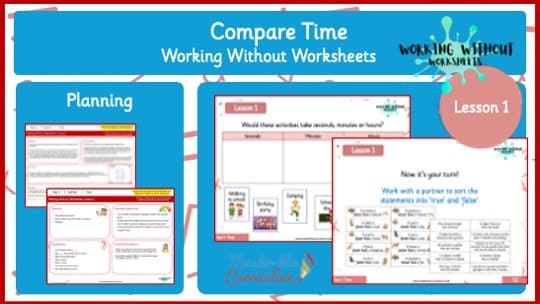
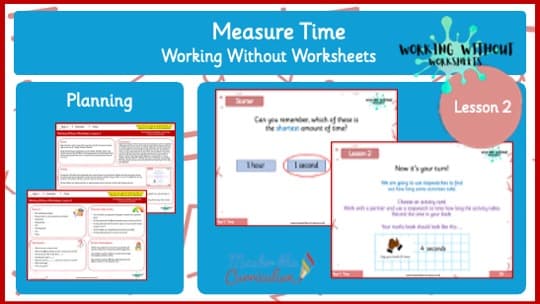
Help children understand and compare durations of time with this engaging Working Without Worksheets lesson for Year 1 Measurement – Time . Designed for classrooms that value active learning and practical discussion over worksheets, this lesson uses songs, movement, and real-world reasoning to explore seconds, minutes, and hours . The lesson begins with a fun song about time (to the tune of Twinkle, Twinkle, Little Star ) that introduces time vocabulary and gets children thinking about how long things take. Pupils then discuss and order everyday activities, deciding whether they take seconds, minutes, or hours . Using a stopwatch , the teacher demonstrates how short or long each duration really feels. During the introduction, pupils share their reasoning about which activities take longer or shorter amounts of time, using comparison language such as faster, slower, longer, and quicker. Misconceptions are addressed through humour and reasoning — for example, “If you only slept for 10 seconds, how would you feel?” In the main activity, pairs work with cut-up time statements to decide whether each is true or false (e.g. “It takes an hour to brush your teeth” ). They sort the statements into piles and justify their thinking to their partner using mathematical vocabulary. The plenary consolidates learning through a running race scenario , where pupils discuss which runner was faster or slower and which time was longer or shorter , applying comparison words in context. What’s Included in the Pack? ✔ Full teacher planning with objectives, activities, and plenary guidance ✔ Starter: sing a time song and discuss seconds, minutes, and hours ✔ Vocabulary focus: faster, slower, longer, shorter, seconds, minutes, hours ✔ Teacher modelling: compare activities and measure time with a stopwatch ✔ Practical task: true or false time sorting activity in pairs ✔ Independent reasoning: explain comparisons using time vocabulary ✔ Plenary: running race discussion to apply comparison skill
Show less