
Working Without Worksheets
EYFSL30 – WWW – Compare Capacity
masterthecurriculum.co.uk
Proposed versionTrusted by primary teachers across the UK · New resources every week
Working Without Worksheets
EYFS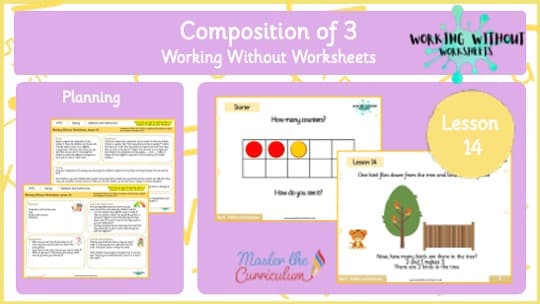
Preview only. The download is a fully editable file.
1 page shown before you download
1CoverThe rest of the pack
Planning, teaching slides and all three worksheet levels come with the download.
Reception Working Without Worksheets lesson on the composition of 3. Includes planning, ten frames, counters in a cup, dominoes, and practical number stories.
Included with membership
Unlock with membershipAlready a member? Sign in and it downloads from this page.
Keep it for later and group it with the rest of the block. No account needed to start.
Working Without Worksheets – Reception Maths: Composition of 3 Help your Reception pupils build strong number foundations with this Working Without Worksheets lesson, where children explore the composition of the number 3 . Through ten frames, story contexts, counters, and dominoes, pupils learn to see that 3 can be made up in different ways—laying the groundwork for addition. The lesson begins with a starter activity : Show a ten frame with 3 double-sided counters in different arrangements. Ask: “How many can you see? How can you see it?” Encourage children to notice compositions such as 3 and 0, 2 and 1, or 1 and 1 and 1. The main input uses practical and visual examples: Show 3 birds in a garden . Ask: “How many birds are there?” Then move the birds between the tree and the fence, asking: “How many in the tree? How many on the fence?” Reinforce with sentences like “2 and 1 makes 3.” Give each child a cup with 3 double-sided counters . Children shake the cup, tip the counters out, and describe what they see (e.g. 2 red and 1 yellow = 3 ). Emphasise that there are always 3 counters altogether. Provide dominoes and ask children to find all with 3 spots. They then describe the split of spots, e.g. “2 and 1 makes 3” or “3 and 0 makes 3.” For the independent activity , pupils explore compositions of 3 in practical and book-based ways, such as: Drawing pictures of groups that make 3 (e.g. 2 apples and 1 apple). Using counters or small toys to show different splits of 3. Recording in maths books by drawing and labelling: “___ and ___ makes 3.” The plenary brings children back together to share examples of how they made 3, reinforcing the idea that numbers can be broken into parts in different ways but still add up to the same total. What’s Included in the Pack? ✔ Full teacher planning with objectives, modelling, and plenary guidance ✔ Starter: explore 3 on a ten frame in different arrangements ✔ Teacher modelling: “3 birds” story, counters in a cup, and dominoes with 3 s
Show lessThe standard small step pack, as her own modules ship it. We do not print page counts here, because her catalogue does not publish them and a guessed number is worse than none.
Her own system, with the star count repeated in every worksheet header so a child can be handed the right sheet without a word.
Working Without Worksheets, Early Years25 numbered lessons
Working Without Worksheets
EYFSWorking Without Worksheets
EYFS
Working Without Worksheets
EYFS
Working Without Worksheets
EYFS
Working Without Worksheets
EYFS
One email a week, for the year group you actually teach. Unsubscribe in a click.