Skip to content

Proposed version

Master the Curriculum

Working Without Worksheets

EYFS

L18 – WWW – Composition of 9 & 10

masterthecurriculum.co.uk

Preview only. The download is a fully editable file.

See inside

1 page shown before you download

Cover of L18 – WWW – Composition of 9 & 101Cover
Cover and first page

The rest of the pack

Planning, teaching slides and all three worksheet levels come with the download.

Early YearsWorking Without Worksheets

L18 – WWW – Composition of 9 & 10

3.829 reviews

Reception Working Without Worksheets lesson on the composition of 9 and 10. Includes planning, ten frame starter, dot plate modelling, and practical activities.

Included with membership

Unlock with membership

Already a member? Sign in and it downloads from this page.

Keep it for later and group it with the rest of the block. No account needed to start.

  • Fully editable Word or PowerPoint file
  • Differentiated three ways
  • Instant download, no watermark

About this resource

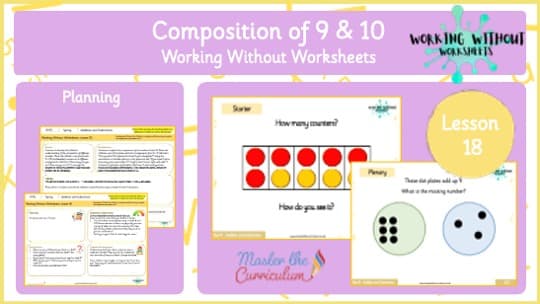
Working Without Worksheets – Reception Maths: Composition of 9 and 10 Help your Reception pupils consolidate their number knowledge with this Working Without Worksheets lesson on the composition of 9 and 10 . Using ten frames and dot plates, children explore all the different ways these larger numbers can be partitioned into smaller parts. The lesson begins with a starter activity : Show a ten frame with 9 or 10 counters arranged in different ways. Ask: “How many can you see? How can you see it?” Encourage children to notice and describe the different compositions, e.g. 5 and 4 make 9 or 7 and 3 make 10. In the main input , the teacher models using dot plates : Display dot plates with arrangements from 0–9. Ask: “Can you find 2 plates that have 9 spots altogether?” Show an example: “If you have 5 spots, how many more make 9?” Confirm that 4 more complete the total. Continue until all possible pairs for 9 are found. Repeat the same process with pairs that make 10 , reinforcing that numbers can be split in many different ways but still combine to the same whole. For the independent activity , children practise creating number bonds with their own dot plates: First, find all the possible pairs of dot plates that make 9 . Then, add in a 10 plate and find all the pairs that make 10 . Encourage children to explain using stem sentences such as: “___ and ___ make 9” or “___ and ___ make 10.” The plenary brings children back together to share the different combinations they found, reinforcing the idea that numbers can be composed in multiple ways but always give the same whole. What’s Included in the Pack? ✔ Full teacher planning with objectives, vocabulary, and plenary ideas ✔ Starter: explore 9 and 10 on a ten frame in different arrangements ✔ Teacher modelling: find pairs of dot plates that make 9 or 10 ✔ Vocabulary focus: bond, part, whole, total, makes, equal ✔ Independent activity: hands-on work with dot plates to explore compositions of 9 and 10 ✔ Stem sentences: “___Read more

Working Without Worksheets – Reception Maths: Composition of 9 and 10 Help your Reception pupils consolidate their number knowledge with this Working Without Worksheets lesson on the composition of 9 and 10 . Using ten frames and dot plates, children explore all the different ways these larger numbers can be partitioned into smaller parts. The lesson begins with a starter activity : Show a ten frame with 9 or 10 counters arranged in different ways. Ask: “How many can you see? How can you see it?” Encourage children to notice and describe the different compositions, e.g. 5 and 4 make 9 or 7 and 3 make 10. In the main input , the teacher models using dot plates : Display dot plates with arrangements from 0–9. Ask: “Can you find 2 plates that have 9 spots altogether?” Show an example: “If you have 5 spots, how many more make 9?” Confirm that 4 more complete the total. Continue until all possible pairs for 9 are found. Repeat the same process with pairs that make 10 , reinforcing that numbers can be split in many different ways but still combine to the same whole. For the independent activity , children practise creating number bonds with their own dot plates: First, find all the possible pairs of dot plates that make 9 . Then, add in a 10 plate and find all the pairs that make 10 . Encourage children to explain using stem sentences such as: “___ and ___ make 9” or “___ and ___ make 10.” The plenary brings children back together to share the different combinations they found, reinforcing the idea that numbers can be composed in multiple ways but always give the same whole. What’s Included in the Pack? ✔ Full teacher planning with objectives, vocabulary, and plenary ideas ✔ Starter: explore 9 and 10 on a ten frame in different arrangements ✔ Teacher modelling: find pairs of dot plates that make 9 or 10 ✔ Vocabulary focus: bond, part, whole, total, makes, equal ✔ Independent activity: hands-on work with dot plates to explore compositions of 9 and 10 ✔ Stem sentences: “___

Show less

What you get, 6 files

  • PDFPlanning
  • PPTXPlanning, editable
  • PDFTeaching slides
  • PPTXTeaching slides, editable
  • PDFWorksheets, all three levels
  • PPTXWorksheets, editable

The standard small step pack, as her own modules ship it. We do not print page counts here, because her catalogue does not publish them and a guessed number is worse than none.

★★★ Differentiated three ways
  • Working towardsScaffolded, with the model or the bar already drawn.
  • Working withinThe expected standard for the year group.
  • Greater depthReasoning and explaining, not just more of the same.

Her own system, with the star count repeated in every worksheet header so a child can be handed the right sheet without a word.

The rest of this block

Working Without Worksheets, Early Years25 numbered lessons

  1. Lesson 16– WWW – Reception Bonds to 5
  2. Lesson 17– WWW – Composition of 6,7,8
  3. Lesson 18 · you are here– WWW – Composition of 9 & 10
  4. Lesson 19– WWW – Number Bonds to 10
  5. Lesson 25– WWW – Continue Repeated Patterns

What teachers said after they used it

All reviews →
3.829 verified reviewsWe ask once, seven days after the download, and one tap is enough.
Joanne PicklesYear 3 teacher, Crossflatts Primary, BingleyVerified download, 5 March 2026

Printed it at eight on a Sunday and taught it on the Monday.

No editing, no reformatting, no hunting for the answers. The three levels are on separate pages, which sounds obvious until you have used the sites where they are not.

10 teachers found this helpful
Michael FerrisMaths lead, Cheadle Heath Primary, StockportVerified download, 16 February 2026

Matches our White Rose planning almost week for week.

I stopped adapting things from three different sites and now start here. The odd week does not line up exactly, but the small step it covers is always somewhere in the same block.

8 teachers found this helpful

Aisha KarimSENCO, Newlands Primary Academy, LutonVerified download, 2 February 2026

The editable file is why we renewed.

Being able to change two questions for the child who joined us in January, without rebuilding the whole sheet, is worth the subscription on its own.

12 teachers found this helpful

More working without worksheets for Early Years

Working Without Worksheets

EYFS

L29 – WWW – Compare Weight

masterthecurriculum.co.uk
4.214 reviews
Included with membership

Working Without Worksheets

EYFS

L28 – WWW – Compare Lengths

masterthecurriculum.co.uk
4.934 reviews
Included with membership

Working Without Worksheets

EYFS

L26 – WWW – Copy Repeated Patterns

masterthecurriculum.co.uk
4.955 reviews
Included with membership
Editable worksheetsWord and PowerPoint, so you can change anythingWhite Rose supportingFollows the small steps you already plan fromDownloadable lesson plansPlanning, slides and worksheets for every stepReasoning and problem solvingBuilt into every step, not sold separately

A free resource every Friday

One email a week, for the year group you actually teach. Unsubscribe in a click.

Year group you teach