Geometry
Y2L4 Compare and Sort Shapes

masterthecurriculum.co.uk
4.447 reviews
Included with membershipProposed versionTrusted by primary teachers across the UK · New resources every week
Geometry
Y2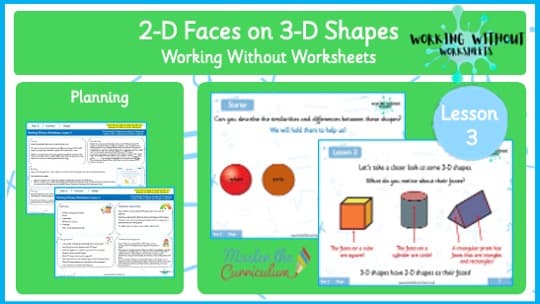
Preview only. The download is a fully editable file.
1 page shown before you download
1CoverThe rest of the pack
Planning, teaching slides and all three worksheet levels come with the download.
Help your Year 2 pupils understand how 3-D shapes are made up of 2-D faces with this hands-on, investigative geometry lesson. Through playdough stamping, paint printing, and discussion, children explore how shapes like cubes, cylinders, and pyramids link 2-D and 3-D geometry concepts.
Included with membership
Unlock with membershipAlready a member? Sign in and it downloads from this page.
Keep it for later and group it with the rest of the block. No account needed to start.
This Year 2 Working Without Worksheets lesson explores the fascinating relationship between 2-D and 3-D shapes, helping pupils recognise that the flat faces of 3-D shapes are 2-D shapes. Using physical objects, playdough, and paint, children deepen their understanding of geometry in a fun, tactile, and creative way. The lesson begins by comparing familiar shapes — such as a cube and square, or a sphere and circle — to highlight how 3-D shapes can have 2-D faces. The discussion draws attention to how some shapes, like spheres, have curved surfaces rather than flat faces. During the teaching input, pupils explore 3-D shapes like cubes, cylinders, and triangular prisms, identifying and describing their faces using accurate mathematical vocabulary. They practise forming sentences such as “I can see 2 circle faces on this cylinder” and discover that some shapes (like cuboids) have multiple types of 2-D faces. The practical activities are designed for full engagement: half the class stamps 3-D shapes into playdough to observe and record the 2-D impressions, while the other half creates paint prints of the faces and labels the corresponding shapes. Both tasks help children make connections between shape properties, developing reasoning, vocabulary, and visual-spatial understanding. The lesson concludes with an engaging reasoning plenary, where children identify a mystery shape (a square-based pyramid) from its description, reinforcing both geometric understanding and descriptive accuracy. What’s Included in the Pack ✔ Full lesson plan with objectives, teaching guidance, and plenary ✔ Animated teaching slides for clear visual modelling ✔ Starter: Compare 2-D and 3-D shapes using real objects ✔ Main activity: Explore faces of 3-D shapes using playdough and paint prints ✔ Plenary: Identify and describe a square-based pyramid ✔ Hands-on, exploratory learning with no worksheets ✔ Perfect for practical classroom or outdoor geometry sessions Why Teachers Love This Resource ✔ Make
Show lessThe standard small step pack, as her own modules ship it. We do not print page counts here, because her catalogue does not publish them and a guessed number is worse than none.
Her own system, with the star count repeated in every worksheet header so a child can be handed the right sheet without a word.
Geometry, Year 24 numbered lessons
Geometry
Y2Geometry
Y2
Geometry
Y2
Geometry
Y2
Geometry
Y2
One email a week, for the year group you actually teach. Unsubscribe in a click.