
Addition & Subtraction
Y1Addition and Subtraction within 10 – Maths Mystery!
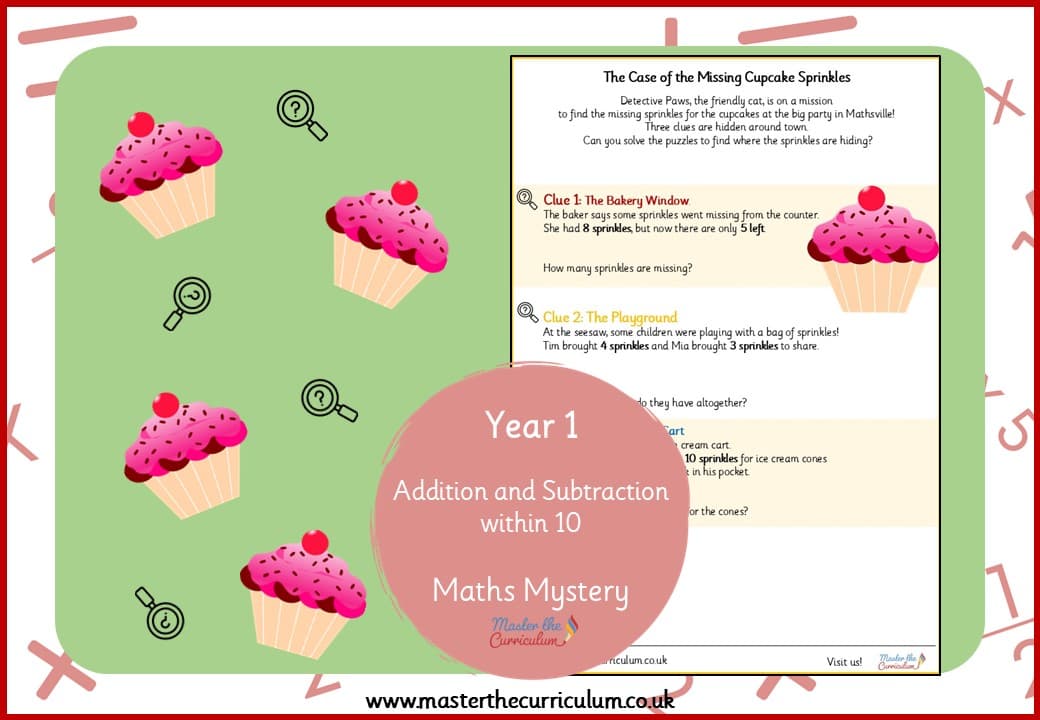
masterthecurriculum.co.uk
4.03 reviews
Included with membershipProposed versionTrusted by primary teachers across the UK · New resources every week
Addition & Subtraction
Y1
Preview only. The download is a fully editable file.
1 page shown before you download
1CoverThe rest of the pack
Planning, teaching slides and all three worksheet levels come with the download.
Included with membership
Unlock with membershipAlready a member? Sign in and it downloads from this page.
Keep it for later and group it with the rest of the block. No account needed to start.
Pupils must learn to use the mathematical symbols + , – and = . Expressions or equations involving these symbols should be introduced as a way to represent numerical situations and mathematical stories. An expression such as 3 5 + should not be interpreted as asking “What is 3 5 + ?” but, rather, as a way to represent the additive structures discussed below, either within a real-life context or within an abstract numerical situation. It is important that pupils do not think of the equals symbol as meaning ‘and the answer is’. They should instead understand that the expressions on each side of an equals symbol have the same value. All examples used to teach this criterion should use quantities within 10, and be supported by manipulatives or images, to ensure that pupils are able to focus on the mathematical structures and to avoid the cognitive load of having to work out the solutions. There are 4 additive structures (aggregation, partitioning, augmentation and reduction) Pupils should learn to link expressions (for example, 5 + 2 and 6 – 2 ) to contexts before they learn to link equations (for example, 5 + 2 = and 6 – 2 = 4 ) to contexts. For each case, pupils’ understanding should be built up in steps: Pupils should first learn to describe the context using precise language (see the language focus box). Pupils should then learn to write the associated expression or equation. Pupils should then use precise language to describe what each number in the expression or equation represents. Pupils must understand that, in partitioning situations, the subtraction symbol represents a splitting up or differentiating of the whole. The problem “There are 6 children altogether. 2 children are wearing coats. How many are not wearing coats?” is represented by 6–2 =4 . Here, the subtraction symbol represents the separation of the 2 children wearing coats, and so, the number of children not wearing coats is exposed Language focus “There are 6 children altogether. 2 children are wea
Show lessThe standard small step pack, as her own modules ship it. We do not print page counts here, because her catalogue does not publish them and a guessed number is worse than none.
Her own system, with the star count repeated in every worksheet header so a child can be handed the right sheet without a word.
Addition & Subtraction
Y1Addition & Subtraction
Y1
Addition & Subtraction
Y1
Addition & Subtraction
Y1
Addition & Subtraction
Y1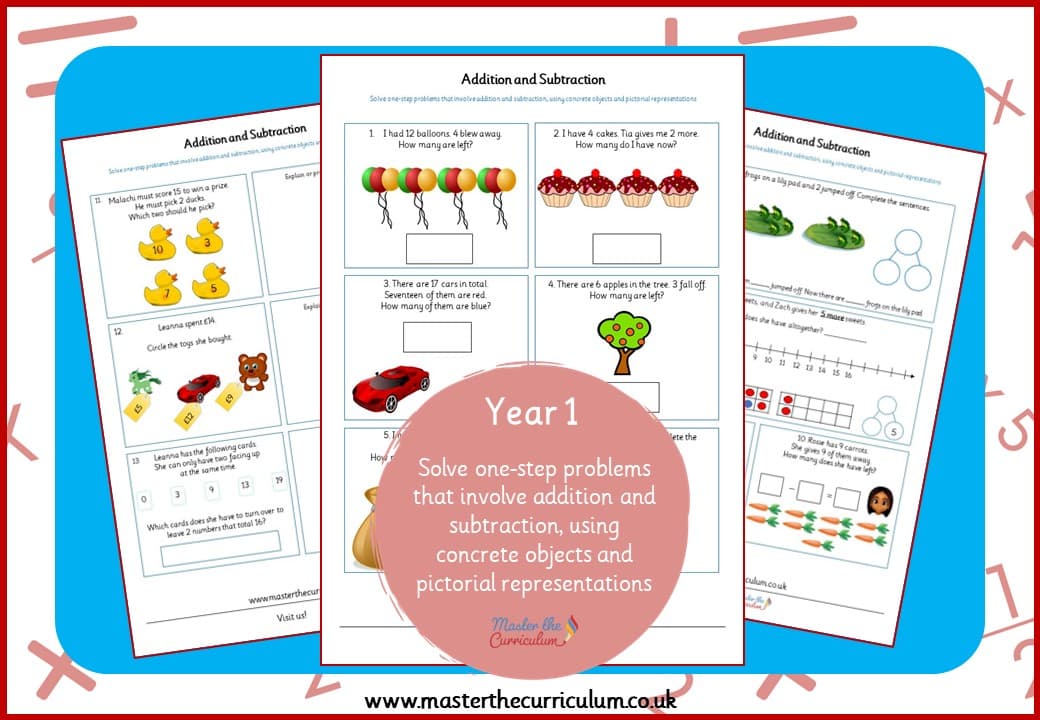
One email a week, for the year group you actually teach. Unsubscribe in a click.