“Fine, though the font is small for my class.”
The maths is right and the sequence is sensible. Several of my children needed it enlarged to A3, which is easy enough but worth knowing before you print thirty.
4 teachers found this helpful
Proposed versionTrusted by primary teachers across the UK · New resources every week
Number & Place Value
Y5
Preview only. The download is a fully editable file.
1 page shown before you download
1CoverThe rest of the pack
Planning, teaching slides and all three worksheet levels come with the download.
Included with membership
Unlock with membershipAlready a member? Sign in and it downloads from this page.
Keep it for later and group it with the rest of the block. No account needed to start.
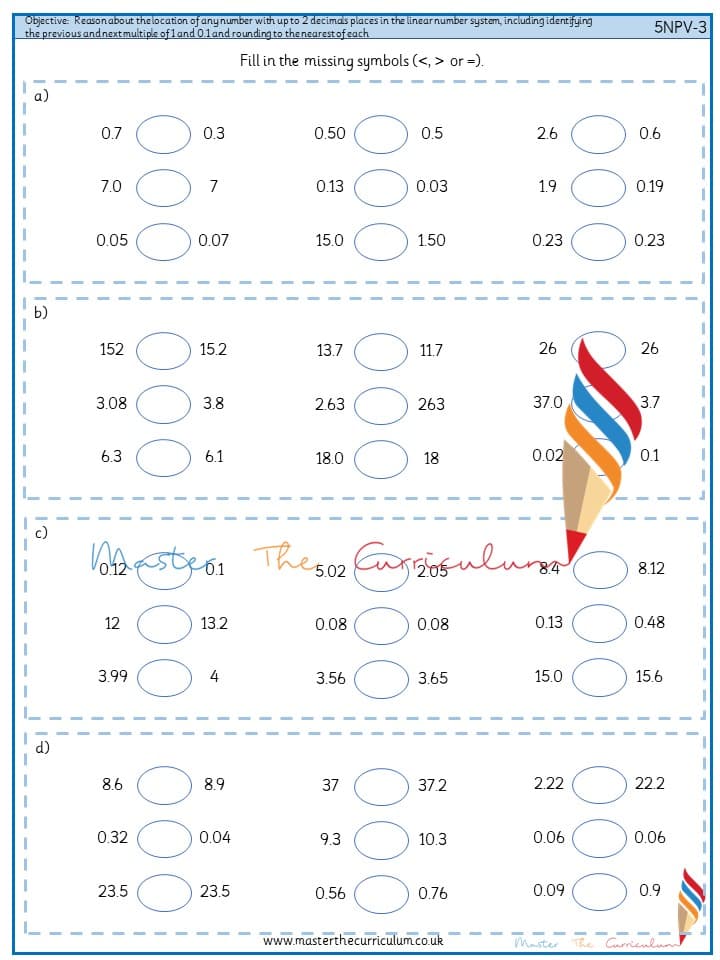
Pupils need to become familiar with the relative positons, on a number line, of numbers with 1 and 2 decimal places. They will need to see number lines with both tenths and intermediate hundredths values marked, and learn, for example, that 0.5 is the same as 0.50 and 3 is the same as 3.0 or 3.00. Pupils should recognise the magnitude and position of a given decimal fraction, irrespective of the precision it is given to, for example, 5 tenths lies between 0.45 and 0.55 on the number line below, whether it is represented as 0.5 or 0.50. Pupils need to be able to identify or place decimal fractions on number lines marked in tenths and/or hundredths. They should use efficient strategies and appropriate reasoning, including identifying the midpoints or working backwards from a whole number or a multiple of one tenth. Pupils need to be able to estimate the value or position of decimal fractions on unmarked or partially marked numbers lines, using appropriate proportional reasoning, rather than counting on from a start point or back from an end point. For example, here pupils should reason: “8.6 is about here on the number line because it’s just over half way”. Here, pupils should reason: “8.75 is about here on the number line because it’s the midpoint of 8.7 and 8.8.” Pupils must also be able to identify which whole numbers, or which pair of multiples of 0.1, a given decimal fraction is between. To begin with, pupils can use a number line for support. In this example, for the number 8.61, pupils must identify the previous and next whole number, and the previous and next multiple of 0.1. Language focus: “a is 0.14 because it is 1 hundredth less than the midpoint of 0.1 and 0.2, which is 0.15.” “b is 0.41 because it is 1 hundredth more than 0.4.” By the end of year 5 pupils need to be able to complete this type of task without the support of a number line. Pupils should then learn to round a given decimal fraction to the nearest whole number by identifying the nearest of t
Show lessThe standard small step pack, as her own modules ship it. We do not print page counts here, because her catalogue does not publish them and a guessed number is worse than none.
Her own system, with the star count repeated in every worksheet header so a child can be handed the right sheet without a word.
“Fine, though the font is small for my class.”
The maths is right and the sequence is sensible. Several of my children needed it enlarged to A3, which is easy enough but worth knowing before you print thirty.
4 teachers found this helpful
“Printed it at eight on a Sunday and taught it on the Monday.”
No editing, no reformatting, no hunting for the answers. The three levels are on separate pages, which sounds obvious until you have used the sites where they are not.
10 teachers found this helpful
“Matches our White Rose planning almost week for week.”
I stopped adapting things from three different sites and now start here. The odd week does not line up exactly, but the small step it covers is always somewhere in the same block.
8 teachers found this helpful
Number & Place Value
Y5
Number & Place Value
Y5
Number & Place Value
Y5
Number & Place Value
Y5
Number & Place Value
Y5
One email a week, for the year group you actually teach. Unsubscribe in a click.