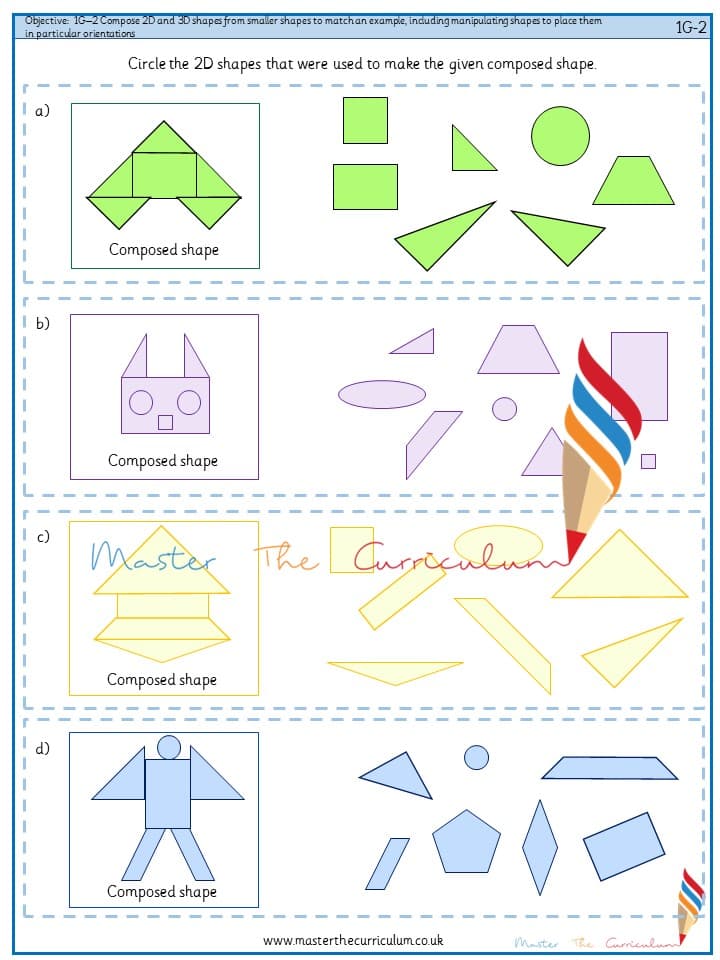
The ability to compose and decompose shapes, and see shapes within shape, is a skill which runs through to key stage 3 and key stage 4, and beyond. In year 1, it is vital that pupils work practically, exploring shapes (for example, shapes cut from card, pattern blocks and tangrams) and putting them together to make new shapes. Pupils must be able to arrange 2D shapes to match an example compound shape. To begin with, the constituent shapes in a given example image should be the same size and colour as the actual shapes that pupils are using. This allows pupils to begin by laying the pieces over the example image, rotating individual pieces to match the exemplars. By the end of year 1, though, pupils should be able to copy a pattern block picture, and make a good attempt at copying a tangram picture, without overlaying the pieces on the example. Tangrams are more challenging to complete than pattern block pictures because: they contain several different-sized triangles, which pupils must distinguish from one another to complete the task. placement of the parallelogram may require pupils to turn it over rather than just rotate it. Pupils must also be able to arrange 3D shapes to match an example compound shape, for example joining a given number of multilink blocks to match an example. As a first step pupils can each make their own shape from a given number of blocks, and then compare the different shapes that have been made. Comparing compound shapes, and identifying the ones that are the same, will require pupils to rotate the shapes in various directions, and provides an opportunity to develop spatial language including: left, right, top, middle, bottom, on top of, below, in front of, behind and between. Pupils must also learn to copy compound shapes composed of other 3D shapes, including cuboids, cylinders, spheres and pyramids.Read more
The ability to compose and decompose shapes, and see shapes within shape, is a skill which runs through to key stage 3 and key stage 4, and beyond. In year 1, it is vital that pupils work practically, exploring shapes (for example, shapes cut from card, pattern blocks and tangrams) and putting them together to make new shapes. Pupils must be able to arrange 2D shapes to match an example compound shape. To begin with, the constituent shapes in a given example image should be the same size and colour as the actual shapes that pupils are using. This allows pupils to begin by laying the pieces over the example image, rotating individual pieces to match the exemplars. By the end of year 1, though, pupils should be able to copy a pattern block picture, and make a good attempt at copying a tangram picture, without overlaying the pieces on the example. Tangrams are more challenging to complete than pattern block pictures because: they contain several different-sized triangles, which pupils must distinguish from one another to complete the task. placement of the parallelogram may require pupils to turn it over rather than just rotate it. Pupils must also be able to arrange 3D shapes to match an example compound shape, for example joining a given number of multilink blocks to match an example. As a first step pupils can each make their own shape from a given number of blocks, and then compare the different shapes that have been made. Comparing compound shapes, and identifying the ones that are the same, will require pupils to rotate the shapes in various directions, and provides an opportunity to develop spatial language including: left, right, top, middle, bottom, on top of, below, in front of, behind and between. Pupils must also learn to copy compound shapes composed of other 3D shapes, including cuboids, cylinders, spheres and pyramids.
Show less