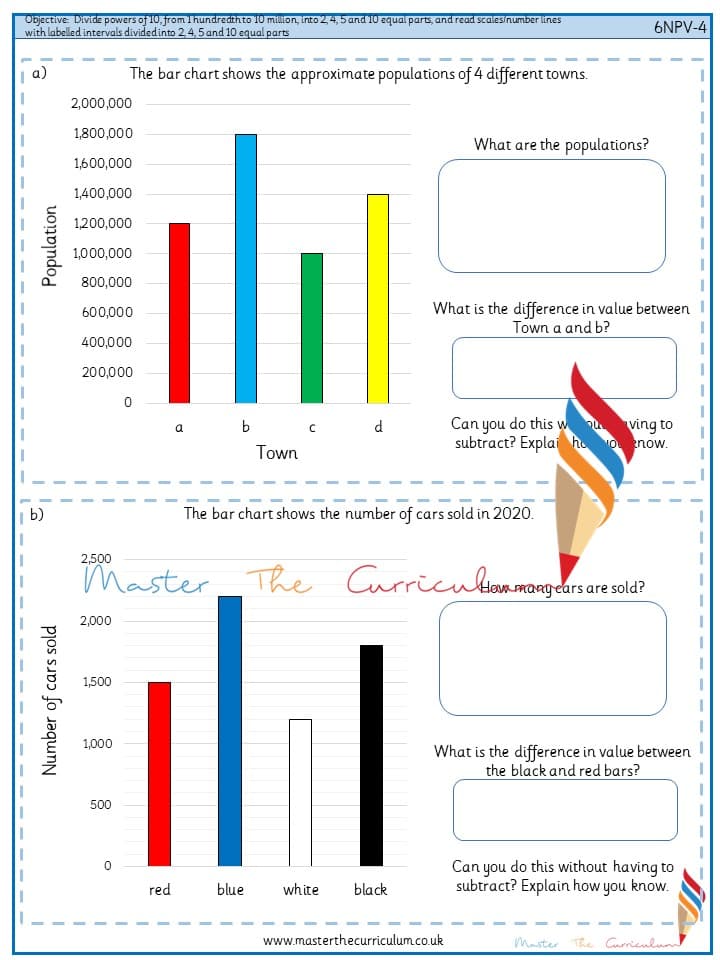
It is important for pupils to be able to divide powers of 10 into 2, 4, 5 or 10 equal parts because these are the intervals commonly found on measuring instruments and graph scales. Pupils have already learnt to divide 1, 100 and 1,000 in this way (5NPV–4, 3NPV–4 and 4NPV–4 respectively), and must now extend this to larger powers of 10. Pupils should be able to make connections between powers of 10, for example, describing similarities and differences between the values of the parts when 1 million, 1,000 and 1 are divided into 4 equal parts. Pupils should be able to skip count in these intervals forwards and backwards from any starting number (for example, counting forward from 800,000 in steps of 20,000, or counting backwards from 5 in steps of 0.25). This builds on counting in steps of 10, 20, 25 and 50 in year 3 (3NPV–4 ), in steps of 100, 200, 250 and 500 in year 4 (4NPV–4), and in steps of 0.1, 0.2, 0.25 and 0.5 in year 5 (5NPV–4). Pupils should practise reading measurement and graphing scales with labelled power-of-10 intervals divided into 2, 4, 5 and 10 equal parts. Pupils need to be able to write and solve addition, subtraction, multiplication and division equations related to powers of 10 divided into 2, 4, 5 and 10 equal parts, as exemplified for 1 million and 4 equal parts below. Pupils should be able to connect finding equal parts of a power of 10 to finding 1/2 , 1/4 , 1/5 or 1/10 of the value.Read more
It is important for pupils to be able to divide powers of 10 into 2, 4, 5 or 10 equal parts because these are the intervals commonly found on measuring instruments and graph scales. Pupils have already learnt to divide 1, 100 and 1,000 in this way (5NPV–4, 3NPV–4 and 4NPV–4 respectively), and must now extend this to larger powers of 10. Pupils should be able to make connections between powers of 10, for example, describing similarities and differences between the values of the parts when 1 million, 1,000 and 1 are divided into 4 equal parts. Pupils should be able to skip count in these intervals forwards and backwards from any starting number (for example, counting forward from 800,000 in steps of 20,000, or counting backwards from 5 in steps of 0.25). This builds on counting in steps of 10, 20, 25 and 50 in year 3 (3NPV–4 ), in steps of 100, 200, 250 and 500 in year 4 (4NPV–4), and in steps of 0.1, 0.2, 0.25 and 0.5 in year 5 (5NPV–4). Pupils should practise reading measurement and graphing scales with labelled power-of-10 intervals divided into 2, 4, 5 and 10 equal parts. Pupils need to be able to write and solve addition, subtraction, multiplication and division equations related to powers of 10 divided into 2, 4, 5 and 10 equal parts, as exemplified for 1 million and 4 equal parts below. Pupils should be able to connect finding equal parts of a power of 10 to finding 1/2 , 1/4 , 1/5 or 1/10 of the value.
Show less