
Fractions
Y5Year 5 Decimals Home Learning
masterthecurriculum.co.uk
Proposed versionTrusted by primary teachers across the UK · New resources every week
Fractions
Y5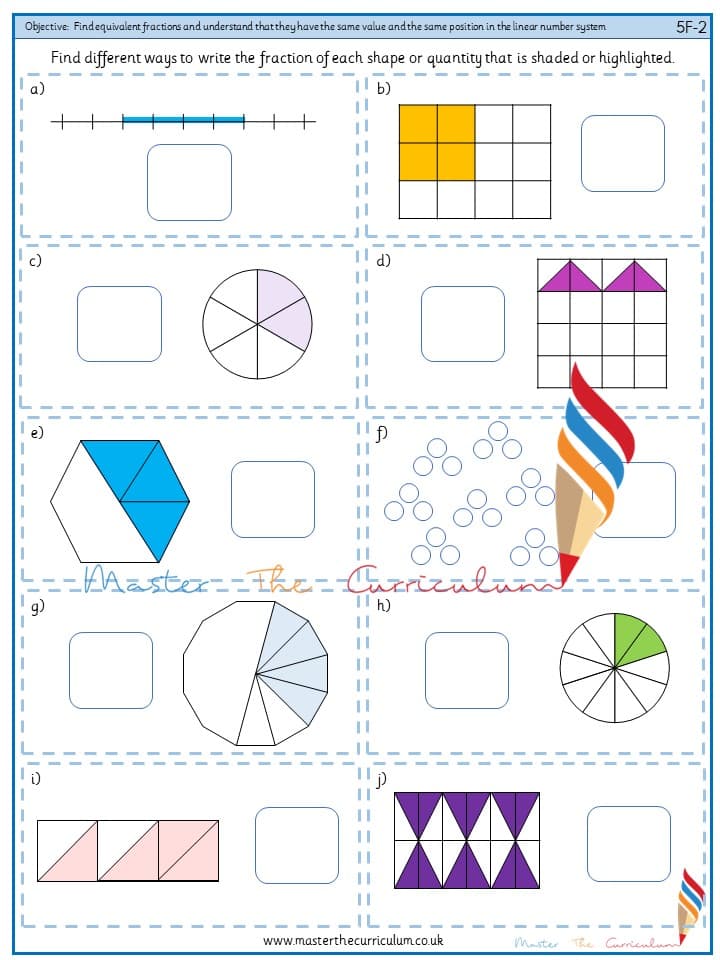
Preview only. The download is a fully editable file.
1 page shown before you download
1CoverThe rest of the pack
Planning, teaching slides and all three worksheet levels come with the download.
Included with membership
Unlock with membershipAlready a member? Sign in and it downloads from this page.
Keep it for later and group it with the rest of the block. No account needed to start.
Pupils must understand that more than one fraction can describe the same portion of a quantity, shape or measure. They should begin with an example where one of the fractions is a unit fraction, and the connection to the equivalent fraction uses known multiplication table facts. Pupils should learn that 2 different fractions describing the same portion of the whole share the same position on a number line, have the same numerical value and are called equivalent fractions. Pupils need to understand that equivalent fractions, such as 1/4 and 3/12 , have the same numerical value because the numerator and denominator within each fraction have the same proportional relationship. In each case the numerator is 1/4 of the denominator (and the denominator is 4 times the numerator). Language focus: “1/4 and 3/12 are equivalent because 1 is the same portion of 4 as 3 is of 12.” Attending to the relationship between the numerator and denominator will prepare pupils for comparing fractions with different denominators in year 6 (6F–3). Pupils should also be able to identify the multiplicative relationship between the pair of numerators, and understand that it is the same as that between the pair of denominators. Pupils should learn to find equivalent fractions of unit fractions by using one of these multiplicative relationships (the ‘vertical’ relationship between the numerator and denominator, or the ‘horizontal’ relationship between the pairs of numerators and denominators). In a similar way, pupils must then learn to find equivalent fractions of non-unit fractions.
Show lessThe standard small step pack, as her own modules ship it. We do not print page counts here, because her catalogue does not publish them and a guessed number is worse than none.
Her own system, with the star count repeated in every worksheet header so a child can be handed the right sheet without a word.
Fractions
Y5Fractions
Y5
Fractions
Y5
Fractions
Y5
Fractions
Y5
One email a week, for the year group you actually teach. Unsubscribe in a click.