Skip to content

Proposed version

Master the Curriculum

Working Without Worksheets

Y4

L2 Count in Multiples of 7

masterthecurriculum.co.uk

Preview only. The download is a fully editable file.

See inside

1 page shown before you download

Cover of L2 Count in Multiples of 71Cover
Cover and first page

The rest of the pack

Planning, teaching slides and all three worksheet levels come with the download.

Year 4Working Without Worksheets

L2 Count in Multiples of 7

4.824 reviews

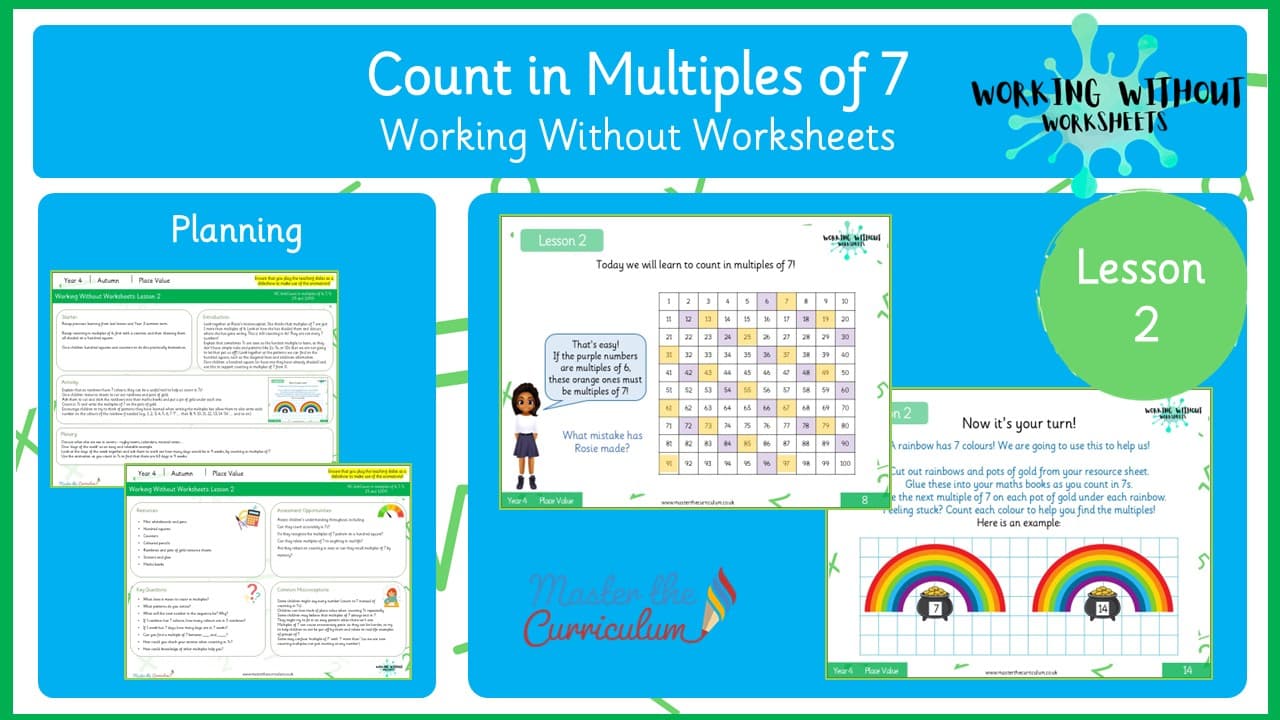
A complete Year 4 Place Value lesson for teaching multiples of 7. Includes hundred-square exploration, rainbow-themed hands-on activities, reasoning tasks, real-life connections, key questions and clear assessment opportunities, all aligned with the national curriculum.

Included with membership

Unlock with membership

Already a member? Sign in and it downloads from this page.

Keep it for later and group it with the rest of the block. No account needed to start.

  • Fully editable Word or PowerPoint file
  • Differentiated three ways
  • Instant download, no watermark

About this resource

This Year 4 Autumn Term Place Value lesson plan— “Count in Multiples of 7” —provides a complete, engaging teaching sequence designed to help children build fluency and confidence with one of the trickier number patterns in the curriculum. Linked directly to the national curriculum objective “Count in multiples of 6, 7, 9, 25 and 1,000,” this session builds on previous learning from counting in multiples of 6 and earlier Year 3 work. Children begin by exploring a hundred square, shading multiples of 7 and discussing patterns such as diagonal lines and alternating odd/even results. The lesson addresses a key misconception through Rosie’s error—believing that multiples of 7 are simply one more than multiples of 6—and uses this as a discussion point to deepen understanding of what “multiples” truly are. A creative hands-on activity uses rainbows (with their 7 colours) and pots of gold to make multiples of 7 meaningful and memorable. Pupils cut out, stick and label rainbows in their books, recording multiples of 7 and noticing patterns as they go. Real-life connections—such as days of the week, musical notes and sports teams—help embed the idea that sevens appear naturally in everyday life. Using an animated slide, children also practise counting in 7s to solve the contextual problem: “How many days are in 9 weeks?” The plan includes detailed key questions, resource lists, assessment opportunities and common misconceptions, supporting high-quality teaching without worksheets . This lesson strengthens children’s fluency, reasoning and ability to spot numerical structures, helping them gain confidence with multiples of 7.Read more

This Year 4 Autumn Term Place Value lesson plan— “Count in Multiples of 7” —provides a complete, engaging teaching sequence designed to help children build fluency and confidence with one of the trickier number patterns in the curriculum. Linked directly to the national curriculum objective “Count in multiples of 6, 7, 9, 25 and 1,000,” this session builds on previous learning from counting in multiples of 6 and earlier Year 3 work. Children begin by exploring a hundred square, shading multiples of 7 and discussing patterns such as diagonal lines and alternating odd/even results. The lesson addresses a key misconception through Rosie’s error—believing that multiples of 7 are simply one more than multiples of 6—and uses this as a discussion point to deepen understanding of what “multiples” truly are. A creative hands-on activity uses rainbows (with their 7 colours) and pots of gold to make multiples of 7 meaningful and memorable. Pupils cut out, stick and label rainbows in their books, recording multiples of 7 and noticing patterns as they go. Real-life connections—such as days of the week, musical notes and sports teams—help embed the idea that sevens appear naturally in everyday life. Using an animated slide, children also practise counting in 7s to solve the contextual problem: “How many days are in 9 weeks?” The plan includes detailed key questions, resource lists, assessment opportunities and common misconceptions, supporting high-quality teaching without worksheets . This lesson strengthens children’s fluency, reasoning and ability to spot numerical structures, helping them gain confidence with multiples of 7.

Show less

What you get, 6 files

  • PDFPlanning
  • PPTXPlanning, editable
  • PDFTeaching slides
  • PPTXTeaching slides, editable
  • PDFWorksheets, all three levels
  • PPTXWorksheets, editable

The standard small step pack, as her own modules ship it. We do not print page counts here, because her catalogue does not publish them and a guessed number is worse than none.

★★★ Differentiated three ways
  • Working towardsScaffolded, with the model or the bar already drawn.
  • Working withinThe expected standard for the year group.
  • Greater depthReasoning and explaining, not just more of the same.

Her own system, with the star count repeated in every worksheet header so a child can be handed the right sheet without a word.

The rest of this block

Working Without Worksheets, Year 411 numbered lessons

  1. Lesson 1Count in Multiples of 6
  2. Lesson 2 · you are hereCount in Multiples of 7
  3. Lesson 3Count in Multiples of 9
  4. Lesson 4Count in Multiples of 25
  5. Lesson 5Count in Multiples of 1,000

What teachers said after they used it

All reviews →
4.824 verified reviewsWe ask once, seven days after the download, and one tap is enough.
Aisha KarimSENCO, Newlands Primary Academy, LutonVerified download, 2 February 2026

The editable file is why we renewed.

Being able to change two questions for the child who joined us in January, without rebuilding the whole sheet, is worth the subscription on its own.

12 teachers found this helpful

Steven LoughYear 2 teacher, Abbeyfields First School, MorpethVerified download, 23 January 2026

Good value, and the answers are actually on it.

Small thing, but half the free sheets online expect you to work the answers out yourself. My TA can run a group on this without a briefing first.

5 teachers found this helpful

Beth NightingaleYear 1 teacher, Poplar Farm School, GranthamVerified download, 13 January 2026

Fine, though the font is small for my class.

The maths is right and the sequence is sensible. Several of my children needed it enlarged to A3, which is easy enough but worth knowing before you print thirty.

4 teachers found this helpful

More working without worksheets for Year 4

Working Without Worksheets

Y4

L3 Convert Between Kilograms and Grams

masterthecurriculum.co.uk
4.650 reviews
Included with membership
Editable worksheetsWord and PowerPoint, so you can change anythingWhite Rose supportingFollows the small steps you already plan fromDownloadable lesson plansPlanning, slides and worksheets for every stepReasoning and problem solvingBuilt into every step, not sold separately

A free resource every Friday

One email a week, for the year group you actually teach. Unsubscribe in a click.

Year group you teach