
NCETM Ready to Progress
Y4Scaling number facts by 100 (2)
masterthecurriculum.co.uk
Proposed versionTrusted by primary teachers across the UK · New resources every week
NCETM Ready to Progress
Y4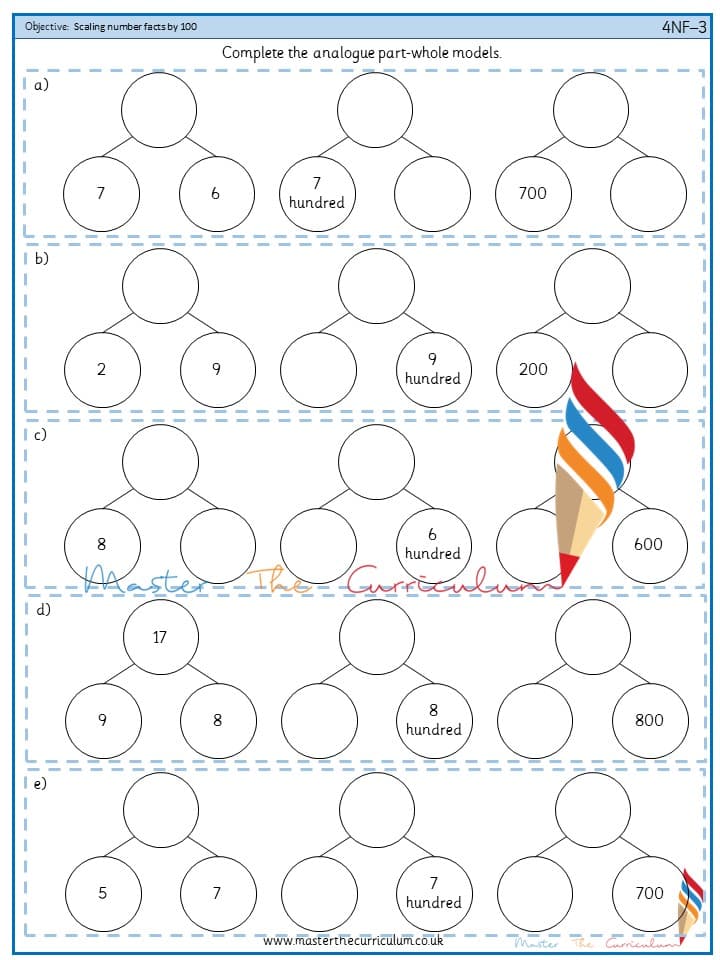
Preview only. The download is a fully editable file.
1 page shown before you download
1CoverThe rest of the pack
Planning, teaching slides and all three worksheet levels come with the download.
Included with membership
Unlock with membershipAlready a member? Sign in and it downloads from this page.
Keep it for later and group it with the rest of the block. No account needed to start.
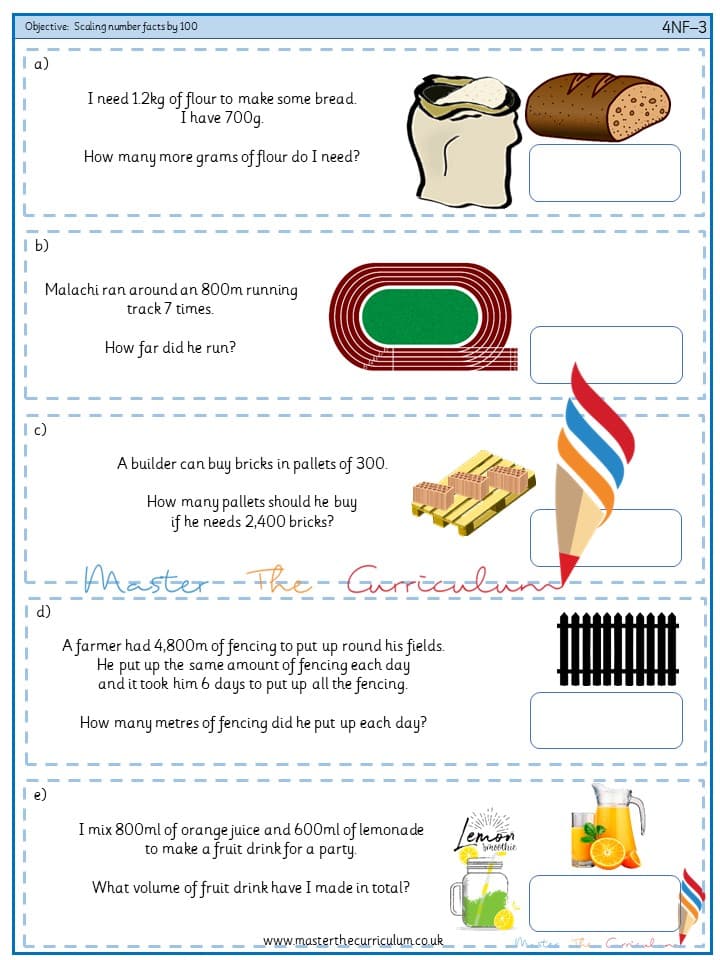
Pupils should begin year 4 with automatic recall of addition and subtraction facts within 20 (3NF–1). By the end of year 4, pupils should be able to recall all multiplication table facts and related division facts. To be ready to progress to year 5, pupils must also be able to combine these facts with unitising in hundreds, including: scaling known additive facts within 10, for example, 900 – 600 = 300 scaling known additive facts that bridge 10, for example, 800 + 600 = 1,400 scaling known multiplication tables facts, for example, 300 × 4 = 1,200 scaling division facts derived from multiplication tables, for example, 1,200 ÷ 4 = 300 For calculations such as 800 + 600 = 1,400, pupils can begin by using tens frames and counters as they did for calculation across 10 (2AS–1) and across 100 (3NF–3), but now using 100-value counters. Similarly, pupils can use 100-value counters to understand how a known multiplicative fact, such as 3 × 5 = 15, relates to a scaled calculation, such as 300 × 5 = 1,500. Pupils should be able reason in terms of unitising in hundreds, or in terms of scaling a factor by 100. Language focus “3 times 5 is equal to 15.” “3 times 5 hundreds is equal to 15 hundreds.” “15 hundreds is equal to 1,500.” “3 times 5 is equal to 15.” “3 hundreds times 5 is equal to 15 hundreds.” “15 hundreds is equal to 1,500.” “If I multiply one factor by 100, I must multiply the product by 100.” “If I multiply the dividend by 100 and the divisor by 100, the quotient remains the same.” “If I multiply the dividend by 100 and keep the divisor the same, I must multiply the quotient by 100.” It is important for pupils to understand all of the calculations in this criterion in terms of working with units of 100, or scaling by 100. You can find out more about fluency and recording for these calculations here in the calculation and fluency section: Number, place value and number facts: 4NPV–2 and 4NF–3.
Show lessThe standard small step pack, as her own modules ship it. We do not print page counts here, because her catalogue does not publish them and a guessed number is worse than none.
Her own system, with the star count repeated in every worksheet header so a child can be handed the right sheet without a word.
NCETM Ready to Progress
Y4NCETM Ready to Progress
Y4
NCETM Ready to Progress
Y4
NCETM Ready to Progress
Y4
One email a week, for the year group you actually teach. Unsubscribe in a click.