
NCETM Ready to Progress
Y4Scaling number facts by 100 (2)
masterthecurriculum.co.uk
Proposed versionTrusted by primary teachers across the UK · New resources every week
NCETM Ready to Progress
Y4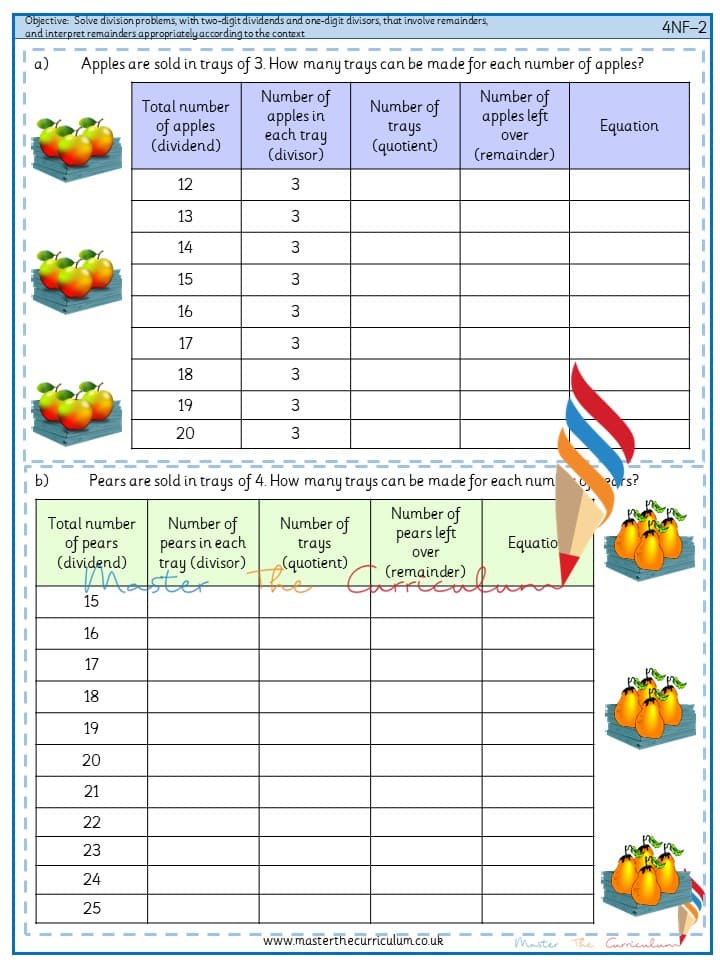
Preview only. The download is a fully editable file.
1 page shown before you download
1CoverThe rest of the pack
Planning, teaching slides and all three worksheet levels come with the download.
Included with membership
Unlock with membershipAlready a member? Sign in and it downloads from this page.
Keep it for later and group it with the rest of the block. No account needed to start.
Pupils should recognise that a remainder arises when there is something ‘left over’ in a division calculation. Pupils should recognise and understand why remainders only occur when the dividend is not a multiple of the divisor. This can be achieved by discussing the patterns seen when the dividend is incrementally increased by 1 while the divisor is kept the same. A common mistake made by pupils is not making the maximum number of groups possible, for example: 17 ÷ 4 = 3 r 5 (incorrect) The table above can be used to help pupils recognise and understand that the remainder is always smaller than the divisor. Note that when pupils use the short division algorithm in year 5, if they ‘carry over’ remainders that are larger than the divisor, the algorithm will not work. Language focus “If the dividend is a multiple of the divisor there is no remainder.” “If the dividend is not a multiple of the divisor, there is a remainder.” “The remainder is always less than the divisor.” Once pupils can correctly perform division calculations that involve remainders, they need to recognise that, when solving contextual division problems, the answer to the division calculation must be interpreted carefully to determine how to make sense of the remainder. The answer to the calculation is not always the answer to the contextual problem. Consider the following context: Four scouts can fit in each tent. How many tents will be needed for thirty scouts? Pupils may simply say that “7 remainder 2 tents are needed”, but this does not answer the question. Pupils should identify what each number in the equation represents to help them correctly interpret the result of the calculation in context. Language focus “The 30 represents the total number of scouts.” “The 4 represents the number of scouts in each tent.” “The 7 represents the number of full tents.” “The 2 represents the number of scouts left over.” “We need another tent for the 2 left-over scouts. 8 tents are needed.”
Show lessThe standard small step pack, as her own modules ship it. We do not print page counts here, because her catalogue does not publish them and a guessed number is worse than none.
Her own system, with the star count repeated in every worksheet header so a child can be handed the right sheet without a word.
NCETM Ready to Progress
Y4NCETM Ready to Progress
Y4
NCETM Ready to Progress
Y4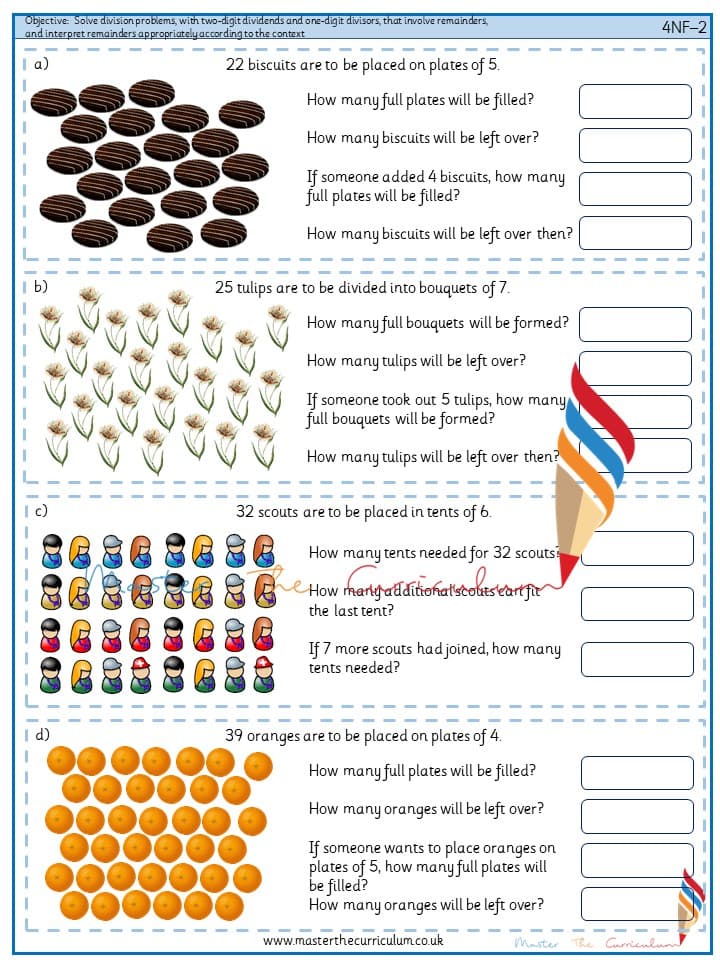
NCETM Ready to Progress
Y4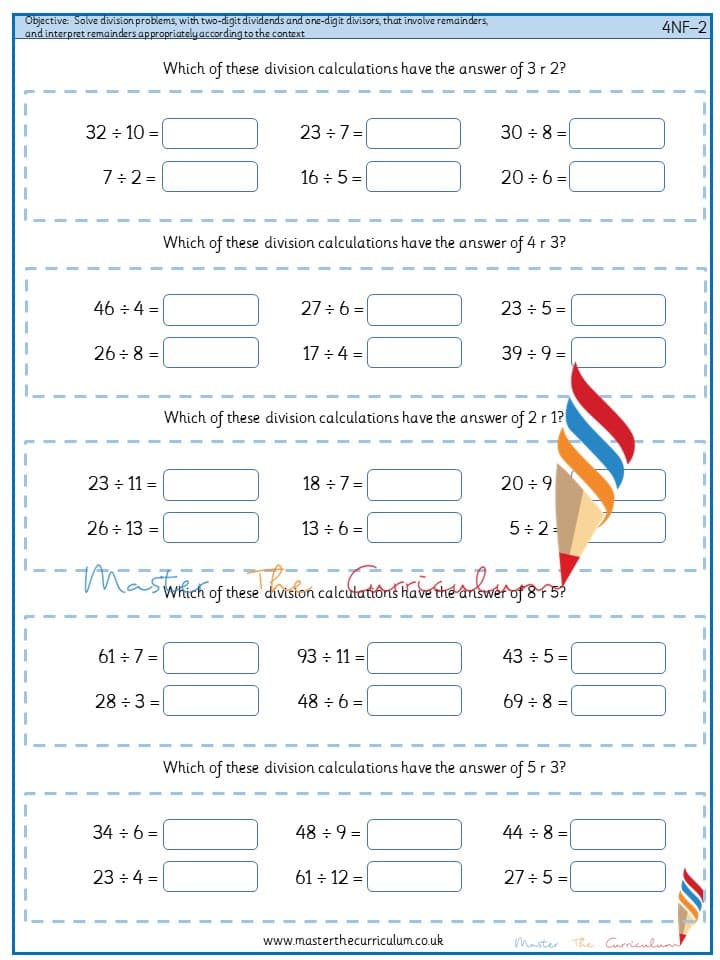
One email a week, for the year group you actually teach. Unsubscribe in a click.