Skip to content

Proposed version

Master the Curriculum

Addition & Subtraction

Y6

Solve problems involving ratio relationships (1)

masterthecurriculum.co.uk

Preview only. The download is a fully editable file.

See inside

1 page shown before you download

Cover of Solve problems involving ratio relationships (1)1Cover
Cover and first page

The rest of the pack

Planning, teaching slides and all three worksheet levels come with the download.

Year 6Addition & Subtraction

Solve problems involving ratio relationships (1)

Included with membership

Unlock with membership

Already a member? Sign in and it downloads from this page.

Keep it for later and group it with the rest of the block. No account needed to start.

  • Fully editable Word or PowerPoint file
  • Differentiated three ways
  • Instant download, no watermark

About this resource

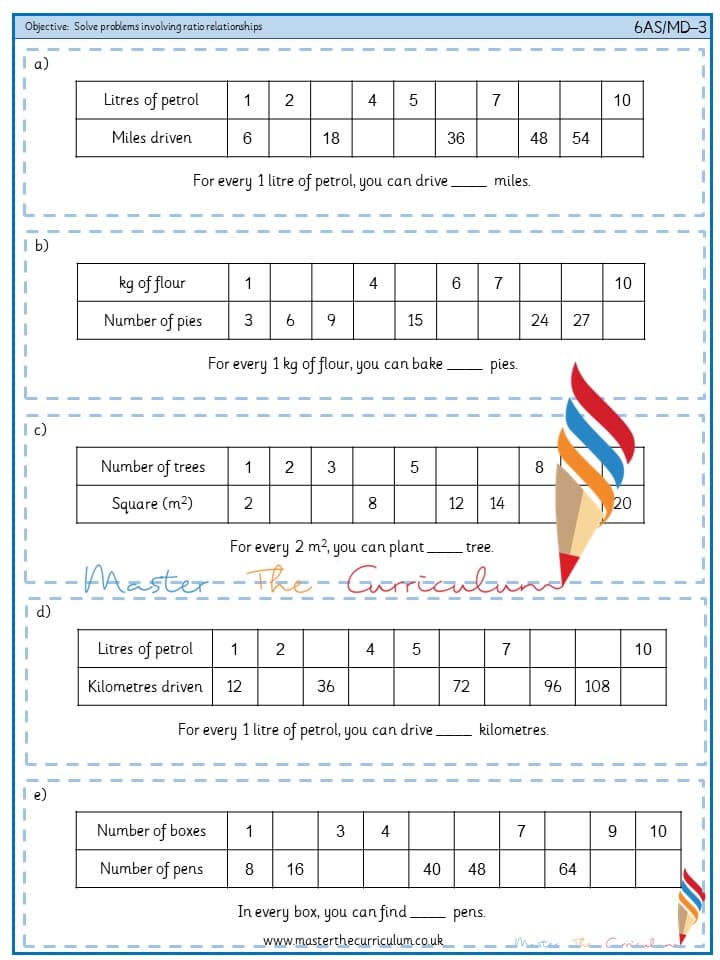
Pupils already have the arithmetic skills to solve problems involving ratio. They should now learn to describe 1-to-many (and many-to-1) correspondence structures. Language focus “For every 1 cup of rice you cook, you need 2 cups of water.” “For every 10 children on the school trip, there must be 1 adult.” Pupils must recognise that proportionality is preserved in these contexts, for example, there is always twice the volume of water needed compared to the volume or rice, regardless of how much rice there is. This will prepare pupils for key stage 3, when they will learn to describe correspondence structures using ratio notation and to express ratios in their simplest forms. Pupils should be able to recognise a 1-to-many or many-to-1 structure, without it being explicitly given and use the relationship to solve problems. Pupils should also be able to answer questions such as: if there were 5 red beads, how many blue beads would there be? if there were 21 blue beads, how many beads would there be altogether? if there were 40 beads altogether, how many red beads and how many blue beads would there be? Pupils must also learn to describe and solve problems related to many-to-many structures. Language focus “For every 2 yellow beads there are 3 green beads”. Pupils may initially use manipulatives, such as cubes or beads, for support, but by the end of year 6, they must be able to complete many-to-many correspondence tables and solve related problems without manipulatives. Pupils should also begin to prepare for using the unitary method at key stage 3, when it is required for unit conversions, percentage calculations and other multiplicative problems. For example, if they are given a smoothie recipe for 2 people (20 strawberries, 1 banana and 150ml milk), they should be able to adjust the recipe by multiplying or dividing by a whole number, for example, dividing the quantities by 2 to find the amounts for 1 person, or multiplying the quantities by 3 to find the amounts foRead more

Pupils already have the arithmetic skills to solve problems involving ratio. They should now learn to describe 1-to-many (and many-to-1) correspondence structures. Language focus “For every 1 cup of rice you cook, you need 2 cups of water.” “For every 10 children on the school trip, there must be 1 adult.” Pupils must recognise that proportionality is preserved in these contexts, for example, there is always twice the volume of water needed compared to the volume or rice, regardless of how much rice there is. This will prepare pupils for key stage 3, when they will learn to describe correspondence structures using ratio notation and to express ratios in their simplest forms. Pupils should be able to recognise a 1-to-many or many-to-1 structure, without it being explicitly given and use the relationship to solve problems. Pupils should also be able to answer questions such as: if there were 5 red beads, how many blue beads would there be? if there were 21 blue beads, how many beads would there be altogether? if there were 40 beads altogether, how many red beads and how many blue beads would there be? Pupils must also learn to describe and solve problems related to many-to-many structures. Language focus “For every 2 yellow beads there are 3 green beads”. Pupils may initially use manipulatives, such as cubes or beads, for support, but by the end of year 6, they must be able to complete many-to-many correspondence tables and solve related problems without manipulatives. Pupils should also begin to prepare for using the unitary method at key stage 3, when it is required for unit conversions, percentage calculations and other multiplicative problems. For example, if they are given a smoothie recipe for 2 people (20 strawberries, 1 banana and 150ml milk), they should be able to adjust the recipe by multiplying or dividing by a whole number, for example, dividing the quantities by 2 to find the amounts for 1 person, or multiplying the quantities by 3 to find the amounts fo

Show less

What you get, 2 files

  • PDFActivity
  • PPTXActivity, editable

The standard small step pack, as her own modules ship it. We do not print page counts here, because her catalogue does not publish them and a guessed number is worse than none.

★★★ Differentiated three ways
  • Working towardsScaffolded, with the model or the bar already drawn.
  • Working withinThe expected standard for the year group.
  • Greater depthReasoning and explaining, not just more of the same.

Her own system, with the star count repeated in every worksheet header so a child can be handed the right sheet without a word.

More addition & subtraction for Year 6

Addition & Subtraction

Y6

Divide up to 4-Digit Numbers by 2-Digit Whole Numbers Using Long Division – Alternative Method

masterthecurriculum.co.uk
Included with membership

Addition & Subtraction

Y6

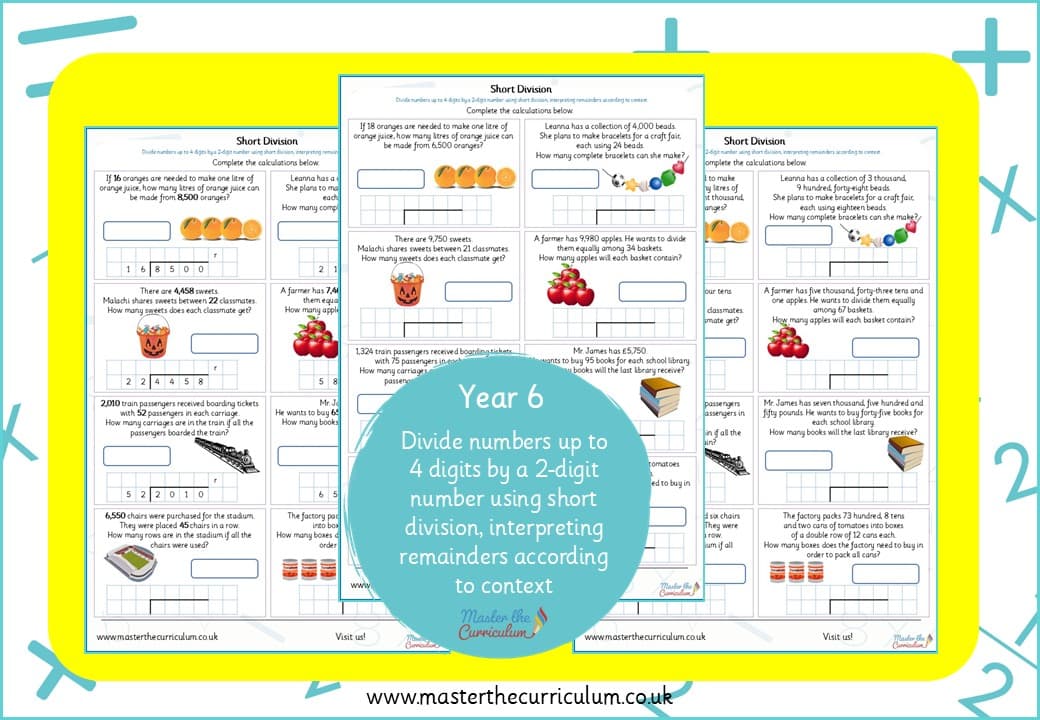
Short Division with Remainders

masterthecurriculum.co.uk
4.67 reviews
Included with membership

Addition & Subtraction

Y6

Interpret Remainders in Context

masterthecurriculum.co.uk
4.855 reviews
Included with membership

Addition & Subtraction

Y6

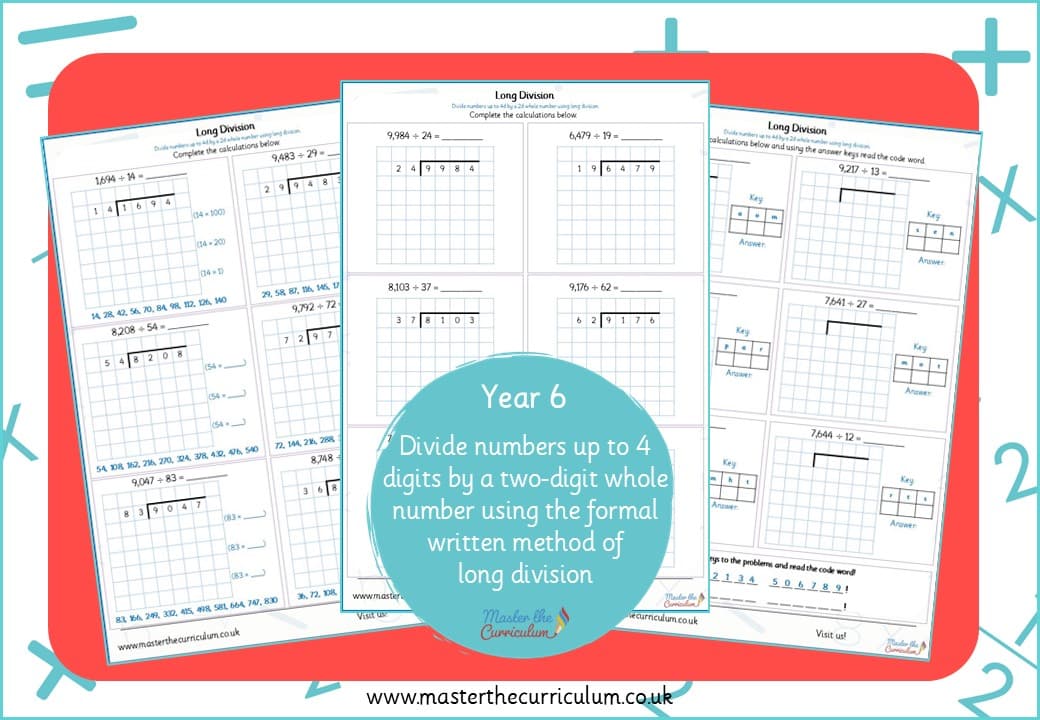
Divide up to 4-Digit Numbers by 2-Digit Whole Numbers Using Long Division

masterthecurriculum.co.uk
4.922 reviews
Included with membership

Addition & Subtraction

Y6

Solve Addition and Subtraction Multi-Step Problems in Context

masterthecurriculum.co.uk
Included with membership
Editable worksheetsWord and PowerPoint, so you can change anythingWhite Rose supportingFollows the small steps you already plan fromDownloadable lesson plansPlanning, slides and worksheets for every stepReasoning and problem solvingBuilt into every step, not sold separately

A free resource every Friday

One email a week, for the year group you actually teach. Unsubscribe in a click.

Year group you teach