
Addition & Subtraction
Y6Divide up to 4-Digit Numbers by 2-Digit Whole Numbers Using Long Division – Alternative Method

masterthecurriculum.co.uk
Proposed versionTrusted by primary teachers across the UK · New resources every week
Addition & Subtraction
Y6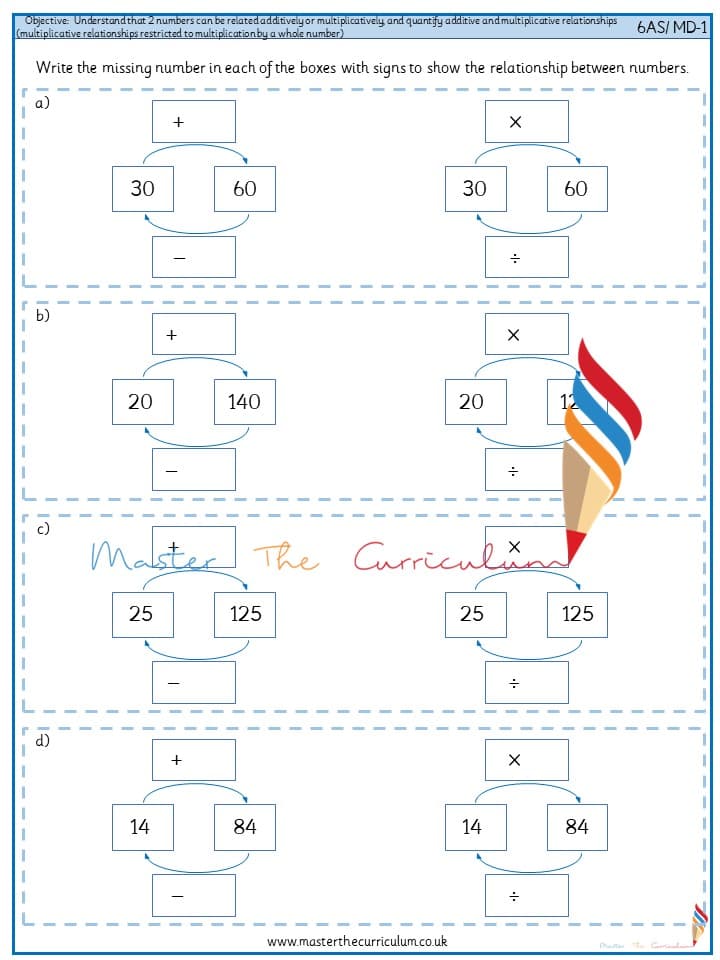
Preview only. The download is a fully editable file.
1 page shown before you download
1CoverThe rest of the pack
Planning, teaching slides and all three worksheet levels come with the download.
Included with membership
Unlock with membershipAlready a member? Sign in and it downloads from this page.
Keep it for later and group it with the rest of the block. No account needed to start.
Throughout key stage 2, pupils have learnt about and used 2 types of mathematical relationship between numbers: additive relationships and multiplicative relationships. In year 6, pupils should learn to represent the relationship between 2 given numbers additively or multiplicatively, as well as use such a representation to calculate a missing number, including in measures and statistics contexts. Consider the following: Holly has cycled 20km. Lola has cycled 60km. We can describe the relationship between the distances either additively (Lola has cycled 40km further than Holly; Holly has cycled 40km fewer than Lola) or multiplicatively (Lola has cycled 3 times the distance that Holly has cycled). As pupils progress into key stage 3, the ability to relate, recognise and use multiplicative relationships is essential. A pupil who can think multiplicatively would, for example, calculate the cost of 1.2m of ribbon at 75p per metre as 1.2×75p, whereas a pupil who was still thinking only in terms of additive relationships would use the approach of finding the cost of 0.2m (15p) and adding it to the cost of 1m (75p). During key stage 3, pupils will regularly use calculators to solve problems with this type of structure, and the multiplicative approach is more efficient because it involves fewer steps. Given any 2 numbers (related by a whole-number multiplier), pupils must be able to identify the additive relationship (in the example above, +40 and −40) and the multiplicative relationship (in the example above ×3 and ÷3). Though multiplicative relationships should be restricted to whole-number multipliers, pupils should be able to connect division by the whole number to scaling by a unit fraction: in the example above, this corresponds to understanding that because 60÷3=20, is one-third times the size of 60. When given a sequence of numbers, pupils should be able to identify whether the terms are all related additively or multiplicatively, identify the specific difference or
Show lessThe standard small step pack, as her own modules ship it. We do not print page counts here, because her catalogue does not publish them and a guessed number is worse than none.
Her own system, with the star count repeated in every worksheet header so a child can be handed the right sheet without a word.
Addition & Subtraction
Y6Addition & Subtraction
Y6
Addition & Subtraction
Y6
Addition & Subtraction
Y6
Addition & Subtraction
Y6
One email a week, for the year group you actually teach. Unsubscribe in a click.