Skip to content

Proposed version

Master the Curriculum

Working Without Worksheets

Y4

L1 Estimate Answers Using Rounding to the Nearest 10, 100 or 1,000

masterthecurriculum.co.uk

Preview only. The download is a fully editable file.

See inside

1 page shown before you download

Cover of L1 Estimate Answers Using Rounding to the Nearest 10, 100 or 1,0001Cover
Cover and first page

The rest of the pack

Planning, teaching slides and all three worksheet levels come with the download.

Year 4Working Without Worksheets

L1 Estimate Answers Using Rounding to the Nearest 10, 100 or 1,000

4.857 reviews

A Year 4 maths lesson on rounding and estimation that revisits rounding to the nearest 10, 100 and 1,000 . Pupils use rounding to simplify calculations, estimate answers and explore real-life problem solving with money.

Included with membership

Unlock with membership

Already a member? Sign in and it downloads from this page.

Keep it for later and group it with the rest of the block. No account needed to start.

  • Fully editable Word or PowerPoint file
  • Differentiated three ways
  • Instant download, no watermark

About this resource

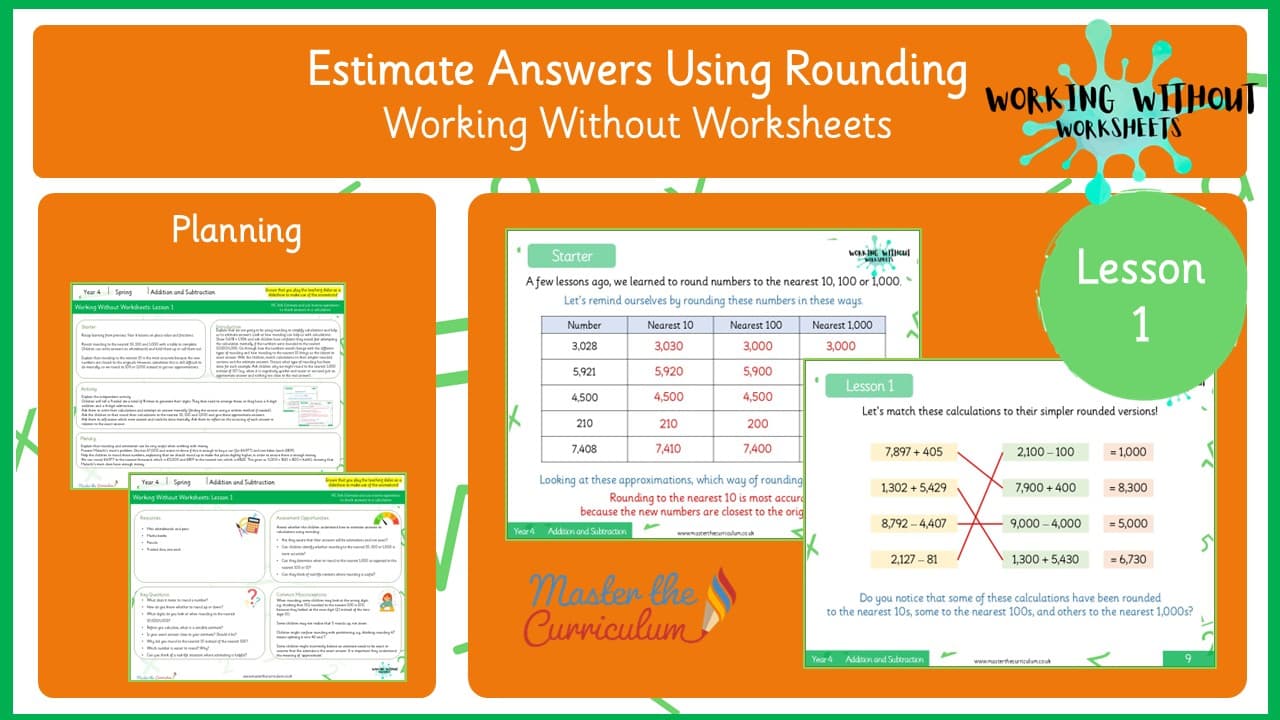
This engaging Year 4 maths lesson on rounding and estimation helps pupils apply their understanding of place value and fractions to simplify calculations and estimate answers with confidence. Designed as a complete lesson, the resource revisits rounding to the nearest 10, 100 and 1,000 , showing children how rounding can make large calculations easier to manage mentally. The lesson begins with a starter activity that recaps prior learning from Year 4 lessons on place value and rounding. Pupils practise rounding numbers using a table activity, responding on whiteboards to build confidence and encourage quick recall. The introduction then demonstrates how rounding can support mental maths and estimation , using examples such as 5,678 + 1,906 to explore how calculations change when numbers are rounded to the nearest 10, 100 or 1,000. During the main activity , pupils generate their own calculations by rolling a 9-sided die to create digits. They arrange these digits into both a 4-digit addition and 4-digit subtraction , attempt to calculate the exact answers, and then estimate using rounding to different place values. This hands-on approach encourages reasoning as pupils compare the accuracy and efficiency of different rounding strategies . The plenary task applies rounding and estimation to a real-life money problem, helping children understand how approximations can support decision-making. Pupils explore whether £7,000 is enough to buy a car and two bikes, learning when it is sensible to round prices up to ensure sufficient money. The resource also addresses common misconceptions , including: Looking at the wrong digit when rounding Believing that 5 rounds down instead of up Confusing rounding with partitioning Thinking an estimate must be exact Perfect for Year 4 maths lessons, KS2 rounding practice, estimation activities, and mental calculation strategies , this resource supports pupils in developing stronger number sense and reasoning skills .Read more

This engaging Year 4 maths lesson on rounding and estimation helps pupils apply their understanding of place value and fractions to simplify calculations and estimate answers with confidence. Designed as a complete lesson, the resource revisits rounding to the nearest 10, 100 and 1,000 , showing children how rounding can make large calculations easier to manage mentally. The lesson begins with a starter activity that recaps prior learning from Year 4 lessons on place value and rounding. Pupils practise rounding numbers using a table activity, responding on whiteboards to build confidence and encourage quick recall. The introduction then demonstrates how rounding can support mental maths and estimation , using examples such as 5,678 + 1,906 to explore how calculations change when numbers are rounded to the nearest 10, 100 or 1,000. During the main activity , pupils generate their own calculations by rolling a 9-sided die to create digits. They arrange these digits into both a 4-digit addition and 4-digit subtraction , attempt to calculate the exact answers, and then estimate using rounding to different place values. This hands-on approach encourages reasoning as pupils compare the accuracy and efficiency of different rounding strategies . The plenary task applies rounding and estimation to a real-life money problem, helping children understand how approximations can support decision-making. Pupils explore whether £7,000 is enough to buy a car and two bikes, learning when it is sensible to round prices up to ensure sufficient money. The resource also addresses common misconceptions , including: Looking at the wrong digit when rounding Believing that 5 rounds down instead of up Confusing rounding with partitioning Thinking an estimate must be exact Perfect for Year 4 maths lessons, KS2 rounding practice, estimation activities, and mental calculation strategies , this resource supports pupils in developing stronger number sense and reasoning skills .

Show less

What you get, 6 files

  • PDFPlanning
  • PPTXPlanning, editable
  • PDFTeaching slides
  • PPTXTeaching slides, editable
  • PDFWorksheets, all three levels
  • PPTXWorksheets, editable

The standard small step pack, as her own modules ship it. We do not print page counts here, because her catalogue does not publish them and a guessed number is worse than none.

★★★ Differentiated three ways
  • Working towardsScaffolded, with the model or the bar already drawn.
  • Working withinThe expected standard for the year group.
  • Greater depthReasoning and explaining, not just more of the same.

Her own system, with the star count repeated in every worksheet header so a child can be handed the right sheet without a word.

The rest of this block

Working Without Worksheets, Year 411 numbered lessons

  1. Lesson 1 · you are hereEstimate Answers Using Rounding to the Nearest 10, 100 or 1,000
  2. Lesson 2Compare Numbers Beyond 1,000
  3. Lesson 3Order Numbers Beyond 1,000
  4. Lesson 4Count in Multiples of 25
  5. Lesson 5Count in Multiples of 1,000

What teachers said after they used it

All reviews →
4.857 verified reviewsWe ask once, seven days after the download, and one tap is enough.
Joanne PicklesYear 3 teacher, Crossflatts Primary, BingleyVerified download, 5 March 2026

Printed it at eight on a Sunday and taught it on the Monday.

No editing, no reformatting, no hunting for the answers. The three levels are on separate pages, which sounds obvious until you have used the sites where they are not.

10 teachers found this helpful

Michael FerrisMaths lead, Cheadle Heath Primary, StockportVerified download, 16 February 2026

Matches our White Rose planning almost week for week.

I stopped adapting things from three different sites and now start here. The odd week does not line up exactly, but the small step it covers is always somewhere in the same block.

8 teachers found this helpful

Aisha KarimSENCO, Newlands Primary Academy, LutonVerified download, 2 February 2026

The editable file is why we renewed.

Being able to change two questions for the child who joined us in January, without rebuilding the whole sheet, is worth the subscription on its own.

12 teachers found this helpful

More working without worksheets for Year 4

Working Without Worksheets

Y4

L3 Convert Between Kilograms and Grams

masterthecurriculum.co.uk
4.650 reviews
Included with membership
Editable worksheetsWord and PowerPoint, so you can change anythingWhite Rose supportingFollows the small steps you already plan fromDownloadable lesson plansPlanning, slides and worksheets for every stepReasoning and problem solvingBuilt into every step, not sold separately

A free resource every Friday

One email a week, for the year group you actually teach. Unsubscribe in a click.

Year group you teach