“The editable file is why we renewed.”
Being able to change two questions for the child who joined us in January, without rebuilding the whole sheet, is worth the subscription on its own.
12 teachers found this helpful
Proposed versionTrusted by primary teachers across the UK · New resources every week
Working Without Worksheets
Y4
Preview only. The download is a fully editable file.
1 page shown before you download
1CoverThe rest of the pack
Planning, teaching slides and all three worksheet levels come with the download.
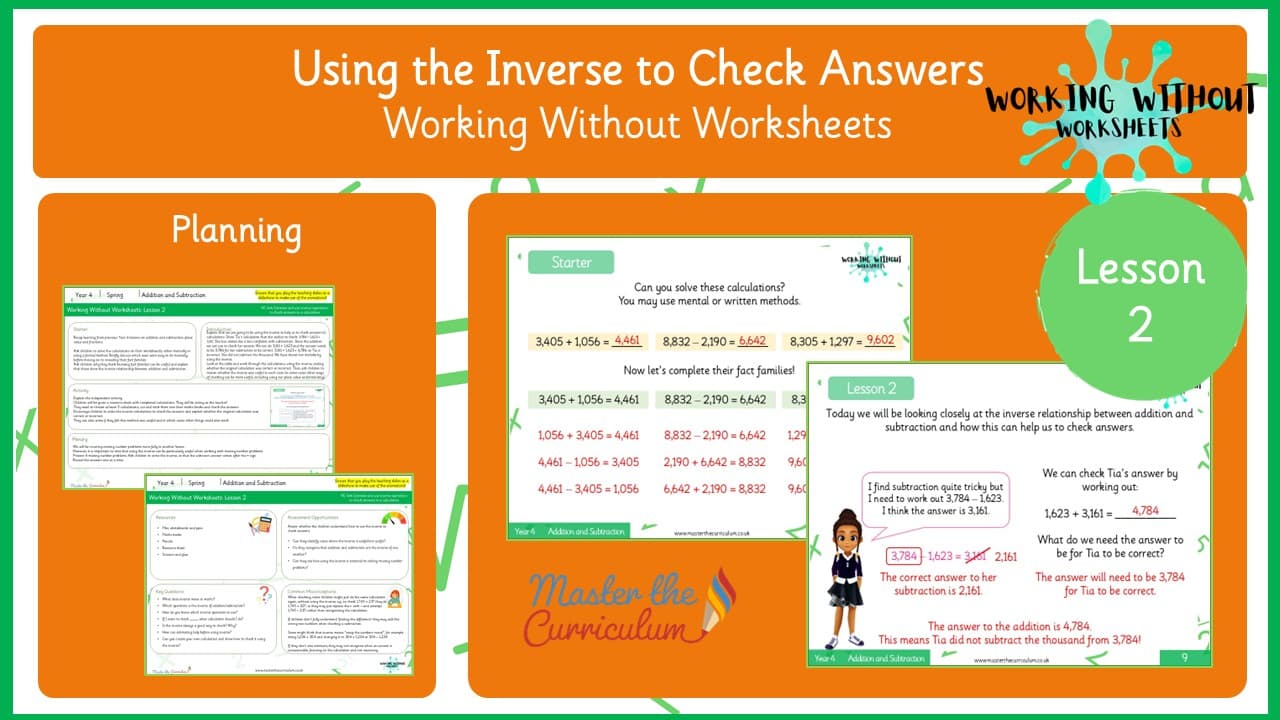
A Year 4 maths lesson on inverse operations where pupils learn how to use addition and subtraction to check calculations , identify errors and solve missing number problems.
Included with membership
Unlock with membershipAlready a member? Sign in and it downloads from this page.
Keep it for later and group it with the rest of the block. No account needed to start.
This engaging Year 4 maths lesson on inverse operations helps pupils understand how addition and subtraction are related and how the inverse can be used to check the accuracy of calculations . The lesson builds on prior learning in place value, addition and subtraction , while strengthening pupils’ reasoning and problem-solving skills. The lesson begins with a starter activity that revisits addition and subtraction calculations from previous Year 4 learning. Pupils solve problems using mental strategies or formal written methods and then explore fact families to see how numbers are connected. This recap supports children in recognising the inverse relationship between addition and subtraction . In the main teaching section , pupils are introduced to the idea of using the inverse to check answers. Using a worked example involving a subtraction calculation, children learn how an addition calculation can verify whether the original answer is correct . Through guided discussion, pupils identify errors and explore how inverse operations can help reveal mistakes in calculations. The lesson also includes opportunities for pupils to evaluate when the inverse is the most useful checking strategy , and when other methods such as estimation or place value reasoning may be more efficient. During the independent activity , pupils take on the role of the teacher. They are given a selection of completed calculations and must choose at least five to check. By writing the inverse calculations , they determine whether the original answers are correct or incorrect and explain their reasoning. This task encourages deeper mathematical thinking and supports the development of self-checking strategies . The plenary introduces missing number problems, demonstrating how inverse operations can be particularly helpful when solving equations with unknown values. Pupils practise rewriting problems so that the unknown number appears after the equals sign and use the inverse to find the solution.
Show lessThe standard small step pack, as her own modules ship it. We do not print page counts here, because her catalogue does not publish them and a guessed number is worse than none.
Her own system, with the star count repeated in every worksheet header so a child can be handed the right sheet without a word.
Working Without Worksheets, Year 411 numbered lessons
“The editable file is why we renewed.”
Being able to change two questions for the child who joined us in January, without rebuilding the whole sheet, is worth the subscription on its own.
12 teachers found this helpful
“Good value, and the answers are actually on it.”
Small thing, but half the free sheets online expect you to work the answers out yourself. My TA can run a group on this without a briefing first.
5 teachers found this helpful
“Fine, though the font is small for my class.”
The maths is right and the sequence is sensible. Several of my children needed it enlarged to A3, which is easy enough but worth knowing before you print thirty.
4 teachers found this helpful
Working Without Worksheets
Y4
Working Without Worksheets
Y4
Working Without Worksheets
Y4
Working Without Worksheets
Y4
Working Without Worksheets
Y4
One email a week, for the year group you actually teach. Unsubscribe in a click.