
Working Without Worksheets
Y1L6 Spring Missing Number Problems within 20

masterthecurriculum.co.uk
Proposed versionTrusted by primary teachers across the UK · New resources every week
Working Without Worksheets
Y1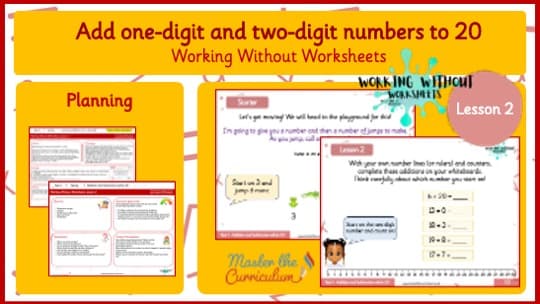
Preview only. The download is a fully editable file.
1 page shown before you download
1CoverThe rest of the pack
Planning, teaching slides and all three worksheet levels come with the download.
A Year 1 maths lesson on adding a one-digit number to a two-digit number using counting on. Includes active outdoor starter, number line activities, and reflection on efficient addition strategies.
Included with membership
Unlock with membershipAlready a member? Sign in and it downloads from this page.
Keep it for later and group it with the rest of the block. No account needed to start.
This engaging Year 1 maths lesson helps children develop confidence in adding a one-digit number to a two-digit number (within 20) using the counting-on method . The lesson begins with a lively starter where pupils use frog jumps on a number line to visualise addition, reinforcing earlier learning from Year 1 Spring 1. Taking the activity outside, children physically jump along a number line to count on from a given number, supporting kinaesthetic learning and number fluency. In the main teaching input, pupils explore how addition can be done in any order and learn the importance of starting with the larger number when counting on to make calculations more efficient. Using number lines, counters, and practical examples such as 14 + 4 , children see how to move along the number line and record their findings. During the activity, pupils create and solve their own addition sentences by selecting random number cards (10–20) and rolling a 10-sided die. They record number sentences in their books and practise efficient counting strategies. The plenary encourages reflection on when counting on is most effective, helping children understand that while it works well for smaller numbers, other strategies may be needed for larger ones. This resource promotes hands-on, active learning and builds conceptual understanding of addition, number patterns, and efficiency in mental calculation.
Show lessThe standard small step pack, as her own modules ship it. We do not print page counts here, because her catalogue does not publish them and a guessed number is worse than none.
Her own system, with the star count repeated in every worksheet header so a child can be handed the right sheet without a word.
Working Without Worksheets, Year 110 numbered lessons
Working Without Worksheets
Y1Working Without Worksheets
Y1
Working Without Worksheets
Y1
Working Without Worksheets
Y1
Working Without Worksheets
Y1
One email a week, for the year group you actually teach. Unsubscribe in a click.