
Working Without Worksheets
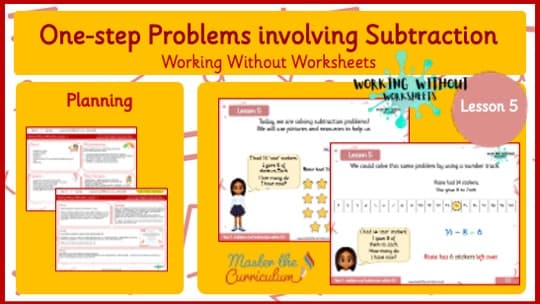
Y1L5 Spring Subtraction Problems within 20
masterthecurriculum.co.uk
Proposed versionTrusted by primary teachers across the UK · New resources every week
Working Without Worksheets
Y1
Preview only. The download is a fully editable file.
1 page shown before you download
1CoverThe rest of the pack
Planning, teaching slides and all three worksheet levels come with the download.
A Year 1 maths lesson on finding missing numbers in addition and subtraction within 20 using number lines, counting strategies, and equality models. Includes practical activities, misconceptions, and plenary ideas.
Included with membership
Unlock with membershipAlready a member? Sign in and it downloads from this page.
Keep it for later and group it with the rest of the block. No account needed to start.
This Year 1 maths lesson helps children develop a deeper understanding of missing number problems in both addition and subtraction within 20. The session builds fluency, reasoning, and flexibility in number work through hands-on exploration using number lines, counting strategies, and balance models . The starter engages pupils with an energetic counting warm-up: counting forwards and backwards to 50 while clapping or stamping, followed by quickfire questions on finding 1 more and 1 less . These oral and physical activities strengthen number fluency and prepare children for working with number sequences and relationships. In the main input , pupils take on the role of maths detectives to find the missing number in equations. First, the teacher revisits subtraction examples such as 14 – ___ = 8 , modelling how to count backwards on a number line to identify the missing part. Then, addition is introduced through problems like 12 + ___ = 19 , where children count forwards to find the missing addend. Both methods emphasise structured reasoning and visual representation. During the activity , pupils use laminated number lines and whiteboard pens to draw jumps, count accurately, and reveal the missing number in both addition and subtraction contexts. The lesson is carefully sequenced—first subtraction, then addition—to build confidence and avoid confusion between the two operations. The plenary deepens conceptual understanding of the equals sign as balance rather than simply “the answer comes next.” Children explore alternative equation structures such as 18 = ___ + 6 and may extend learning through a practical demonstration with scales and cubes to show equality in action. Common misconceptions are anticipated, including misunderstanding the equals sign, guessing missing numbers, or failing to use inverse operations to check answers. Through structured modelling, questioning, and visual supports, children gain confidence solving missing number problems and strengthen the
Show lessThe standard small step pack, as her own modules ship it. We do not print page counts here, because her catalogue does not publish them and a guessed number is worse than none.
Her own system, with the star count repeated in every worksheet header so a child can be handed the right sheet without a word.
Working Without Worksheets, Year 110 numbered lessons
Working Without Worksheets
Y1Working Without Worksheets
Y1
Working Without Worksheets
Y1
Working Without Worksheets
Y1
Working Without Worksheets
Y1
One email a week, for the year group you actually teach. Unsubscribe in a click.