
Working Without Worksheets
Y1L6 Spring Missing Number Problems within 20

masterthecurriculum.co.uk
Proposed versionTrusted by primary teachers across the UK · New resources every week
Working Without Worksheets
Y1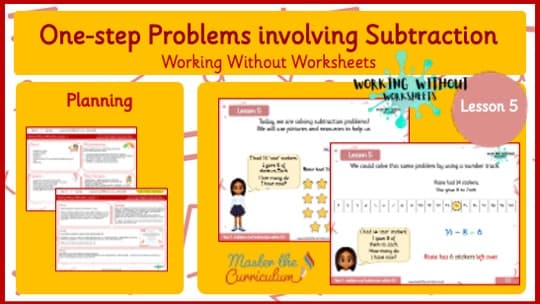
Preview only. The download is a fully editable file.
1 page shown before you download
1CoverThe rest of the pack
Planning, teaching slides and all three worksheet levels come with the download.
A Year 1 maths lesson solving subtraction word problems within 20 using counters, number lines, and ten-frames. Includes animated starter, practical activity, and discussion of common misconceptions.
Included with membership
Unlock with membershipAlready a member? Sign in and it downloads from this page.
Keep it for later and group it with the rest of the block. No account needed to start.
This Year 1 maths lesson introduces children to solving subtraction word problems within 20 using practical resources, pictorial representations, and number lines . Building on the previous addition lesson, pupils first watch an engaging animation showing 12 ants, 3 leave the nest, 9 left over , and discuss key subtraction vocabulary such as left over and take away . They record the matching number sentence (12 – 3 = 9) to strengthen the connection between real-life stories and mathematical symbols. In the main teaching input, the teacher models subtraction problems like 14 – 8 = 6 using star stickers and counters before demonstrating how to count backwards on a number line. Children learn that subtraction means moving to the left and that, unlike addition, subtraction cannot be reordered . During the activity, pupils choose subtraction word problems, underline important information, and solve them independently using counters, number lines, or drawings. They record accurate subtraction sentences and may attempt multiple problems for fluency practice. The plenary introduces ten-frames as another visual subtraction method, demonstrating 18 – 5 = 13 by crossing out or removing counters. The session ends with reflection and discussion about preferred strategies, deepening conceptual understanding. The lesson also highlights common misconceptions —such as double-counting the starting number, confusing addition and subtraction, or assuming subtraction is commutative—so teachers can address errors promptly. By the end of the lesson, pupils confidently solve subtraction problems within 20 using a range of strategies and understand how subtraction connects to real-life contexts and earlier learning in addition.
Show lessThe standard small step pack, as her own modules ship it. We do not print page counts here, because her catalogue does not publish them and a guessed number is worse than none.
Her own system, with the star count repeated in every worksheet header so a child can be handed the right sheet without a word.
Working Without Worksheets, Year 110 numbered lessons
Working Without Worksheets
Y1Working Without Worksheets
Y1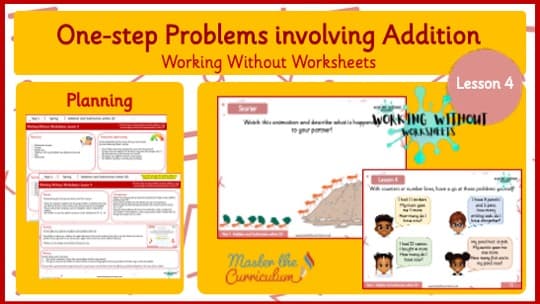
Working Without Worksheets
Y1
Working Without Worksheets
Y1
Working Without Worksheets
Y1
One email a week, for the year group you actually teach. Unsubscribe in a click.