Skip to content

Proposed version

Master the Curriculum

Working Without Worksheets

Y2

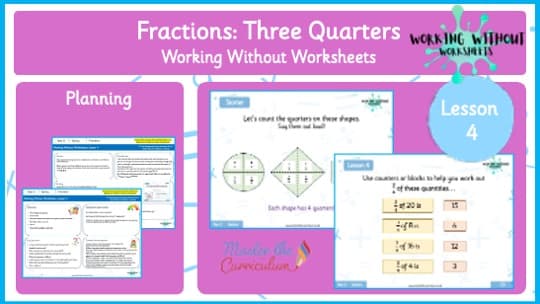
L4 Recognise and Find Three Quarters

masterthecurriculum.co.uk

Preview only. The download is a fully editable file.

See inside

1 page shown before you download

Cover of L4 Recognise and Find Three Quarters1Cover
Cover and first page

The rest of the pack

Planning, teaching slides and all three worksheet levels come with the download.

Year 2Working Without Worksheets

L4 Recognise and Find Three Quarters

4.255 reviews

Year 2 Working Without Worksheets lesson on finding three quarters (3/4). Includes planning, modelling, butterfly counters activity, and plenary.

Included with membership

Unlock with membership

Already a member? Sign in and it downloads from this page.

Keep it for later and group it with the rest of the block. No account needed to start.

  • Fully editable Word or PowerPoint file
  • Differentiated three ways
  • Instant download, no watermark

About this resource

Working Without Worksheets – Year 2 Fractions: Finding Three Quarters (3/4) This Working Without Worksheets lesson helps Year 2 pupils move forward in their fractions journey by learning how to find and record three quarters (3/4) of shapes and quantities. Using visual models, practical sharing, and hands-on activities, children gain confidence in recognising that 3/4 means 3 out of 4 equal parts . The lesson begins with a starter activity : Recap prior learning in fractions, multiplication and division, and addition and subtraction . Revisit quarters and show how we can count around a shape in quarters: 1/4, 2/4, 3/4, 4/4 . Model saying the fractions out loud, so children begin to connect notation with spoken fractions. In the main input , children explore three quarters in detail: Use a bar model split into 4 equal parts , reinforcing that each is 1/4. Shade one part (1/4), then two parts (2/4, or half), then a third part (3/4). Demonstrate with a square to reinforce the concept visually. Use a chocolate bar with 12 pieces to show: 3/4 of 12 = 9 . Support children to practise on whiteboards, completing sentences such as “3/4 of 20 is 15.” using counters if needed. For the independent activity , children use butterfly templates to explore 1/4, 2/4, and 3/4: Provide pots of counters (numbers chosen to divide equally into 4 groups). Children share counters equally between the 4 wings. Record answers in books: “1/4 of ___ = ___, 2/4 of ___ = ___, 3/4 of ___ = ___.” Repeat with at least 3 different totals for varied practice. As a creative option, provide small butterfly outlines for children to stick into books and use bingo dabbers to show spots on wings instead of counters. The plenary consolidates learning: Share examples and discuss how we can see 3/4 as almost a whole (with 1/4 left). Reinforce fraction vocabulary: quarter, numerator, denominator, three quarters, equal parts, whole. Link back to equivalence: compare 2/4 and 3/4 to show progression from half to alRead more

Working Without Worksheets – Year 2 Fractions: Finding Three Quarters (3/4) This Working Without Worksheets lesson helps Year 2 pupils move forward in their fractions journey by learning how to find and record three quarters (3/4) of shapes and quantities. Using visual models, practical sharing, and hands-on activities, children gain confidence in recognising that 3/4 means 3 out of 4 equal parts . The lesson begins with a starter activity : Recap prior learning in fractions, multiplication and division, and addition and subtraction . Revisit quarters and show how we can count around a shape in quarters: 1/4, 2/4, 3/4, 4/4 . Model saying the fractions out loud, so children begin to connect notation with spoken fractions. In the main input , children explore three quarters in detail: Use a bar model split into 4 equal parts , reinforcing that each is 1/4. Shade one part (1/4), then two parts (2/4, or half), then a third part (3/4). Demonstrate with a square to reinforce the concept visually. Use a chocolate bar with 12 pieces to show: 3/4 of 12 = 9 . Support children to practise on whiteboards, completing sentences such as “3/4 of 20 is 15.” using counters if needed. For the independent activity , children use butterfly templates to explore 1/4, 2/4, and 3/4: Provide pots of counters (numbers chosen to divide equally into 4 groups). Children share counters equally between the 4 wings. Record answers in books: “1/4 of ___ = ___, 2/4 of ___ = ___, 3/4 of ___ = ___.” Repeat with at least 3 different totals for varied practice. As a creative option, provide small butterfly outlines for children to stick into books and use bingo dabbers to show spots on wings instead of counters. The plenary consolidates learning: Share examples and discuss how we can see 3/4 as almost a whole (with 1/4 left). Reinforce fraction vocabulary: quarter, numerator, denominator, three quarters, equal parts, whole. Link back to equivalence: compare 2/4 and 3/4 to show progression from half to al

Show less

What you get, 6 files

  • PDFPlanning
  • PPTXPlanning, editable
  • PDFTeaching slides
  • PPTXTeaching slides, editable
  • PDFWorksheets, all three levels
  • PPTXWorksheets, editable

The standard small step pack, as her own modules ship it. We do not print page counts here, because her catalogue does not publish them and a guessed number is worse than none.

★★★ Differentiated three ways
  • Working towardsScaffolded, with the model or the bar already drawn.
  • Working withinThe expected standard for the year group.
  • Greater depthReasoning and explaining, not just more of the same.

Her own system, with the star count repeated in every worksheet header so a child can be handed the right sheet without a word.

The rest of this block

Working Without Worksheets, Year 211 numbered lessons

  1. Lesson 2Recognise and Find Two Quarters
  2. Lesson 3Equivalence of One Half and Two Quarters
  3. Lesson 4 · you are hereRecognise and Find Three Quarters
  4. Lesson 5Recognise and Find One Third
  5. Lesson 6– WWW – Y2 Represent Numbers on a Number Line

What teachers said after they used it

All reviews →
4.255 verified reviewsWe ask once, seven days after the download, and one tap is enough.
Steven LoughYear 2 teacher, Abbeyfields First School, MorpethVerified download, 23 January 2026

Good value, and the answers are actually on it.

Small thing, but half the free sheets online expect you to work the answers out yourself. My TA can run a group on this without a briefing first.

5 teachers found this helpful
Beth NightingaleYear 1 teacher, Poplar Farm School, GranthamVerified download, 13 January 2026

Fine, though the font is small for my class.

The maths is right and the sequence is sensible. Several of my children needed it enlarged to A3, which is easy enough but worth knowing before you print thirty.

4 teachers found this helpful

Joanne PicklesYear 3 teacher, Crossflatts Primary, BingleyVerified download, 5 March 2026

Printed it at eight on a Sunday and taught it on the Monday.

No editing, no reformatting, no hunting for the answers. The three levels are on separate pages, which sounds obvious until you have used the sites where they are not.

10 teachers found this helpful

More working without worksheets for Year 2

Working Without Worksheets

Y2

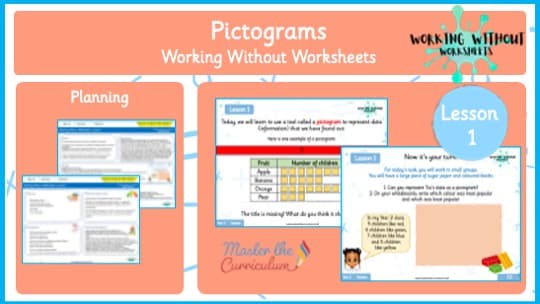
L1 Pictograms

masterthecurriculum.co.uk
4.650 reviews
Included with membership
Editable worksheetsWord and PowerPoint, so you can change anythingWhite Rose supportingFollows the small steps you already plan fromDownloadable lesson plansPlanning, slides and worksheets for every stepReasoning and problem solvingBuilt into every step, not sold separately

A free resource every Friday

One email a week, for the year group you actually teach. Unsubscribe in a click.

Year group you teach