“Fine, though the font is small for my class.”
The maths is right and the sequence is sensible. Several of my children needed it enlarged to A3, which is easy enough but worth knowing before you print thirty.
4 teachers found this helpful
Proposed versionTrusted by primary teachers across the UK · New resources every week
Working Without Worksheets
Y3
Preview only. The download is a fully editable file.
1 page shown before you download
1CoverThe rest of the pack
Planning, teaching slides and all three worksheet levels come with the download.
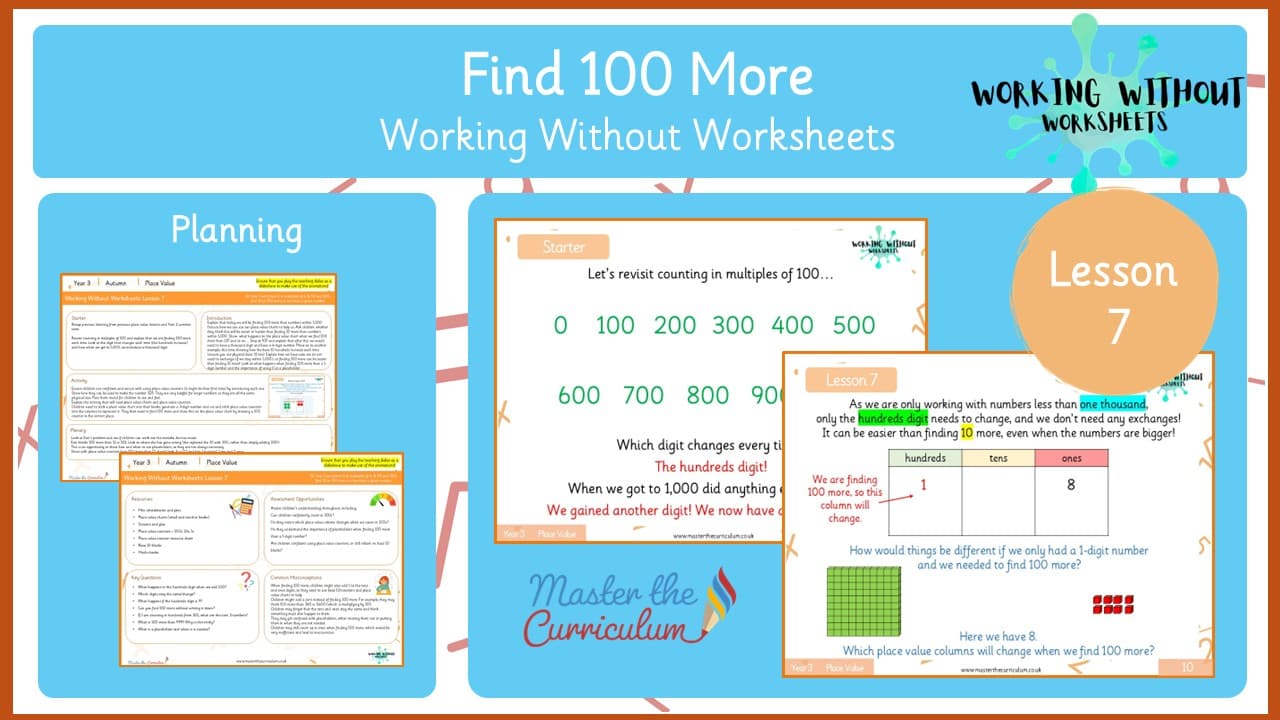
A Year 3 maths lesson teaching children to find 100 more than numbers within 1,000 using place value charts and Base 10 counters . Includes interactive activities, visual examples, and strategies to address common misconceptions.
Included with membership
Unlock with membershipAlready a member? Sign in and it downloads from this page.
Keep it for later and group it with the rest of the block. No account needed to start.
This Year 3 maths lesson focuses on helping children understand how to find 100 more than a number within 1,000 , building on previous place value learning from Year 2 and earlier Year 3 lessons. The starter revisits counting in multiples of 100, highlighting how the hundreds digit increases each time, and introduces the thousand digit when numbers exceed 999. In the introduction, students explore how to find 100 more using place value charts and Base 10 counters , comparing the process to finding 10 more to discuss which is easier and why. Animated examples, such as finding 100 more than 137 up to 937, demonstrate how the hundreds digit increases while the tens and ones digits remain unchanged. Children also learn the importance of placeholders , especially when adding 100 to single-digit numbers. During the activity, children generate 3-digit numbers and represent them on place value charts using place value counters . They then find 100 more and show this visually by adding a 100-counter in the correct column, reinforcing the concept of place value and helping them see when exchanges are necessary. The plenary consolidates learning with a common misconception example: adding 100 to 12. Students identify the mistake (thinking it becomes 102 instead of 112) and discuss when placeholders are needed. Common misconceptions addressed include adding 1 to the tens or ones digits, confusing adding 100 with multiplying by 10, and counting in ones instead of hundreds. This resource is ideal for teachers seeking a hands-on, interactive Year 3 lesson on finding 100 more, place value, and addition within 1,000 , with activities designed to reinforce conceptual understanding and prevent common errors.
Show lessThe standard small step pack, as her own modules ship it. We do not print page counts here, because her catalogue does not publish them and a guessed number is worse than none.
Her own system, with the star count repeated in every worksheet header so a child can be handed the right sheet without a word.
Working Without Worksheets, Year 310 numbered lessons
“Fine, though the font is small for my class.”
The maths is right and the sequence is sensible. Several of my children needed it enlarged to A3, which is easy enough but worth knowing before you print thirty.
4 teachers found this helpful
“Printed it at eight on a Sunday and taught it on the Monday.”
No editing, no reformatting, no hunting for the answers. The three levels are on separate pages, which sounds obvious until you have used the sites where they are not.
10 teachers found this helpful
“Matches our White Rose planning almost week for week.”
I stopped adapting things from three different sites and now start here. The odd week does not line up exactly, but the small step it covers is always somewhere in the same block.
8 teachers found this helpful
Working Without Worksheets
Y3
Working Without Worksheets
Y3
Working Without Worksheets
Y3
Working Without Worksheets
Y3
Working Without Worksheets
Y3
One email a week, for the year group you actually teach. Unsubscribe in a click.