
Working Without Worksheets
Y3L5 Record and Compare Times
masterthecurriculum.co.uk
Proposed versionTrusted by primary teachers across the UK · New resources every week
Working Without Worksheets
Y3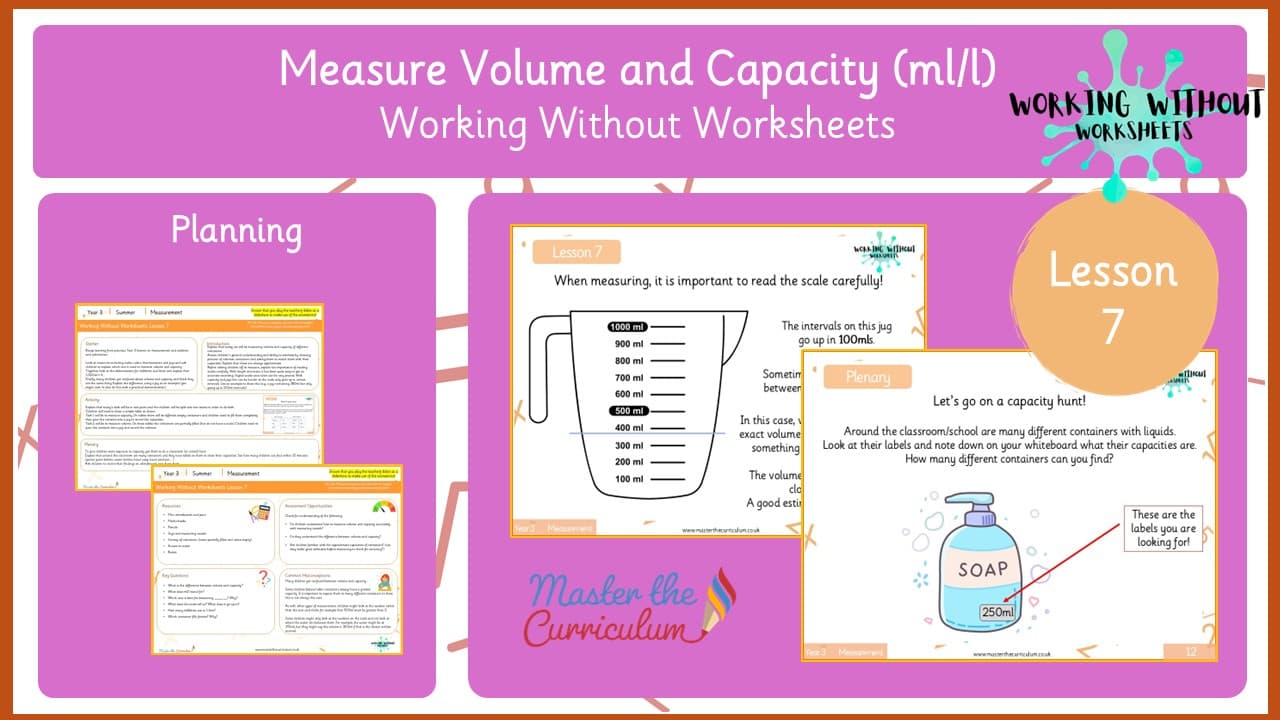
Preview only. The download is a fully editable file.
1 page shown before you download
1CoverThe rest of the pack
Planning, teaching slides and all three worksheet levels come with the download.
A practical Year 3 maths lesson on measuring volume and capacity using litres and millilitres. Children explore the difference between volume and capacity, estimate and measure containers, read scales accurately, and apply their learning through engaging hands-on activities.
Included with membership
Unlock with membershipAlready a member? Sign in and it downloads from this page.
Keep it for later and group it with the rest of the block. No account needed to start.
Help Year 3 pupils develop a secure understanding of volume and capacity with this engaging, practical maths lesson. Designed to support the National Curriculum objective of measuring, comparing, adding and subtracting volume and capacity using litres (l) and millilitres (ml), this resource encourages hands-on learning without the need for worksheets. Through a range of interactive activities, children explore the difference between volume and capacity, learn how to read measuring scales accurately, and investigate the relationship between litres and millilitres, including the key conversion that 1,000ml equals 1 litre. Pupils estimate the capacities of everyday containers before measuring them, helping to strengthen both reasoning and practical measurement skills. The lesson includes two collaborative measurement tasks. Children measure the capacity of empty containers by filling them and recording their capacities using measuring jugs, then measure the volume of liquid in partially filled containers. A classroom capacity hunt provides additional opportunities to identify and compare real-life examples of containers with different capacities. Ideal for Year 3 teachers seeking an active and engaging approach to teaching measurement, this resource supports mathematical vocabulary development, estimation skills, accurate scale reading, and a deeper understanding of volume and capacity through practical investigation and discussion. Perfect for classroom teaching, intervention groups, or mastery-based learning approaches, this lesson promotes confidence and fluency in measuring volume and capacity using real-world contexts.
Show lessThe standard small step pack, as her own modules ship it. We do not print page counts here, because her catalogue does not publish them and a guessed number is worse than none.
Her own system, with the star count repeated in every worksheet header so a child can be handed the right sheet without a word.
Working Without Worksheets, Year 310 numbered lessons
Working Without Worksheets
Y3Working Without Worksheets
Y3
Working Without Worksheets
Y3
Working Without Worksheets
Y3
Working Without Worksheets
Y3
One email a week, for the year group you actually teach. Unsubscribe in a click.