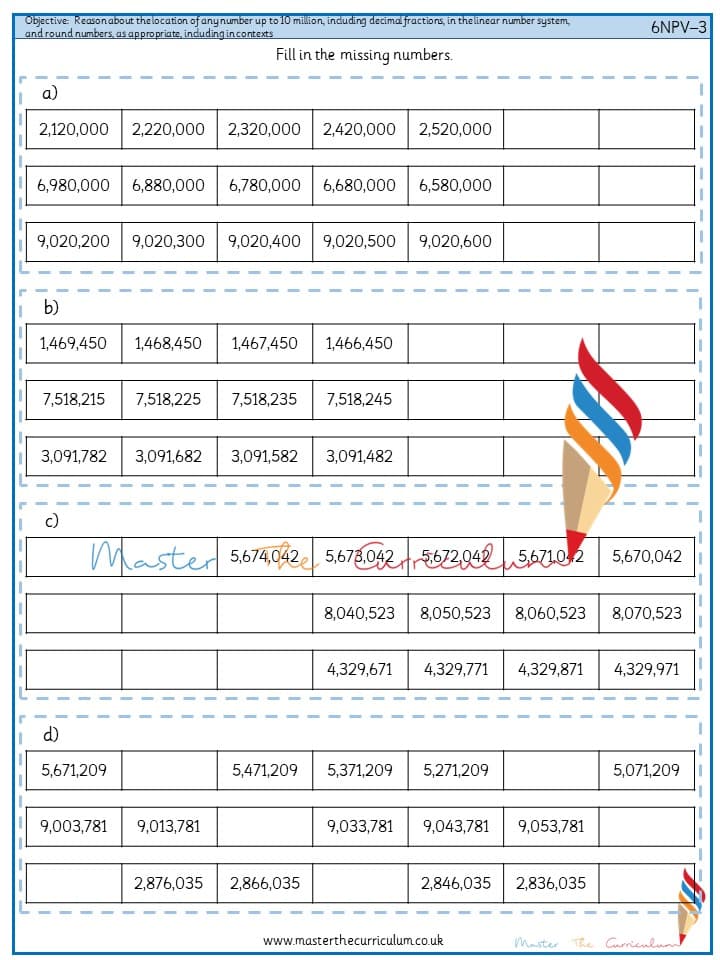
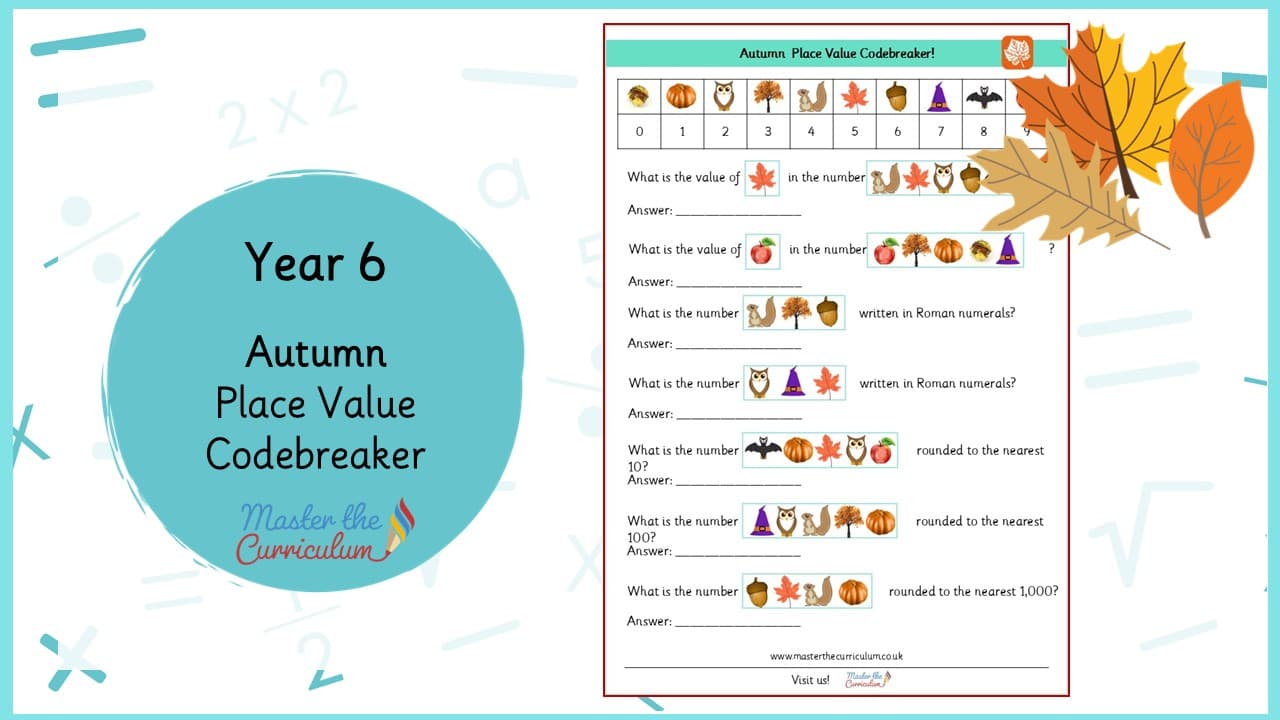
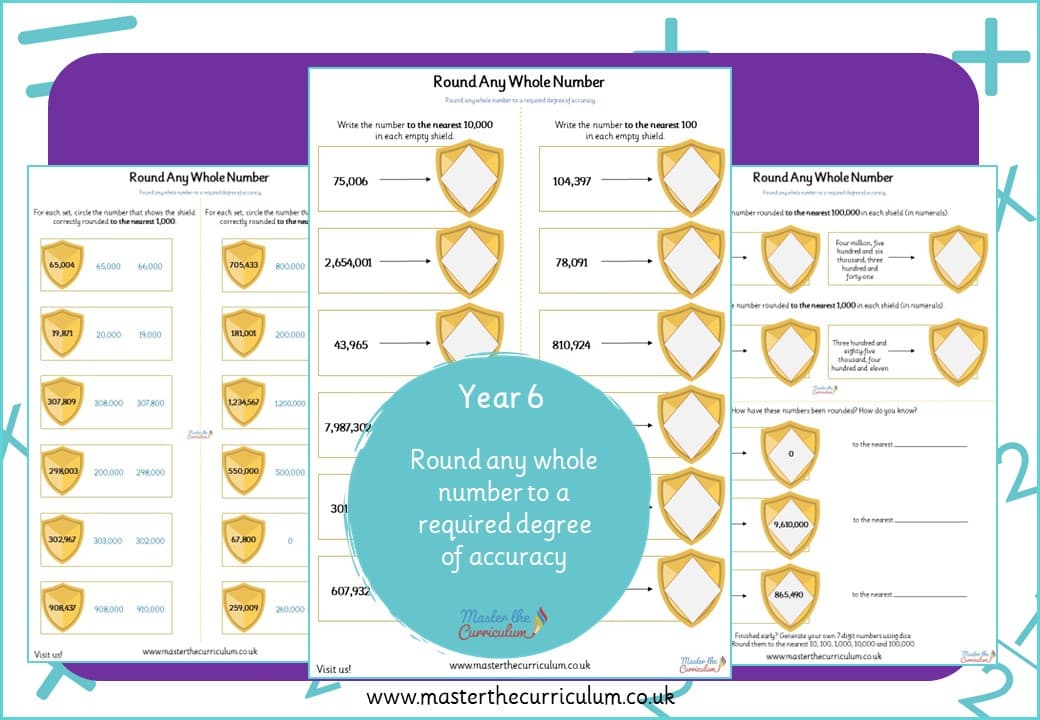
Pupils have already learnt about the location of whole numbers with up to 4 digits in the linear number system (1NPV–2, 2NPV–2, 3NPV–3 and 4NPV–3) and about the location of decimal fractions with up to 2 decimal places between whole numbers in the linear number system (5NPV–3). Pupils must now extend their understanding to larger numbers. Pupils need to be able to identify or place numbers with up to 7 digits on marked number lines with a variety of scales, for example placing 12,500 on a 12,000 to 13,000 number line, and on a 10,000 to 20,000 number line. Pupils need to be able to estimate the value or position of numbers on unmarked or partially marked numbers lines, using appropriate proportional reasoning. In the example below, pupils should reason: “a must be about 875,000 because it is about halfway between the midpoint of the number line, which is 850,000, and 900,000.” Pupils should understand that, to estimate the position of a number with more significant digits on a large-value number line, they must attend to the leading digits and can ignore values in the smaller place-value positions. For example, when estimating the position of 5,192,012 on a 5,100,000 to 5,200,000 number line they only need to attend to the first 4 digits. Pupils must also be able to round numbers in preparation for key stage 3, when they will learn to round numbers to a given number of significant figures or decimal places. They have already learnt to round numbers with up to 4 digits to the nearest multiple of 1,000, 100 and 10, and to round decimal fractions to the nearest whole number or multiple of 0.1. Now pupils should extend this to larger numbers. They must also learn that numbers are rounded for the purpose of eliminating an unnecessary level of detail. They must understand that rounding is a method of approximating, and that rounded numbers can be used to give estimated values including estimated answers to calculations. Pupils should only be asked to round numbers to a usRead more
Pupils have already learnt about the location of whole numbers with up to 4 digits in the linear number system (1NPV–2, 2NPV–2, 3NPV–3 and 4NPV–3) and about the location of decimal fractions with up to 2 decimal places between whole numbers in the linear number system (5NPV–3). Pupils must now extend their understanding to larger numbers. Pupils need to be able to identify or place numbers with up to 7 digits on marked number lines with a variety of scales, for example placing 12,500 on a 12,000 to 13,000 number line, and on a 10,000 to 20,000 number line. Pupils need to be able to estimate the value or position of numbers on unmarked or partially marked numbers lines, using appropriate proportional reasoning. In the example below, pupils should reason: “a must be about 875,000 because it is about halfway between the midpoint of the number line, which is 850,000, and 900,000.” Pupils should understand that, to estimate the position of a number with more significant digits on a large-value number line, they must attend to the leading digits and can ignore values in the smaller place-value positions. For example, when estimating the position of 5,192,012 on a 5,100,000 to 5,200,000 number line they only need to attend to the first 4 digits. Pupils must also be able to round numbers in preparation for key stage 3, when they will learn to round numbers to a given number of significant figures or decimal places. They have already learnt to round numbers with up to 4 digits to the nearest multiple of 1,000, 100 and 10, and to round decimal fractions to the nearest whole number or multiple of 0.1. Now pupils should extend this to larger numbers. They must also learn that numbers are rounded for the purpose of eliminating an unnecessary level of detail. They must understand that rounding is a method of approximating, and that rounded numbers can be used to give estimated values including estimated answers to calculations. Pupils should only be asked to round numbers to a us
Show less