
Working Without Worksheets
Y1L6 Spring Missing Number Problems within 20

masterthecurriculum.co.uk
Proposed versionTrusted by primary teachers across the UK · New resources every week
Working Without Worksheets
Y1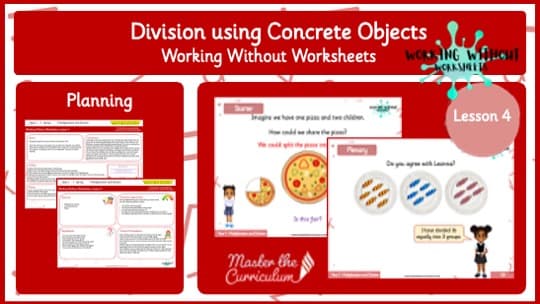
Preview only. The download is a fully editable file.
1 page shown before you download
1CoverThe rest of the pack
Planning, teaching slides and all three worksheet levels come with the download.
A practical Year 1 lesson introducing division as sharing equally. Children use real objects to explore equal groups, link multiplication and division, and discover when numbers can and can’t be shared equally — all without worksheets!
Included with membership
Unlock with membershipAlready a member? Sign in and it downloads from this page.
Keep it for later and group it with the rest of the block. No account needed to start.
In this hands-on Year 1 Working Without Worksheets lesson, children are introduced to the concept of division as sharing equally . Building on their understanding of equal groups from multiplication, pupils explore what it means to divide a total amount fairly between groups using concrete resources such as counters, cubes, or small objects. The lesson begins with a practical starter using a pizza-sharing example , helping children see that division is all about fairness and equality. The teacher demonstrates that if one person gets a bigger slice, it is not shared equally. This leads to the key concept that division means sharing into equal parts . During the teaching input, children explore how dividing relates to multiplication — for example, if 3 groups of 4 make 12, then 12 shared equally into 3 groups gives 4 in each. Using counters or cubes, children practise sharing different totals into equal groups and discover that sometimes there may be a remainder when numbers do not divide equally. In the main activity, children work practically in small groups using counting resources and plates to share objects equally. Through teacher-led challenges such as “Share 15 into 3 equal groups,” they develop fluency in reasoning about equal sharing, spotting when a number cannot be divided equally , and understanding the idea of a ‘left over’ amount. The plenary reinforces the importance of equality, using the example of Leanna’s sweets to address misconceptions and clarify how to check that each group has the same number. This fun, interactive lesson lays strong foundations for future understanding of division and fractions. What’s Included in the Pack ✔ Full lesson plan with objectives, teaching notes, and plenary guidance ✔ Animated teaching slides with visual sharing examples ✔ Practical group activity using real objects and plates ✔ Discussion questions for reasoning and mastery ✔ Common misconceptions and teacher prompts ✔ Fully aligned with Working Without Worksheet
Show lessThe standard small step pack, as her own modules ship it. We do not print page counts here, because her catalogue does not publish them and a guessed number is worse than none.
Her own system, with the star count repeated in every worksheet header so a child can be handed the right sheet without a word.
Working Without Worksheets, Year 110 numbered lessons
Working Without Worksheets
Y1Working Without Worksheets
Y1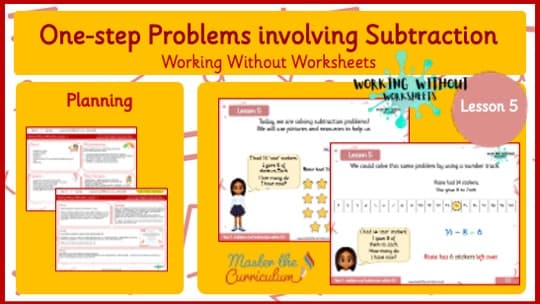
Working Without Worksheets
Y1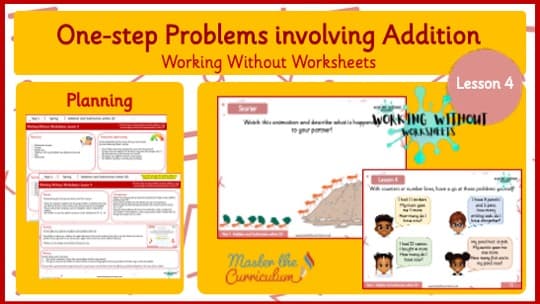
Working Without Worksheets
Y1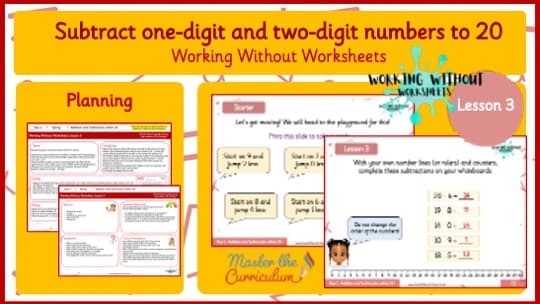
Working Without Worksheets
Y1
One email a week, for the year group you actually teach. Unsubscribe in a click.