Skip to content

Proposed version

Master the Curriculum

Working Without Worksheets

Y2

L1 Patterns and Sequences

masterthecurriculum.co.uk3 levels

Preview only. The download is a fully editable file.

See inside

1 page shown before you download

Cover of L1 Patterns and Sequences1Cover
Cover and first page

The rest of the pack

Planning, teaching slides and all three worksheet levels come with the download.

Year 2Working Without Worksheets

L1 Patterns and Sequences

4.857 reviews

A Working Without Worksheets lesson for Year 2 pupils exploring repeating patterns and sequences through practical and visual activities using cubes and beads. Includes plan, slides, and hands-on tasks.

Included with membership

Unlock with membership

Already a member? Sign in and it downloads from this page.

Keep it for later and group it with the rest of the block. No account needed to start.

  • Fully editable Word or PowerPoint file
  • Differentiated three ways
  • Instant download, no watermark

About this resource

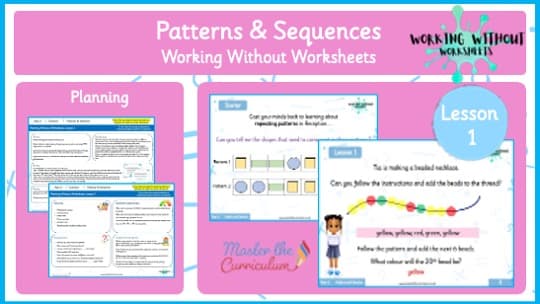
This Working Without Worksheets lesson for Year 2 introduces children to position, direction, and repeating patterns , extending their early understanding of sequences into more complex examples involving orientation and missing elements. Through practical, hands-on activities, children explore how patterns can change in direction, shape, or colour — deepening spatial reasoning and logical thinking. The lesson begins with a starter revisiting previous learning from shape and money units. Children complete simple repeating patterns using colours and 2-D shapes, reinforcing recognition of sequence order and repetition. The teacher then explains that today’s learning extends this understanding with more challenging patterns and orientation-based sequences . During the introduction , animated slides demonstrate how repeating shapes can rotate or change direction while maintaining the same colour and form. This helps children recognise that position and orientation can be part of a pattern. The class then explores Tia’s beaded necklace pattern, predicting which colour comes next and determining that the 20th bead must be yellow by identifying the pattern’s structure. The next challenge features Zach’s broken necklace, where children must reason which colours are missing from the pattern. This develops logical thinking, prediction, and pattern continuation skills . In the activity , learning becomes fully practical. Task 1: In pairs, children sit back-to-back with multilink cubes. One child describes the first few cubes of a pattern, while their partner continues the sequence to build a 12-cube “wand.” They then check if the sequence matches. Task 2: A recorded task using beaded necklace templates. Children choose one of two differentiated sheets — one with missing beads (more challenging) and one to complete — and finish the pattern using coloured pencils. Finally, in the plenary , children identify and correct an error in Rosie’s number sequence, explaining that she misRead more

This Working Without Worksheets lesson for Year 2 introduces children to position, direction, and repeating patterns , extending their early understanding of sequences into more complex examples involving orientation and missing elements. Through practical, hands-on activities, children explore how patterns can change in direction, shape, or colour — deepening spatial reasoning and logical thinking. The lesson begins with a starter revisiting previous learning from shape and money units. Children complete simple repeating patterns using colours and 2-D shapes, reinforcing recognition of sequence order and repetition. The teacher then explains that today’s learning extends this understanding with more challenging patterns and orientation-based sequences . During the introduction , animated slides demonstrate how repeating shapes can rotate or change direction while maintaining the same colour and form. This helps children recognise that position and orientation can be part of a pattern. The class then explores Tia’s beaded necklace pattern, predicting which colour comes next and determining that the 20th bead must be yellow by identifying the pattern’s structure. The next challenge features Zach’s broken necklace, where children must reason which colours are missing from the pattern. This develops logical thinking, prediction, and pattern continuation skills . In the activity , learning becomes fully practical. Task 1: In pairs, children sit back-to-back with multilink cubes. One child describes the first few cubes of a pattern, while their partner continues the sequence to build a 12-cube “wand.” They then check if the sequence matches. Task 2: A recorded task using beaded necklace templates. Children choose one of two differentiated sheets — one with missing beads (more challenging) and one to complete — and finish the pattern using coloured pencils. Finally, in the plenary , children identify and correct an error in Rosie’s number sequence, explaining that she mis

Show less

What you get, 6 files

  • PDFPlanning
  • PPTXPlanning, editable
  • PDFTeaching slides
  • PPTXTeaching slides, editable
  • PDFWorksheets, all three levels
  • PPTXWorksheets, editable

The standard small step pack, as her own modules ship it. We do not print page counts here, because her catalogue does not publish them and a guessed number is worse than none.

★★★ Differentiated three ways
  • Working towardsScaffolded, with the model or the bar already drawn.
  • Working withinThe expected standard for the year group.
  • Greater depthReasoning and explaining, not just more of the same.

Her own system, with the star count repeated in every worksheet header so a child can be handed the right sheet without a word.

The rest of this block

Working Without Worksheets, Year 211 numbered lessons

  1. Lesson 1 · you are herePatterns and Sequences
  2. Lesson 2– WWW – Y2 Counting in Steps of 5
  3. Lesson 3– WWW – Y2 Counting in Steps of 3
  4. Lesson 4– WWW – Y2 Counting in tens from any number forwards and backwards
  5. Lesson 5– WWW – Y2 Recall Facts to 20

What teachers said after they used it

All reviews →
4.857 verified reviewsWe ask once, seven days after the download, and one tap is enough.
Joanne PicklesYear 3 teacher, Crossflatts Primary, BingleyVerified download, 5 March 2026

Printed it at eight on a Sunday and taught it on the Monday.

No editing, no reformatting, no hunting for the answers. The three levels are on separate pages, which sounds obvious until you have used the sites where they are not.

10 teachers found this helpful
Michael FerrisMaths lead, Cheadle Heath Primary, StockportVerified download, 16 February 2026

Matches our White Rose planning almost week for week.

I stopped adapting things from three different sites and now start here. The odd week does not line up exactly, but the small step it covers is always somewhere in the same block.

8 teachers found this helpful

Aisha KarimSENCO, Newlands Primary Academy, LutonVerified download, 2 February 2026

The editable file is why we renewed.

Being able to change two questions for the child who joined us in January, without rebuilding the whole sheet, is worth the subscription on its own.

12 teachers found this helpful

More working without worksheets for Year 2

Working Without Worksheets

Y2

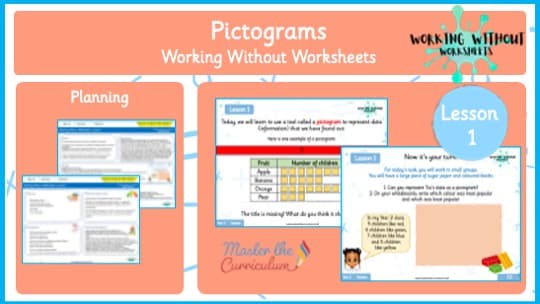
L1 Pictograms

masterthecurriculum.co.uk
4.650 reviews
Included with membership
Editable worksheetsWord and PowerPoint, so you can change anythingWhite Rose supportingFollows the small steps you already plan fromDownloadable lesson plansPlanning, slides and worksheets for every stepReasoning and problem solvingBuilt into every step, not sold separately

A free resource every Friday

One email a week, for the year group you actually teach. Unsubscribe in a click.

Year group you teach