“Good value, and the answers are actually on it.”
Small thing, but half the free sheets online expect you to work the answers out yourself. My TA can run a group on this without a briefing first.
5 teachers found this helpful
Proposed versionTrusted by primary teachers across the UK · New resources every week
Fractions
Y3
Preview only. The download is a fully editable file.
1 page shown before you download
1CoverThe rest of the pack
Planning, teaching slides and all three worksheet levels come with the download.
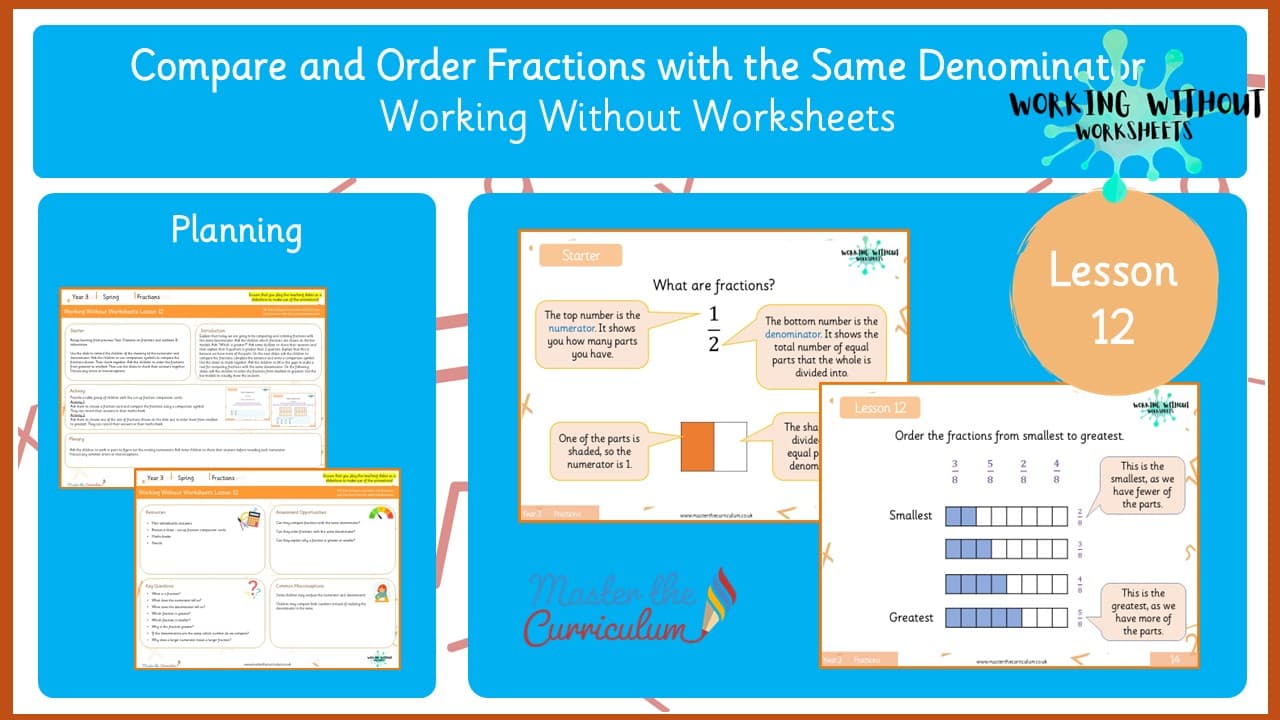
A Year 3 fractions lesson on ordering and comparing unit fractions using visual models, reasoning activities and mathematical discussion aligned to the UK maths curriculum.
Included with membership
Unlock with membershipAlready a member? Sign in and it downloads from this page.
Keep it for later and group it with the rest of the block. No account needed to start.
Introduce Year 3 pupils to ordering and comparing unit fractions through this engaging and practical maths lesson designed for the Spring Fractions unit. Using visual representations, reasoning activities and hands-on comparisons, children develop a strong understanding of how unit fractions relate to the whole and to each other. The lesson begins with a recap of prior learning on unit fractions, including what a unit fraction is and how the numerator and denominator define its value. Pupils then explore how to compare unit fractions with different denominators and understand why the size of the denominator affects the size of the fraction. Through clear teaching examples and visual models such as fraction strips, bar models and number lines, pupils learn how to identify, compare and order unit fractions accurately. They are encouraged to recognise that the larger the denominator, the smaller the unit fraction, and to explain this using mathematical reasoning. Children take part in practical activities that involve comparing pairs of unit fractions, ordering sets of fractions from smallest to largest and completing missing number challenges. Reasoning tasks support pupils in explaining their thinking using correct mathematical vocabulary and visual evidence. The lesson also addresses common misconceptions, such as assuming that a larger denominator means a larger fraction, or misinterpreting the role of the numerator in unit fractions. Guided questioning helps pupils build confidence in justifying their answers and spotting patterns. Ideal for whole-class teaching, intervention groups and mastery-based maths lessons, this Year 3 fractions resource provides rich opportunities for fluency, reasoning and problem-solving. Fully aligned with the UK National Curriculum, the lesson supports pupils in confidently ordering and comparing unit fractions using visual and practical approaches.
Show lessThe standard small step pack, as her own modules ship it. We do not print page counts here, because her catalogue does not publish them and a guessed number is worse than none.
Her own system, with the star count repeated in every worksheet header so a child can be handed the right sheet without a word.
Fractions, Year 311 numbered lessons
“Good value, and the answers are actually on it.”
Small thing, but half the free sheets online expect you to work the answers out yourself. My TA can run a group on this without a briefing first.
5 teachers found this helpful
“Fine, though the font is small for my class.”
The maths is right and the sequence is sensible. Several of my children needed it enlarged to A3, which is easy enough but worth knowing before you print thirty.
4 teachers found this helpful
“Printed it at eight on a Sunday and taught it on the Monday.”
No editing, no reformatting, no hunting for the answers. The three levels are on separate pages, which sounds obvious until you have used the sites where they are not.
10 teachers found this helpful
Fractions
Y3
Fractions
Y3
Fractions
Y3
Fractions
Y3
Fractions
Y3
One email a week, for the year group you actually teach. Unsubscribe in a click.