
Working Without Worksheets
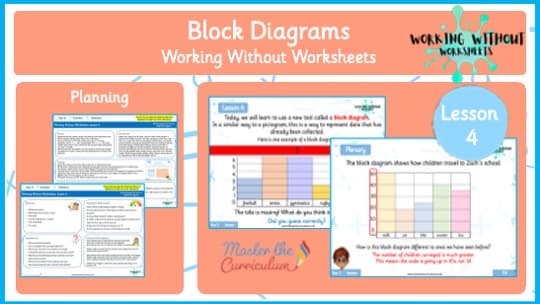
Y2L4 Block Diagrams
masterthecurriculum.co.uk
Proposed versionTrusted by primary teachers across the UK · New resources every week
Working Without Worksheets
Y2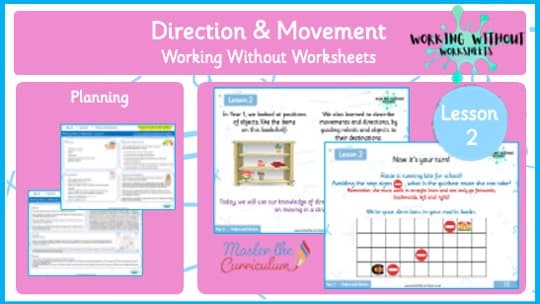
Preview only. The download is a fully editable file.
1 page shown before you download
1CoverThe rest of the pack
Planning, teaching slides and all three worksheet levels come with the download.
A Working Without Worksheets Year 2 Position and Direction lesson introducing perspective and two-step instructions through games, movement, and problem-solving. Includes full plan, slides, and active learning activities.
Included with membership
Unlock with membershipAlready a member? Sign in and it downloads from this page.
Keep it for later and group it with the rest of the block. No account needed to start.
This Working Without Worksheets Year 2 Position and Direction lesson builds on the movement and direction skills introduced in Year 1, helping pupils deepen their understanding of how to describe, follow, and record directions — including the concept of perspective . Through interactive games, physical movement, and problem-solving activities, children learn how to use precise mathematical vocabulary such as forwards , backwards , left , right , and turns , while thinking about direction from another person’s or object’s point of view. The starter begins with an animated game of Simon Says , revisiting key movement vocabulary from Year 1. Children follow verbal commands such as “turn left,” “step backwards,” and “move forwards,” reinforcing understanding of left and right through fun, active learning. During the introduction , the teacher explains that this lesson takes direction work further by introducing perspective — recognising that directions look different depending on which way you are facing. Using animated slides, the class observes a robot moving on screen. The teacher models how the robot’s forward movement appears different from our viewpoint, building awareness of orientation and direction in space. Children then practise this concept by physically moving themselves or programming a toy robot or car to follow two-step instructions , linking directional vocabulary to real movement. In the main activity , pupils are challenged with a practical and engaging task: help Rosie get to school while avoiding stop signs . Children must plan the shortest and most efficient route, giving step-by-step directions using correct vocabulary. They then record their route in their maths books, either by sticking in a printed version of the grid or referencing it on the board. This task encourages reasoning, spatial awareness, and the application of mathematical language in context. This Working Without Worksheets lesson combines movement, logic, and collaboration — devel
Show lessThe standard small step pack, as her own modules ship it. We do not print page counts here, because her catalogue does not publish them and a guessed number is worse than none.
Her own system, with the star count repeated in every worksheet header so a child can be handed the right sheet without a word.
Working Without Worksheets, Year 211 numbered lessons
Working Without Worksheets
Y2Working Without Worksheets
Y2
Working Without Worksheets
Y2
Working Without Worksheets
Y2
Working Without Worksheets
Y2
One email a week, for the year group you actually teach. Unsubscribe in a click.