Skip to content

Proposed version

Master the Curriculum

Geometry

EYFS

L20 – WWW – Recognise 3D Shapes

masterthecurriculum.co.uk

Preview only. The download is a fully editable file.

See inside

1 page shown before you download

Cover of L20 – WWW – Recognise 3D Shapes1Cover
Cover and first page

The rest of the pack

Planning, teaching slides and all three worksheet levels come with the download.

Early YearsGeometry

L20 – WWW – Recognise 3D Shapes

Reception Working Without Worksheets lesson on recognising 3-D shapes. Includes planning, feely bag starter, tower building, and model-making activity.

Included with membership

Unlock with membership

Already a member? Sign in and it downloads from this page.

Keep it for later and group it with the rest of the block. No account needed to start.

  • Fully editable Word or PowerPoint file
  • Differentiated three ways
  • Instant download, no watermark

About this resource

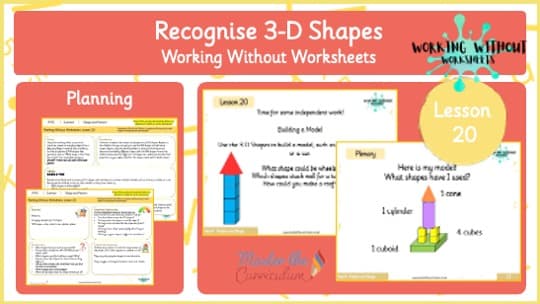
Working Without Worksheets – Reception Maths: Recognise 3-D Shapes Introduce Reception pupils to the world of 3-D shapes with this Working Without Worksheets lesson. Using feely bags, everyday objects, and practical construction activities, children learn to name, recognise, and describe the properties of common 3-D shapes such as cube, cuboid, cone, cylinder, and sphere . The lesson begins with a starter activity : Place an object in a feely bag and ask: “What shape is this? How does it feel?” Use everyday objects to link to 3-D shapes (e.g. soup tin = cylinder, dice = cube, ball = sphere). Encourage children to describe how the shape feels—flat, curved, pointy, smooth. In the main input , children explore the properties of 3-D shapes by building with them: Demonstrate how cubes and cuboids stack easily because of their flat faces. Show that spheres roll rather than stack, and cones work best on top of towers. Explore cylinders, comparing stacking on curved vs. flat surfaces. Introduce key vocabulary: faces, edges, corners, flat, curved . For the independent activity , children design and build their own models using 3-D shapes: Encourage them to make rockets, houses, or cars with cubes, cuboids, cones, cylinders, and spheres. Prompt with questions: “Which shapes make good wheels? Which shape is best for the roof? Which shapes stack well for towers?” As they work, children explain their choices using shape vocabulary. The plenary consolidates learning: Display a model made from 3-D shapes and ask: “What shapes have I used?” Work through each shape, identifying its properties, e.g. “This is a cuboid – it has rectangular faces.” Reinforce the importance of recognising 3-D shapes in real-life contexts. What’s Included in the Pack? ✔ Full teacher planning with objectives, vocabulary, key questions, and assessment notes ✔ Starter: feely bag and real-life objects to explore 3-D shapes ✔ Teacher modelling: build towers to explore which shapes stack and which roll ✔ VocabuRead more

Working Without Worksheets – Reception Maths: Recognise 3-D Shapes Introduce Reception pupils to the world of 3-D shapes with this Working Without Worksheets lesson. Using feely bags, everyday objects, and practical construction activities, children learn to name, recognise, and describe the properties of common 3-D shapes such as cube, cuboid, cone, cylinder, and sphere . The lesson begins with a starter activity : Place an object in a feely bag and ask: “What shape is this? How does it feel?” Use everyday objects to link to 3-D shapes (e.g. soup tin = cylinder, dice = cube, ball = sphere). Encourage children to describe how the shape feels—flat, curved, pointy, smooth. In the main input , children explore the properties of 3-D shapes by building with them: Demonstrate how cubes and cuboids stack easily because of their flat faces. Show that spheres roll rather than stack, and cones work best on top of towers. Explore cylinders, comparing stacking on curved vs. flat surfaces. Introduce key vocabulary: faces, edges, corners, flat, curved . For the independent activity , children design and build their own models using 3-D shapes: Encourage them to make rockets, houses, or cars with cubes, cuboids, cones, cylinders, and spheres. Prompt with questions: “Which shapes make good wheels? Which shape is best for the roof? Which shapes stack well for towers?” As they work, children explain their choices using shape vocabulary. The plenary consolidates learning: Display a model made from 3-D shapes and ask: “What shapes have I used?” Work through each shape, identifying its properties, e.g. “This is a cuboid – it has rectangular faces.” Reinforce the importance of recognising 3-D shapes in real-life contexts. What’s Included in the Pack? ✔ Full teacher planning with objectives, vocabulary, key questions, and assessment notes ✔ Starter: feely bag and real-life objects to explore 3-D shapes ✔ Teacher modelling: build towers to explore which shapes stack and which roll ✔ Vocabu

Show less

What you get, 6 files

  • PDFPlanning
  • PPTXPlanning, editable
  • PDFTeaching slides
  • PPTXTeaching slides, editable
  • PDFWorksheets, all three levels
  • PPTXWorksheets, editable

The standard small step pack, as her own modules ship it. We do not print page counts here, because her catalogue does not publish them and a guessed number is worse than none.

★★★ Differentiated three ways
  • Working towardsScaffolded, with the model or the bar already drawn.
  • Working withinThe expected standard for the year group.
  • Greater depthReasoning and explaining, not just more of the same.

Her own system, with the star count repeated in every worksheet header so a child can be handed the right sheet without a word.

The rest of this block

Geometry, Early Years9 numbered lessons

  1. Lesson 3Just like me Week 3 Lesson 3: Repeated Patterns with Shapes
  2. Lesson 4To 20 and Beyond: Week 3: Lesson 4 – Replicate my Shape
  3. Lesson 20 · you are here– WWW – Recognise 3D Shapes
  4. Lesson 21– WWW – Recognise 2-D Shapes
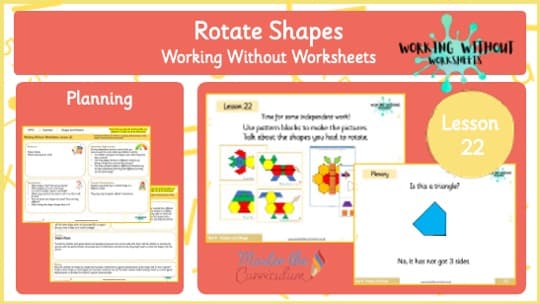
  5. Lesson 22– WWW – Rotate Shapes

More geometry for Early Years

Geometry

EYFS

L24 – WWW – Decompose Shapes

masterthecurriculum.co.uk
4.216 reviews
Included with membership

Geometry

EYFS

L22 – WWW – Rotate Shapes

masterthecurriculum.co.uk
4.921 reviews
Included with membership
Editable worksheetsWord and PowerPoint, so you can change anythingWhite Rose supportingFollows the small steps you already plan fromDownloadable lesson plansPlanning, slides and worksheets for every stepReasoning and problem solvingBuilt into every step, not sold separately

A free resource every Friday

One email a week, for the year group you actually teach. Unsubscribe in a click.

Year group you teach