
Working Without Worksheets
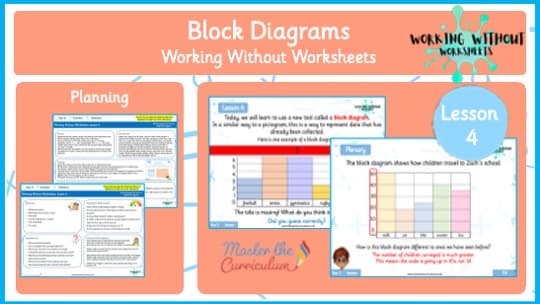
Y2L4 Block Diagrams
masterthecurriculum.co.uk
Proposed versionTrusted by primary teachers across the UK · New resources every week
Working Without Worksheets
Y2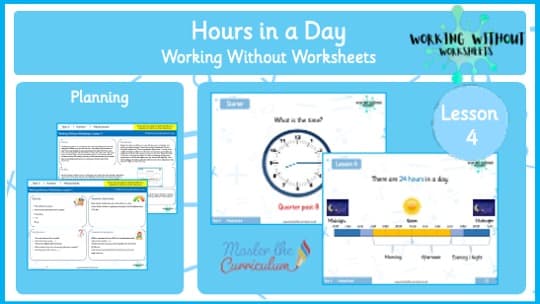
Preview only. The download is a fully editable file.
1 page shown before you download
1CoverThe rest of the pack
Planning, teaching slides and all three worksheet levels come with the download.
An engaging, practical lesson helping Year 2 pupils understand that there are 24 hours in a day , split into day and night. Through discussion, visual timetables, and real-life examples, children explore how time is divided into a.m. and p.m. and link hours to their daily routines — all without worksheets.
Included with membership
Unlock with membershipAlready a member? Sign in and it downloads from this page.
Keep it for later and group it with the rest of the block. No account needed to start.
This Year 2 Working Without Worksheets lesson introduces children to the concept of 24 hours in a day, deepening their understanding of how time is structured across morning, afternoon, evening, and night. Using visual aids, discussion, and real-world connections, children learn to describe time using a.m. and p.m., reinforcing key vocabulary from earlier lessons on telling the time. The lesson begins with a lively starter recap, revisiting quarter past and quarter to times before asking, “How many hours are there in a day?” Children share their ideas, thinking about how long they sleep, how long school lasts, and even how many hours a flight might take. This encourages reasoning and real-world understanding of time duration. In the main teaching input, pupils learn that a full day has 24 hours, beginning and ending at midnight. The teacher explains how the day is divided: 12 hours of daytime (morning and afternoon) 12 hours of nighttime (evening and overnight) Children explore the terms ‘noon’ (12 o’clock in the middle of the day), ‘a.m.’ (before noon), and ‘p.m.’ (after noon). Using the teaching slides, they identify what activities happen during these times — such as waking up, going to school, having lunch, and going to bed — to make strong real-life links. The main activity is creative and collaborative: pupils work in pairs or small groups to design a daily timetable showing what they do at different times of the day. They draw pictures, label their activities, and indicate whether they happen in the morning, afternoon, or evening. Each timetable is glued into maths books as a record of learning. In the plenary, children share their timetables with the class, describing what they do and when, using time language in context. Teachers guide discussion with questions like: “How many hours do you sleep for?” “What time do you eat breakfast?” “How many activities can we fit into one day?” This lesson strengthens pupils’ awareness of time as a cycle, building the fo
Show lessThe standard small step pack, as her own modules ship it. We do not print page counts here, because her catalogue does not publish them and a guessed number is worse than none.
Her own system, with the star count repeated in every worksheet header so a child can be handed the right sheet without a word.
Working Without Worksheets, Year 211 numbered lessons
Working Without Worksheets
Y2Working Without Worksheets
Y2
Working Without Worksheets
Y2
Working Without Worksheets
Y2
Working Without Worksheets
Y2
One email a week, for the year group you actually teach. Unsubscribe in a click.