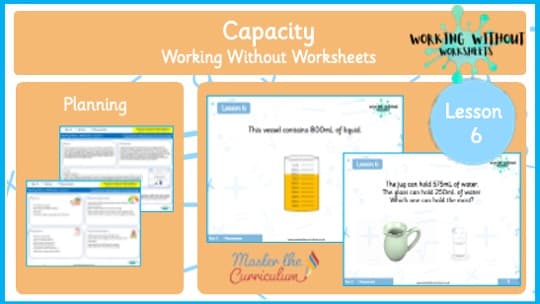
Year 2 Spring Term Measurement – Lesson 6: Capacity Lesson Overview: In this Working Without Worksheets lesson, Year 2 pupils are introduced to capacity and volume as measures of how much liquid a container can hold. The lesson begins with a discussion of what capacity means and examples from everyday life (cups, bottles, buckets). Children explore key vocabulary such as full, empty, half-full, nearly full, and nearly empty before moving on to practical investigations. Using measuring jugs and different containers, pupils estimate, measure, and compare capacities in litres (l) and millilitres (ml). This hands-on lesson helps children build secure understanding of capacity through real-life contexts and active exploration. What’s Included in the Pack? ✔ Full lesson plan with clear objectives, teaching notes, and plenary guidance ✔ Animated teaching slides introducing capacity and measurement in litres and millilitres ✔ Starter: Discuss what capacity means, with real-life examples of containers ✔ Teaching input: Demonstrate full, empty, half-full, nearly full/empty, and introduce litres (l) and millilitres (ml) ✔ Main activity: – Estimate and measure capacity using measuring jugs and water – Compare and order different containers by capacity – Record findings and discuss which holds the most/least ✔ Plenary: Practical discussion – which container is most suitable for different purposes (e.g., filling a paddling pool, holding a drink)? ✔ Guidance on misconceptions: confusing size with capacity, not reading scales correctly ✔ Hands-on, interactive, and worksheet-free Why Teachers Love This Resource ✔ Introduces capacity in a meaningful, real-world context ✔ Combines estimation, prediction, and accurate measurement ✔ Fun, practical activities with water keep pupils engaged ✔ Builds mathematical vocabulary: full, empty, half-full, litres, millilitres ✔ Fully aligned with Year 2 National Curriculum objectives and Working Without Worksheets pedagogy Curriculum Links (Year 2Read more
Year 2 Spring Term Measurement – Lesson 6: Capacity Lesson Overview: In this Working Without Worksheets lesson, Year 2 pupils are introduced to capacity and volume as measures of how much liquid a container can hold. The lesson begins with a discussion of what capacity means and examples from everyday life (cups, bottles, buckets). Children explore key vocabulary such as full, empty, half-full, nearly full, and nearly empty before moving on to practical investigations. Using measuring jugs and different containers, pupils estimate, measure, and compare capacities in litres (l) and millilitres (ml). This hands-on lesson helps children build secure understanding of capacity through real-life contexts and active exploration. What’s Included in the Pack? ✔ Full lesson plan with clear objectives, teaching notes, and plenary guidance ✔ Animated teaching slides introducing capacity and measurement in litres and millilitres ✔ Starter: Discuss what capacity means, with real-life examples of containers ✔ Teaching input: Demonstrate full, empty, half-full, nearly full/empty, and introduce litres (l) and millilitres (ml) ✔ Main activity: – Estimate and measure capacity using measuring jugs and water – Compare and order different containers by capacity – Record findings and discuss which holds the most/least ✔ Plenary: Practical discussion – which container is most suitable for different purposes (e.g., filling a paddling pool, holding a drink)? ✔ Guidance on misconceptions: confusing size with capacity, not reading scales correctly ✔ Hands-on, interactive, and worksheet-free Why Teachers Love This Resource ✔ Introduces capacity in a meaningful, real-world context ✔ Combines estimation, prediction, and accurate measurement ✔ Fun, practical activities with water keep pupils engaged ✔ Builds mathematical vocabulary: full, empty, half-full, litres, millilitres ✔ Fully aligned with Year 2 National Curriculum objectives and Working Without Worksheets pedagogy Curriculum Links (Year 2
Show less