Skip to content

Proposed version

Master the Curriculum

Working Without Worksheets

Y3

L6 Solve Real-World Division Problems

masterthecurriculum.co.uk

Preview only. The download is a fully editable file.

See inside

1 page shown before you download

Cover of L6 Solve Real-World Division Problems1Cover
Cover and first page

The rest of the pack

Planning, teaching slides and all three worksheet levels come with the download.

Year 3Working Without Worksheets

L6 Solve Real-World Division Problems

A Year 3 maths lesson on solving division word problems, including one-step and two-step problems with reasoning and practical support.

Included with membership

Unlock with membership

Already a member? Sign in and it downloads from this page.

Keep it for later and group it with the rest of the block. No account needed to start.

  • Fully editable Word or PowerPoint file
  • Differentiated three ways
  • Instant download, no watermark

About this resource

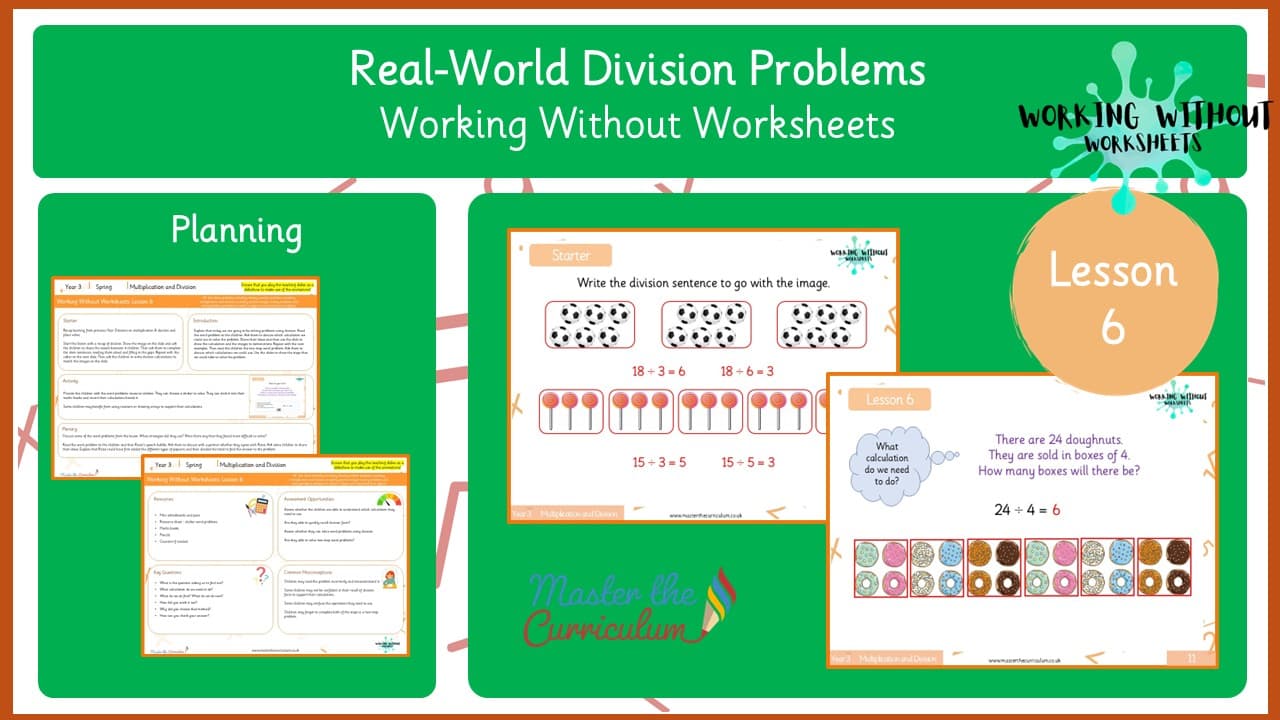
This engaging Year 3 maths lesson focuses on solving division word problems, helping pupils apply their understanding of sharing and grouping in real-life contexts. Part of the Spring term Multiplication and Division unit, this resource follows a “working without worksheets” approach, encouraging active learning, discussion, and mathematical reasoning. The lesson begins with a recap of prior learning, including division and place value. Pupils revisit the concept of sharing into equal groups using visual representations, such as sweets and cakes, and complete stem sentences to strengthen their mathematical language and understanding. They are then encouraged to write division calculations to match pictorial representations, reinforcing the link between concrete, pictorial, and abstract methods. Through clear modelling and guided teaching, children are introduced to a range of one-step and two-step division word problems. They are supported in identifying what each question is asking, choosing the correct calculation, and breaking problems down into manageable steps. Visual aids and structured examples help pupils to develop confidence and accuracy. During independent practice, pupils solve division word problems using resource stickers, recording their methods and answers in their maths books. Concrete resources such as counters or arrays can be used to support understanding and scaffold learning where needed. The plenary encourages discussion and deeper thinking, including evaluating different methods and reasoning about solutions. Pupils are given opportunities to explain their thinking and consider alternative approaches, helping to strengthen problem-solving and reasoning skills. The resource also highlights common misconceptions, such as misunderstanding the context of a problem, confusion between operations, or missing steps in two-step problems. Fully aligned with the Year 3 National Curriculum, this lesson supports pupils in developing fluency, reasoning, anRead more

This engaging Year 3 maths lesson focuses on solving division word problems, helping pupils apply their understanding of sharing and grouping in real-life contexts. Part of the Spring term Multiplication and Division unit, this resource follows a “working without worksheets” approach, encouraging active learning, discussion, and mathematical reasoning. The lesson begins with a recap of prior learning, including division and place value. Pupils revisit the concept of sharing into equal groups using visual representations, such as sweets and cakes, and complete stem sentences to strengthen their mathematical language and understanding. They are then encouraged to write division calculations to match pictorial representations, reinforcing the link between concrete, pictorial, and abstract methods. Through clear modelling and guided teaching, children are introduced to a range of one-step and two-step division word problems. They are supported in identifying what each question is asking, choosing the correct calculation, and breaking problems down into manageable steps. Visual aids and structured examples help pupils to develop confidence and accuracy. During independent practice, pupils solve division word problems using resource stickers, recording their methods and answers in their maths books. Concrete resources such as counters or arrays can be used to support understanding and scaffold learning where needed. The plenary encourages discussion and deeper thinking, including evaluating different methods and reasoning about solutions. Pupils are given opportunities to explain their thinking and consider alternative approaches, helping to strengthen problem-solving and reasoning skills. The resource also highlights common misconceptions, such as misunderstanding the context of a problem, confusion between operations, or missing steps in two-step problems. Fully aligned with the Year 3 National Curriculum, this lesson supports pupils in developing fluency, reasoning, an

Show less

What you get, 6 files

  • PDFPlanning
  • PPTXPlanning, editable
  • PDFTeaching slides
  • PPTXTeaching slides, editable
  • PDFWorksheets, all three levels
  • PPTXWorksheets, editable

The standard small step pack, as her own modules ship it. We do not print page counts here, because her catalogue does not publish them and a guessed number is worse than none.

★★★ Differentiated three ways
  • Working towardsScaffolded, with the model or the bar already drawn.
  • Working withinThe expected standard for the year group.
  • Greater depthReasoning and explaining, not just more of the same.

Her own system, with the star count repeated in every worksheet header so a child can be handed the right sheet without a word.

The rest of this block

Working Without Worksheets, Year 310 numbered lessons

  1. Lesson 4Count in Multiples of 100
  2. Lesson 5Solve Real-World Multiplication Problems
  3. Lesson 6 · you are hereSolve Real-World Division Problems
  4. Lesson 7Understand and Solve Scaling Problems
  5. Lesson 8Understand and Solve Correspondence Problems

More working without worksheets for Year 3

Working Without Worksheets

Y3

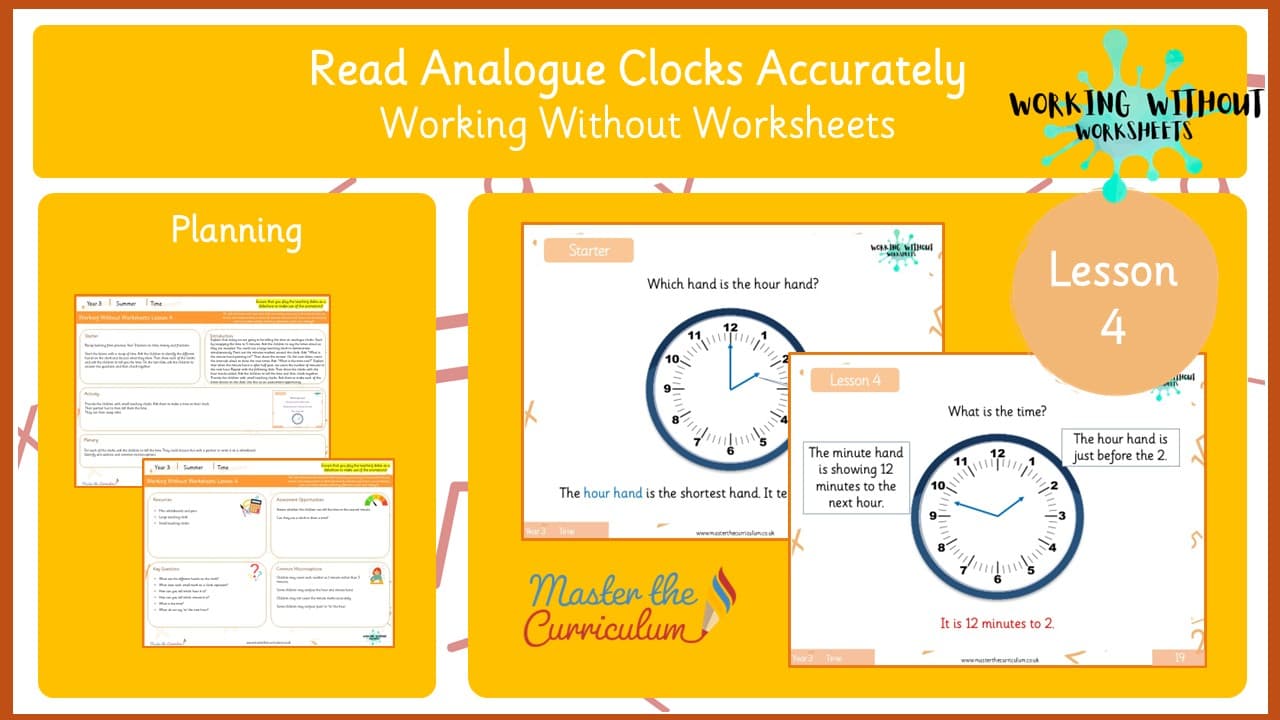
L4 Read Analogue Clocks Accurately

masterthecurriculum.co.uk
4.47 reviews
Included with membership
Editable worksheetsWord and PowerPoint, so you can change anythingWhite Rose supportingFollows the small steps you already plan fromDownloadable lesson plansPlanning, slides and worksheets for every stepReasoning and problem solvingBuilt into every step, not sold separately

A free resource every Friday

One email a week, for the year group you actually teach. Unsubscribe in a click.

Year group you teach