Skip to content

Proposed version

Master the Curriculum

Working Without Worksheets

Y3

L7 Understand and Solve Scaling Problems

masterthecurriculum.co.uk

Preview only. The download is a fully editable file.

See inside

1 page shown before you download

Cover of L7 Understand and Solve Scaling Problems1Cover
Cover and first page

The rest of the pack

Planning, teaching slides and all three worksheet levels come with the download.

Year 3Working Without Worksheets

L7 Understand and Solve Scaling Problems

4.829 reviews

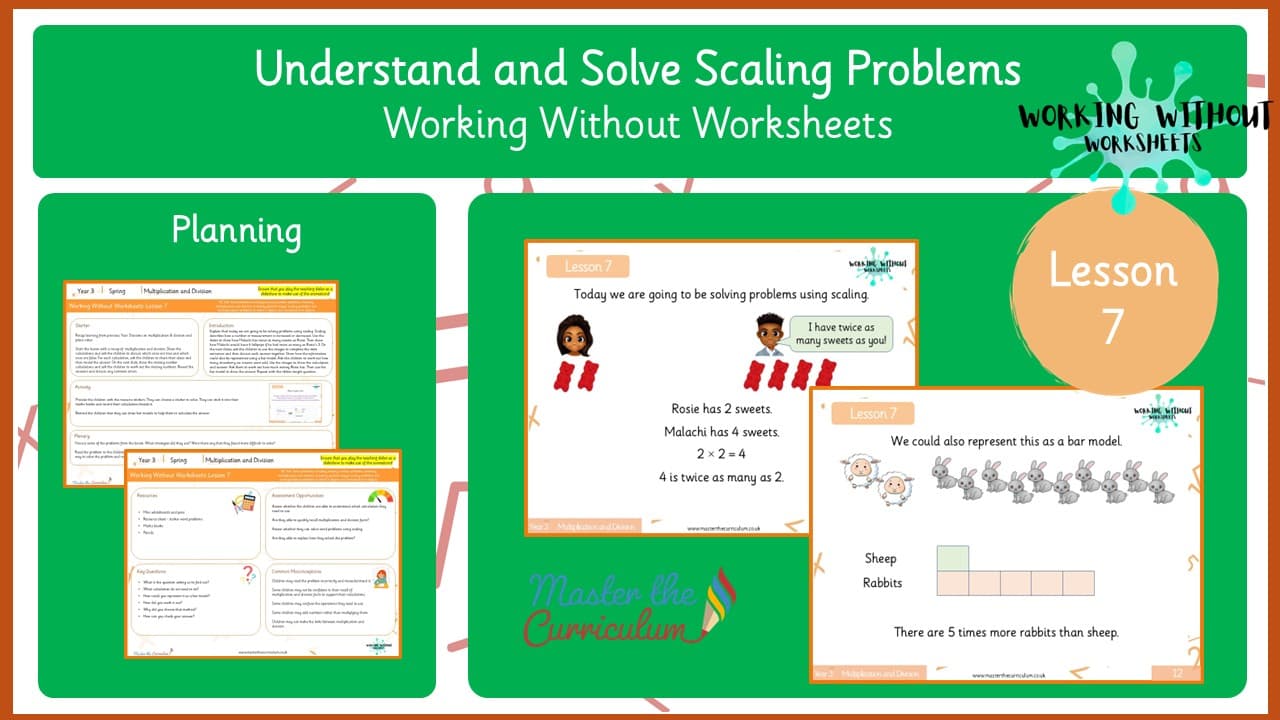
A Year 3 maths lesson on solving scaling problems using multiplication and division, featuring bar models, reasoning, and practical activities.

Included with membership

Unlock with membership

Already a member? Sign in and it downloads from this page.

Keep it for later and group it with the rest of the block. No account needed to start.

  • Fully editable Word or PowerPoint file
  • Differentiated three ways
  • Instant download, no watermark

About this resource

This engaging Year 3 maths lesson focuses on solving scaling problems, helping pupils understand how quantities increase or decrease using multiplication and division. As part of the Spring term Multiplication and Division unit, this resource follows a “working without worksheets” approach, promoting active learning, discussion, and visual reasoning. The lesson begins with a recap of key prior learning, including multiplication, division, and place value. Pupils explore true and false calculations and solve missing number problems, encouraging them to think critically and identify common errors. The main teaching introduces the concept of scaling, showing how amounts can be doubled, halved, or adjusted proportionally. Pupils explore practical examples, such as comparing quantities (e.g. “twice as many”), and use visual representations including images and bar models to support their understanding. Step-by-step modelling helps children interpret scaling problems and choose appropriate calculations. Through guided practice, pupils complete stem sentences, interpret bar models, and solve real-life problems involving scaling, such as quantities of items, money, and measurement contexts. This supports the development of both conceptual understanding and procedural fluency. During independent work, pupils solve scaling problems using resource stickers, recording their calculations and methods in their maths books. They are encouraged to draw bar models to represent problems visually and support their reasoning. The plenary provides opportunities for discussion, collaboration, and reflection, with pupils explaining their methods and comparing different strategies. Key questions are embedded throughout to promote mathematical reasoning and deepen understanding. Aligned with the Year 3 National Curriculum, this lesson supports pupils in solving multiplication and division problems, including scaling contexts. It is ideal for Key Stage 2 classrooms, maths mastery lessons, or Read more

This engaging Year 3 maths lesson focuses on solving scaling problems, helping pupils understand how quantities increase or decrease using multiplication and division. As part of the Spring term Multiplication and Division unit, this resource follows a “working without worksheets” approach, promoting active learning, discussion, and visual reasoning. The lesson begins with a recap of key prior learning, including multiplication, division, and place value. Pupils explore true and false calculations and solve missing number problems, encouraging them to think critically and identify common errors. The main teaching introduces the concept of scaling, showing how amounts can be doubled, halved, or adjusted proportionally. Pupils explore practical examples, such as comparing quantities (e.g. “twice as many”), and use visual representations including images and bar models to support their understanding. Step-by-step modelling helps children interpret scaling problems and choose appropriate calculations. Through guided practice, pupils complete stem sentences, interpret bar models, and solve real-life problems involving scaling, such as quantities of items, money, and measurement contexts. This supports the development of both conceptual understanding and procedural fluency. During independent work, pupils solve scaling problems using resource stickers, recording their calculations and methods in their maths books. They are encouraged to draw bar models to represent problems visually and support their reasoning. The plenary provides opportunities for discussion, collaboration, and reflection, with pupils explaining their methods and comparing different strategies. Key questions are embedded throughout to promote mathematical reasoning and deepen understanding. Aligned with the Year 3 National Curriculum, this lesson supports pupils in solving multiplication and division problems, including scaling contexts. It is ideal for Key Stage 2 classrooms, maths mastery lessons, or

Show less

What you get, 6 files

  • PDFPlanning
  • PPTXPlanning, editable
  • PDFTeaching slides
  • PPTXTeaching slides, editable
  • PDFWorksheets, all three levels
  • PPTXWorksheets, editable

The standard small step pack, as her own modules ship it. We do not print page counts here, because her catalogue does not publish them and a guessed number is worse than none.

★★★ Differentiated three ways
  • Working towardsScaffolded, with the model or the bar already drawn.
  • Working withinThe expected standard for the year group.
  • Greater depthReasoning and explaining, not just more of the same.

Her own system, with the star count repeated in every worksheet header so a child can be handed the right sheet without a word.

The rest of this block

Working Without Worksheets, Year 310 numbered lessons

  1. Lesson 5Solve Real-World Multiplication Problems
  2. Lesson 6Solve Real-World Division Problems
  3. Lesson 7 · you are hereUnderstand and Solve Scaling Problems
  4. Lesson 8Understand and Solve Correspondence Problems
  5. Lesson 93-Digit Column Subtraction, no exchanges

What teachers said after they used it

All reviews →
4.829 verified reviewsWe ask once, seven days after the download, and one tap is enough.
Steven LoughYear 2 teacher, Abbeyfields First School, MorpethVerified download, 23 January 2026

Good value, and the answers are actually on it.

Small thing, but half the free sheets online expect you to work the answers out yourself. My TA can run a group on this without a briefing first.

5 teachers found this helpful
Beth NightingaleYear 1 teacher, Poplar Farm School, GranthamVerified download, 13 January 2026

Fine, though the font is small for my class.

The maths is right and the sequence is sensible. Several of my children needed it enlarged to A3, which is easy enough but worth knowing before you print thirty.

4 teachers found this helpful

Joanne PicklesYear 3 teacher, Crossflatts Primary, BingleyVerified download, 5 March 2026

Printed it at eight on a Sunday and taught it on the Monday.

No editing, no reformatting, no hunting for the answers. The three levels are on separate pages, which sounds obvious until you have used the sites where they are not.

10 teachers found this helpful

More working without worksheets for Year 3

Working Without Worksheets

Y3

L4 Read Analogue Clocks Accurately

masterthecurriculum.co.uk
4.47 reviews
Included with membership
Editable worksheetsWord and PowerPoint, so you can change anythingWhite Rose supportingFollows the small steps you already plan fromDownloadable lesson plansPlanning, slides and worksheets for every stepReasoning and problem solvingBuilt into every step, not sold separately

A free resource every Friday

One email a week, for the year group you actually teach. Unsubscribe in a click.

Year group you teach