Skip to content

Proposed version

Master the Curriculum

Working Without Worksheets

Y3

L2 Use Inverse Operations to Check Answers

masterthecurriculum.co.uk

Preview only. The download is a fully editable file.

See inside

1 page shown before you download

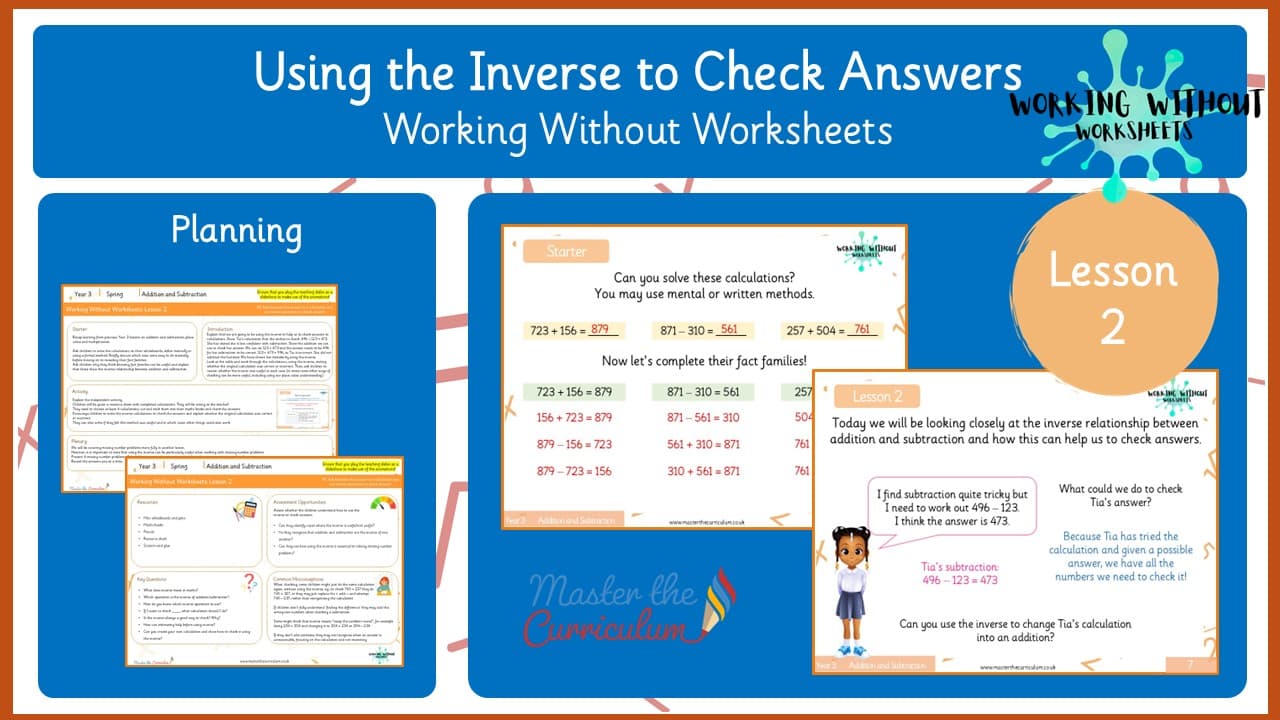
Cover of L2 Use Inverse Operations to Check Answers1Cover
Cover and first page

The rest of the pack

Planning, teaching slides and all three worksheet levels come with the download.

Year 3Working Without Worksheets

L2 Use Inverse Operations to Check Answers

4.825 reviews

A Year 3 maths lesson on inverse operations that teaches pupils how to use addition and subtraction to check calculations. Includes fact family revision, reasoning tasks, a “teacher for the day” checking activity, and an introduction to missing number problems.

Included with membership

Unlock with membership

Already a member? Sign in and it downloads from this page.

Keep it for later and group it with the rest of the block. No account needed to start.

  • Fully editable Word or PowerPoint file
  • Differentiated three ways
  • Instant download, no watermark

About this resource

This Year 3 maths lesson on inverse operations helps pupils understand how addition and subtraction are connected and how the inverse can be used to check the accuracy of calculations . Through discussion, reasoning activities and a teacher-style checking task, children develop a deeper understanding of number relationships and mathematical reasoning. The lesson begins with a starter activity revising previous Year 3 learning on addition, subtraction, place value and multiplication . Pupils solve several calculations on whiteboards using either mental strategies or formal written methods. The answers are then linked to fact families , helping children recognise the inverse relationship between addition and subtraction. Pupils discuss why knowing fact families can make checking calculations quicker and more reliable. During the main teaching input , pupils learn how to use the inverse to check answers. They examine a worked example where a pupil checks the subtraction calculation 496 – 123 = 473 . By performing the inverse addition 123 + 473 , children discover that the total should equal the original number (496) if the subtraction is correct. As the result is 596 , they identify the mistake and discuss how the inverse operation helped reveal the error. Children then work through a table of calculations together, using inverse operations to decide whether answers are correct or incorrect . They are encouraged to reason about whether using the inverse is the most useful checking strategy in each case, or whether other approaches, such as place value understanding or estimation , might be more efficient. In the independent activity , pupils take on the role of the teacher. They are given a sheet of completed calculations and must select at least four to check. Children cut and stick the problems into their maths books, write the inverse calculations to test the answers, and explain whether the original calculation is correct. They are also encouraged to reflect on wheRead more

This Year 3 maths lesson on inverse operations helps pupils understand how addition and subtraction are connected and how the inverse can be used to check the accuracy of calculations . Through discussion, reasoning activities and a teacher-style checking task, children develop a deeper understanding of number relationships and mathematical reasoning. The lesson begins with a starter activity revising previous Year 3 learning on addition, subtraction, place value and multiplication . Pupils solve several calculations on whiteboards using either mental strategies or formal written methods. The answers are then linked to fact families , helping children recognise the inverse relationship between addition and subtraction. Pupils discuss why knowing fact families can make checking calculations quicker and more reliable. During the main teaching input , pupils learn how to use the inverse to check answers. They examine a worked example where a pupil checks the subtraction calculation 496 – 123 = 473 . By performing the inverse addition 123 + 473 , children discover that the total should equal the original number (496) if the subtraction is correct. As the result is 596 , they identify the mistake and discuss how the inverse operation helped reveal the error. Children then work through a table of calculations together, using inverse operations to decide whether answers are correct or incorrect . They are encouraged to reason about whether using the inverse is the most useful checking strategy in each case, or whether other approaches, such as place value understanding or estimation , might be more efficient. In the independent activity , pupils take on the role of the teacher. They are given a sheet of completed calculations and must select at least four to check. Children cut and stick the problems into their maths books, write the inverse calculations to test the answers, and explain whether the original calculation is correct. They are also encouraged to reflect on whe

Show less

What you get, 6 files

  • PDFPlanning
  • PPTXPlanning, editable
  • PDFTeaching slides
  • PPTXTeaching slides, editable
  • PDFWorksheets, all three levels
  • PPTXWorksheets, editable

The standard small step pack, as her own modules ship it. We do not print page counts here, because her catalogue does not publish them and a guessed number is worse than none.

★★★ Differentiated three ways
  • Working towardsScaffolded, with the model or the bar already drawn.
  • Working withinThe expected standard for the year group.
  • Greater depthReasoning and explaining, not just more of the same.

Her own system, with the star count repeated in every worksheet header so a child can be handed the right sheet without a word.

The rest of this block

Working Without Worksheets, Year 310 numbered lessons

  1. Lesson 1Estimate Answers to Calculations Using Rounding to the Nearest 10 or 100
  2. Lesson 2 · you are hereUse Inverse Operations to Check Answers
  3. Lesson 3Use Known Number Facts to Solve Problems
  4. Lesson 4Count in Multiples of 100
  5. Lesson 5Find 10 More

What teachers said after they used it

All reviews →
4.825 verified reviewsWe ask once, seven days after the download, and one tap is enough.
Aisha KarimSENCO, Newlands Primary Academy, LutonVerified download, 2 February 2026

The editable file is why we renewed.

Being able to change two questions for the child who joined us in January, without rebuilding the whole sheet, is worth the subscription on its own.

12 teachers found this helpful
Steven LoughYear 2 teacher, Abbeyfields First School, MorpethVerified download, 23 January 2026

Good value, and the answers are actually on it.

Small thing, but half the free sheets online expect you to work the answers out yourself. My TA can run a group on this without a briefing first.

5 teachers found this helpful

Beth NightingaleYear 1 teacher, Poplar Farm School, GranthamVerified download, 13 January 2026

Fine, though the font is small for my class.

The maths is right and the sequence is sensible. Several of my children needed it enlarged to A3, which is easy enough but worth knowing before you print thirty.

4 teachers found this helpful

More working without worksheets for Year 3

Working Without Worksheets

Y3

L4 Read Analogue Clocks Accurately

masterthecurriculum.co.uk
4.47 reviews
Included with membership
Editable worksheetsWord and PowerPoint, so you can change anythingWhite Rose supportingFollows the small steps you already plan fromDownloadable lesson plansPlanning, slides and worksheets for every stepReasoning and problem solvingBuilt into every step, not sold separately

A free resource every Friday

One email a week, for the year group you actually teach. Unsubscribe in a click.

Year group you teach