
Working Without Worksheets
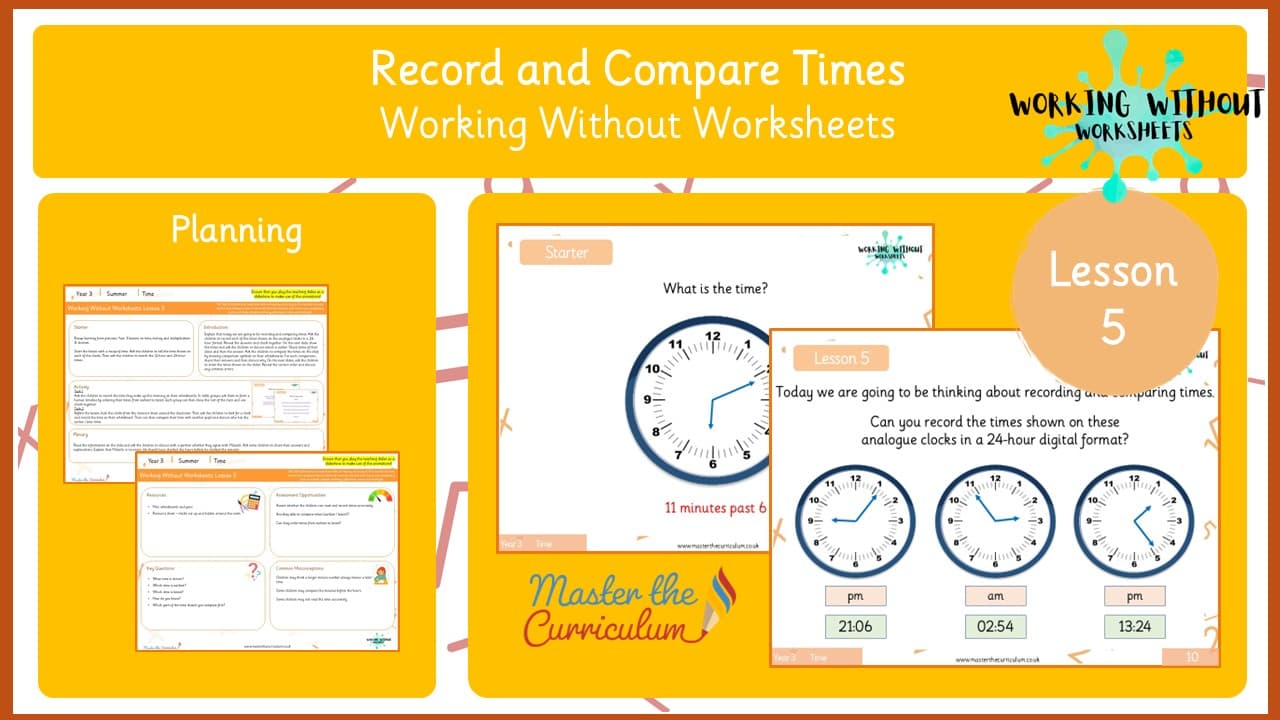
Y3L5 Record and Compare Times
masterthecurriculum.co.uk
Proposed versionTrusted by primary teachers across the UK · New resources every week
Working Without Worksheets
Y3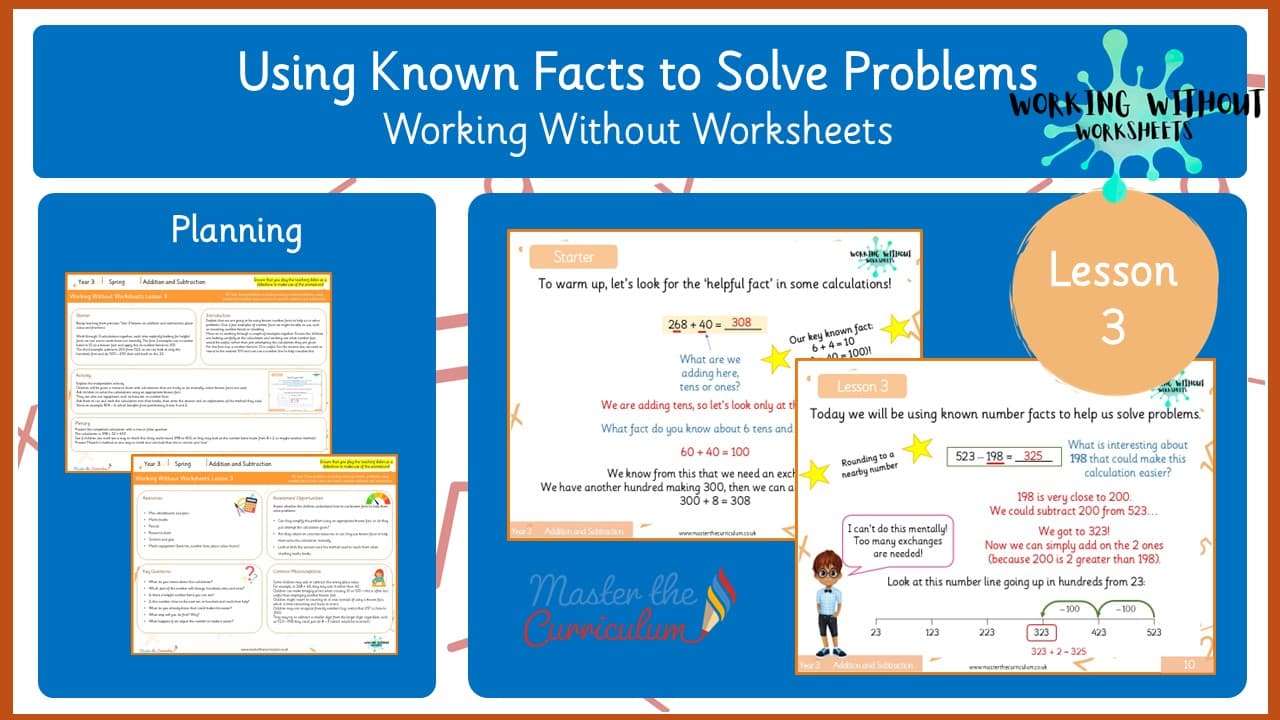
Preview only. The download is a fully editable file.
1 page shown before you download
1CoverThe rest of the pack
Planning, teaching slides and all three worksheet levels come with the download.
A Year 3 maths lesson on using known number facts to solve calculations . Pupils apply strategies such as number bonds, rounding and partitioning to make tricky addition and subtraction problems easier to solve mentally.
Included with membership
Unlock with membershipAlready a member? Sign in and it downloads from this page.
Keep it for later and group it with the rest of the block. No account needed to start.
This Year 3 maths lesson on using known number facts to solve calculations helps pupils develop efficient mental maths strategies. Children learn how to recognise helpful number relationships such as number bonds, rounding, doubling and partitioning in order to simplify calculations that might otherwise seem difficult. The lesson begins with a starter activity revisiting key Year 3 concepts , including addition, subtraction, place value and fractions. Pupils work through three calculations together and discuss which known facts can help them solve them mentally. The first examples use number bonds to 10 and extend these to number bonds to 100 , helping pupils see how familiar facts can be applied to larger numbers. The final example focuses on subtracting 200 from 523, demonstrating how children can look first at the hundreds (500 − 200) before adding the remaining 23. During the main teaching input , pupils are introduced to the idea of using known number facts as problem-solving strategies . The teacher models how to look carefully at each calculation and identify the most helpful approach before solving it. Examples include using number bonds to simplify addition and rounding numbers to the nearest 100 to make mental calculations easier. A number line can be used to help visualise how rounding supports efficient problem solving. In the independent activity , pupils apply their understanding by solving a set of calculations that are difficult to complete mentally without recognising helpful number facts. Children choose an appropriate strategy, such as number bonds, partitioning, rounding or doubling, and may use equipment like base ten blocks or number lines to support their thinking. Pupils then cut and stick the calculations into their maths books, record their answers and explain the strategy they used. For example, when solving 804 − 6 , pupils can partition 6 into 4 and 2 to make the subtraction easier. The plenary activity encourages reasoning and checking.
Show lessThe standard small step pack, as her own modules ship it. We do not print page counts here, because her catalogue does not publish them and a guessed number is worse than none.
Her own system, with the star count repeated in every worksheet header so a child can be handed the right sheet without a word.
Working Without Worksheets, Year 310 numbered lessons
Working Without Worksheets
Y3Working Without Worksheets
Y3
Working Without Worksheets
Y3
Working Without Worksheets
Y3
Working Without Worksheets
Y3
One email a week, for the year group you actually teach. Unsubscribe in a click.