Skip to content

Proposed version

Master the Curriculum

Working Without Worksheets

Y1

L5 Months of the Year

masterthecurriculum.co.uk

Preview only. The download is a fully editable file.

See inside

1 page shown before you download

Cover of L5 Months of the Year1Cover
Cover and first page

The rest of the pack

Planning, teaching slides and all three worksheet levels come with the download.

Year 1Working Without Worksheets

L5 Months of the Year

4.859 reviews

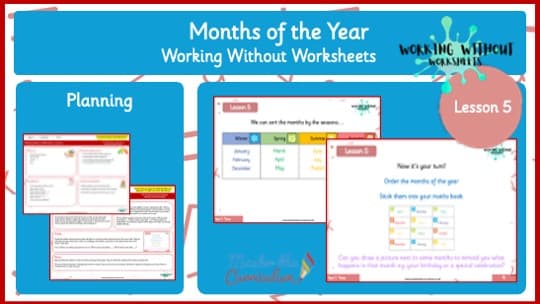
A Working Without Worksheets lesson where Year 1 pupils learn to name, order, and talk about the months of the year through songs, discussions, and hands-on sequencing. Includes plan, slides, and practical activities.

Included with membership

Unlock with membership

Already a member? Sign in and it downloads from this page.

Keep it for later and group it with the rest of the block. No account needed to start.

  • Fully editable Word or PowerPoint file
  • Differentiated three ways
  • Instant download, no watermark

About this resource

Help children learn to name, order and talk about the months of the year with this engaging Working Without Worksheets lesson. Designed for Year 1, this practical and discussion-led session uses songs, visuals and meaningful connections to help pupils understand the sequence of months and how they relate to seasons and key events in their lives. The lesson begins with a lively starter discussion to discover what children already know about the months. Pupils are encouraged to recall their birthday month, talk about special times of year, and think about what makes each month unique. Using the teaching slides, the class reads each month aloud in sequence, reinforcing pronunciation and order. As each month appears, teachers can highlight festivals, celebrations, and seasonal characteristics — helping to build context and understanding. During the main introduction , children link the months of the year to the four seasons , deepening their grasp of the yearly cycle. Using questions like “Which is the coldest season?” and “Which month comes before April?”, pupils practise sequencing vocabulary such as before , after , first , and last . This meaningful talk encourages reasoning and pattern recognition as they explore the natural and cultural rhythm of the year. In the activity , children cut, order, and stick the months of the year in the correct order into their maths books. To extend learning, they can draw or write about events that happen in specific months — such as birthdays, holidays, or celebrations — making learning personal and memorable. The lesson concludes with questioning and review to reinforce understanding of the order and seasonal grouping of months. Pupils develop their ability to use precise language about time and sequence, preparing them for future learning on calendars and time intervals. What’s Included in the Pack ✔ Full lesson plan with objectives, teaching guidance, and key questions ✔ Animated teaching slides for whole-class modelling ✔ StarRead more

Help children learn to name, order and talk about the months of the year with this engaging Working Without Worksheets lesson. Designed for Year 1, this practical and discussion-led session uses songs, visuals and meaningful connections to help pupils understand the sequence of months and how they relate to seasons and key events in their lives. The lesson begins with a lively starter discussion to discover what children already know about the months. Pupils are encouraged to recall their birthday month, talk about special times of year, and think about what makes each month unique. Using the teaching slides, the class reads each month aloud in sequence, reinforcing pronunciation and order. As each month appears, teachers can highlight festivals, celebrations, and seasonal characteristics — helping to build context and understanding. During the main introduction , children link the months of the year to the four seasons , deepening their grasp of the yearly cycle. Using questions like “Which is the coldest season?” and “Which month comes before April?”, pupils practise sequencing vocabulary such as before , after , first , and last . This meaningful talk encourages reasoning and pattern recognition as they explore the natural and cultural rhythm of the year. In the activity , children cut, order, and stick the months of the year in the correct order into their maths books. To extend learning, they can draw or write about events that happen in specific months — such as birthdays, holidays, or celebrations — making learning personal and memorable. The lesson concludes with questioning and review to reinforce understanding of the order and seasonal grouping of months. Pupils develop their ability to use precise language about time and sequence, preparing them for future learning on calendars and time intervals. What’s Included in the Pack ✔ Full lesson plan with objectives, teaching guidance, and key questions ✔ Animated teaching slides for whole-class modelling ✔ Star

Show less

What you get, 6 files

  • PDFPlanning
  • PPTXPlanning, editable
  • PDFTeaching slides
  • PPTXTeaching slides, editable
  • PDFWorksheets, all three levels
  • PPTXWorksheets, editable

The standard small step pack, as her own modules ship it. We do not print page counts here, because her catalogue does not publish them and a guessed number is worse than none.

★★★ Differentiated three ways
  • Working towardsScaffolded, with the model or the bar already drawn.
  • Working withinThe expected standard for the year group.
  • Greater depthReasoning and explaining, not just more of the same.

Her own system, with the star count repeated in every worksheet header so a child can be handed the right sheet without a word.

The rest of this block

Working Without Worksheets, Year 110 numbered lessons

  1. Lesson 3– WWW – Y1 Count, Read and Write Numbers to 10 in Numerals
  2. Lesson 4– WWW – Y1 Counting in 2s
  3. Lesson 5 · you are hereMonths of the Year
  4. Lesson 6– WWW – Y1 Counting in 10s
  5. Lesson 7– WWW – Y1 One More

What teachers said after they used it

All reviews →
4.859 verified reviewsWe ask once, seven days after the download, and one tap is enough.
Aisha KarimSENCO, Newlands Primary Academy, LutonVerified download, 2 February 2026

The editable file is why we renewed.

Being able to change two questions for the child who joined us in January, without rebuilding the whole sheet, is worth the subscription on its own.

12 teachers found this helpful

Steven LoughYear 2 teacher, Abbeyfields First School, MorpethVerified download, 23 January 2026

Good value, and the answers are actually on it.

Small thing, but half the free sheets online expect you to work the answers out yourself. My TA can run a group on this without a briefing first.

5 teachers found this helpful

Beth NightingaleYear 1 teacher, Poplar Farm School, GranthamVerified download, 13 January 2026

Fine, though the font is small for my class.

The maths is right and the sequence is sensible. Several of my children needed it enlarged to A3, which is easy enough but worth knowing before you print thirty.

4 teachers found this helpful

More working without worksheets for Year 1

Editable worksheetsWord and PowerPoint, so you can change anythingWhite Rose supportingFollows the small steps you already plan fromDownloadable lesson plansPlanning, slides and worksheets for every stepReasoning and problem solvingBuilt into every step, not sold separately

A free resource every Friday

One email a week, for the year group you actually teach. Unsubscribe in a click.

Year group you teach