
Working Without Worksheets
Y2L4 Block Diagrams
masterthecurriculum.co.uk
Proposed versionTrusted by primary teachers across the UK · New resources every week
Working Without Worksheets
Y2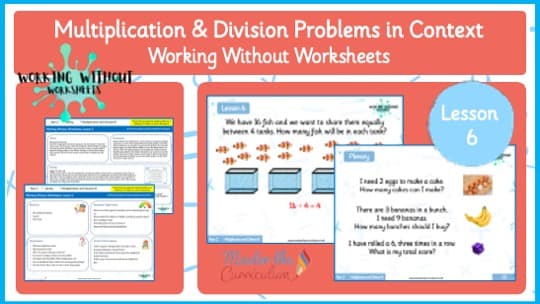
Preview only. The download is a fully editable file.
1 page shown before you download
1CoverThe rest of the pack
Planning, teaching slides and all three worksheet levels come with the download.
Year 2 Working Without Worksheets lesson on multiplication and division in context. Includes planning, teaching slides, practical activities, and plenary.
Included with membership
Unlock with membershipAlready a member? Sign in and it downloads from this page.
Keep it for later and group it with the rest of the block. No account needed to start.
Working Without Worksheets – Year 2 Multiplication and Division: Solve Problems in Contexts This Working Without Worksheets lesson helps Year 2 children apply their multiplication and division knowledge to real-life problem-solving . With a focus on reasoning and practical contexts, children deepen their understanding of grouping, sharing, and repeated addition while developing strategies to represent and solve problems. The starter activities recap prior learning and build fluency: Quick-fire multiplication and division recall (e.g., 2 × 8, 14 ÷ 2). Discuss what multiplication means (repeated addition) and what division means (sharing or grouping equally). Solve simple word problems using familiar objects, such as baskets of apples or bicycles with wheels, to link maths to everyday life. In the main teaching input , children explore multiplication and division through contextual examples: Use concrete and pictorial representations to solve problems such as: “There are 6 bicycles. Each has 2 wheels. How many wheels altogether?” Work through division contexts, for example: “We have 16 fish to share equally between 4 tanks. How many fish in each tank?” Model recording strategies, including repeated addition, arrays, and written number sentences. Encourage children to explain whether a problem requires multiplication (finding the total number in equal groups) or division (sharing equally). The independent activity is practical and collaborative: Children work in pairs with counters, cubes, or drawings to solve real-life problems. Examples include: 6 boxes of crayons, 3 crayons in each box. How many crayons? Share 15 apples between 5 friends. How many each? Put 20 marbles into 5 bags. How many in each bag? Plant 3 rows of flowers, with 7 flowers in each. How many flowers altogether? Children record their calculations and answers in their maths books, reinforcing number sentences alongside practical representations. The plenary links maths back to the real world: Discuss
Show lessThe standard small step pack, as her own modules ship it. We do not print page counts here, because her catalogue does not publish them and a guessed number is worse than none.
Her own system, with the star count repeated in every worksheet header so a child can be handed the right sheet without a word.
Working Without Worksheets, Year 211 numbered lessons
Working Without Worksheets
Y2Working Without Worksheets
Y2
Working Without Worksheets
Y2
Working Without Worksheets
Y2
Working Without Worksheets
Y2
One email a week, for the year group you actually teach. Unsubscribe in a click.