
Working Without Worksheets
Y1L6 Spring Missing Number Problems within 20

masterthecurriculum.co.uk
Proposed versionTrusted by primary teachers across the UK · New resources every week
Working Without Worksheets
Y1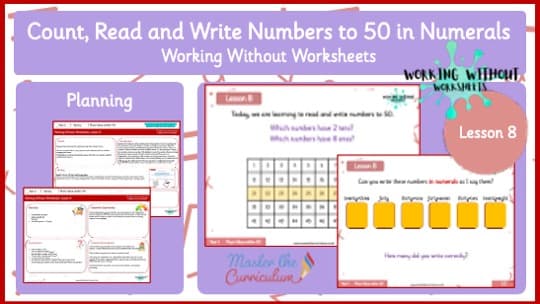
Preview only. The download is a fully editable file.
1 page shown before you download
1CoverThe rest of the pack
Planning, teaching slides and all three worksheet levels come with the download.
Year 1 Working Without Worksheets lesson on reading and writing numbers to 50 in numerals. Includes planning, teaching slides, counting starter, interactive activities, and plenary.
Included with membership
Unlock with membershipAlready a member? Sign in and it downloads from this page.
Keep it for later and group it with the rest of the block. No account needed to start.
Working Without Worksheets – Year 1 Place Value: Count, Read and Write Numbers to 50 in Numerals This Working Without Worksheets lesson develops children’s fluency in reading and writing numbers to 50 in numerals . Through whole-class modelling, paired practice, and interactive number tasks, children strengthen their place value understanding and accuracy in forming two-digit numbers. The lesson begins with a practical starter activity : Recap counting forwards and backwards within 50 using the animated slides. Children then work in pairs with counters and 50-grids/hundred squares, pointing to numbers as they count forwards and backwards. This builds fluency while reinforcing learning from the previous lesson. In the main input , children focus on reading and writing numerals correctly: Explain that today’s focus is reading and writing numbers to 50 . Model using the animation to point to numbers while children say them aloud. Emphasise correct pronunciation (e.g., thirty not thirteen ). Discuss how numbers above 10 are made from two digits: a tens digit and a ones digit. Practise naming circled numbers on the grid, highlighting the pattern of saying tens first, then ones. Move on to an independent whiteboard task: children read circled numbers and write them down, ensuring digits are written in the correct order. Use flashcards for oral rehearsal: say a number, children write it, then reveal the correct answer. Finish the input with a kinaesthetic task—hand out number cards (20–50) and ask children to line up in the correct order. The independent activity reinforces numeral fluency: Call out numbers between 0 and 50. Children must find them on their hundred squares and write them on whiteboards. To increase challenge, ask children to write the numbers without using the hundred square, relying on listening and memory. The plenary addresses common misconceptions: Look at two children’s mistakes on the slide. Discuss digit reversal (e.g., writing 32 as 23). Clarify th
Show lessThe standard small step pack, as her own modules ship it. We do not print page counts here, because her catalogue does not publish them and a guessed number is worse than none.
Her own system, with the star count repeated in every worksheet header so a child can be handed the right sheet without a word.
Working Without Worksheets, Year 110 numbered lessons
Working Without Worksheets
Y1Working Without Worksheets
Y1
Working Without Worksheets
Y1
Working Without Worksheets
Y1
Working Without Worksheets
Y1
One email a week, for the year group you actually teach. Unsubscribe in a click.