Skip to content

Proposed version

Master the Curriculum

Working Without Worksheets

Y1

L9 Spring Identify One More and One Less within 50

masterthecurriculum.co.uk

Preview only. The download is a fully editable file.

See inside

1 page shown before you download

Cover of L9 Spring Identify One More and One Less within 501Cover
Cover and first page

The rest of the pack

Planning, teaching slides and all three worksheet levels come with the download.

Year 1Working Without Worksheets

L9 Spring Identify One More and One Less within 50

4.09 reviews

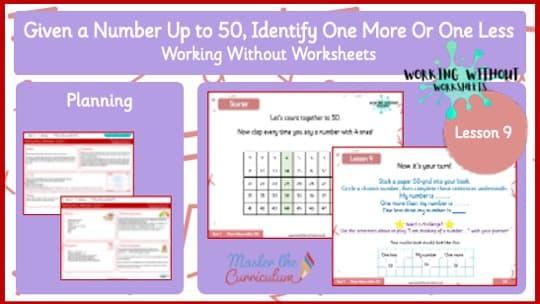
Year 1 Working Without Worksheets lesson on finding one more and one less within 50. Includes planning, teaching slides, practical activities, and plenary.

Included with membership

Unlock with membership

Already a member? Sign in and it downloads from this page.

Keep it for later and group it with the rest of the block. No account needed to start.

  • Fully editable Word or PowerPoint file
  • Differentiated three ways
  • Instant download, no watermark

About this resource

Working Without Worksheets – Year 1 Place Value: One More and One Less Within 50 This Working Without Worksheets lesson supports children in developing fluency with finding one more and one less within 50 . Through active, practical learning, children use a 50-grid to visualise how numbers increase and decrease, while reinforcing their understanding of tens and ones. The starter activity makes counting interactive and fun: As a class, count from 1–50 together. Add in actions to strengthen number awareness: stomp on multiples of 10, clap on numbers with 4 ones, and jump on numbers with 2 tens. This kinaesthetic activity builds familiarity with place value patterns and prepares children for identifying one more and one less. In the main teaching input , children focus on finding one more and one less to 50: Model using the 50-grid and animated slides to show how a counter moves when adding or subtracting 1. Discuss how the grid looks different to a number line, particularly when moving into a new row (finding one more than a number ending in 9) or when moving to the end of the previous row (finding one less than a number ending in 1). Provide multiple worked examples to secure understanding and address common misconceptions. Practise completing stem sentences: “One more than ___ is ___” and “One less than ___ is ___.” The independent activity encourages children to apply their knowledge: Children choose a number between 20 and 50 and circle it on their 50-grid. They complete sentences in their books: My number is ___. One more than my number is ___. One less than my number is ___. As an extension, children can play “I am thinking of a number…” with a partner, giving more than/less than clues to identify the hidden number. The plenary consolidates learning: Use the animated slide to assess children’s ability to recall one more and one less. Include trickier sentence structures (e.g., “One less than 20 is ___”) to ensure children can apply their learning flexibly. ReveaRead more

Working Without Worksheets – Year 1 Place Value: One More and One Less Within 50 This Working Without Worksheets lesson supports children in developing fluency with finding one more and one less within 50 . Through active, practical learning, children use a 50-grid to visualise how numbers increase and decrease, while reinforcing their understanding of tens and ones. The starter activity makes counting interactive and fun: As a class, count from 1–50 together. Add in actions to strengthen number awareness: stomp on multiples of 10, clap on numbers with 4 ones, and jump on numbers with 2 tens. This kinaesthetic activity builds familiarity with place value patterns and prepares children for identifying one more and one less. In the main teaching input , children focus on finding one more and one less to 50: Model using the 50-grid and animated slides to show how a counter moves when adding or subtracting 1. Discuss how the grid looks different to a number line, particularly when moving into a new row (finding one more than a number ending in 9) or when moving to the end of the previous row (finding one less than a number ending in 1). Provide multiple worked examples to secure understanding and address common misconceptions. Practise completing stem sentences: “One more than ___ is ___” and “One less than ___ is ___.” The independent activity encourages children to apply their knowledge: Children choose a number between 20 and 50 and circle it on their 50-grid. They complete sentences in their books: My number is ___. One more than my number is ___. One less than my number is ___. As an extension, children can play “I am thinking of a number…” with a partner, giving more than/less than clues to identify the hidden number. The plenary consolidates learning: Use the animated slide to assess children’s ability to recall one more and one less. Include trickier sentence structures (e.g., “One less than 20 is ___”) to ensure children can apply their learning flexibly. Revea

Show less

What you get, 6 files

  • PDFPlanning
  • PPTXPlanning, editable
  • PDFTeaching slides
  • PPTXTeaching slides, editable
  • PDFWorksheets, all three levels
  • PPTXWorksheets, editable

The standard small step pack, as her own modules ship it. We do not print page counts here, because her catalogue does not publish them and a guessed number is worse than none.

★★★ Differentiated three ways
  • Working towardsScaffolded, with the model or the bar already drawn.
  • Working withinThe expected standard for the year group.
  • Greater depthReasoning and explaining, not just more of the same.

Her own system, with the star count repeated in every worksheet header so a child can be handed the right sheet without a word.

The rest of this block

Working Without Worksheets, Year 110 numbered lessons

  1. Lesson 6Spring Use Comparison Language
  2. Lesson 7– WWW – Y1 One More
  3. Lesson 8Spring Write Numbers to 50 in Numerals
  4. Lesson 9 · you are hereSpring Identify One More and One Less within 50
  5. Lesson 10Spring Represent Numbers up to 50

What teachers said after they used it

All reviews →
4.09 verified reviewsWe ask once, seven days after the download, and one tap is enough.
Steven LoughYear 2 teacher, Abbeyfields First School, MorpethVerified download, 23 January 2026

Good value, and the answers are actually on it.

Small thing, but half the free sheets online expect you to work the answers out yourself. My TA can run a group on this without a briefing first.

5 teachers found this helpful

Beth NightingaleYear 1 teacher, Poplar Farm School, GranthamVerified download, 13 January 2026

Fine, though the font is small for my class.

The maths is right and the sequence is sensible. Several of my children needed it enlarged to A3, which is easy enough but worth knowing before you print thirty.

4 teachers found this helpful

Joanne PicklesYear 3 teacher, Crossflatts Primary, BingleyVerified download, 5 March 2026

Printed it at eight on a Sunday and taught it on the Monday.

No editing, no reformatting, no hunting for the answers. The three levels are on separate pages, which sounds obvious until you have used the sites where they are not.

10 teachers found this helpful

More working without worksheets for Year 1

Editable worksheetsWord and PowerPoint, so you can change anythingWhite Rose supportingFollows the small steps you already plan fromDownloadable lesson plansPlanning, slides and worksheets for every stepReasoning and problem solvingBuilt into every step, not sold separately

A free resource every Friday

One email a week, for the year group you actually teach. Unsubscribe in a click.

Year group you teach