
Working Without Worksheets
Y1L6 Spring Missing Number Problems within 20

masterthecurriculum.co.uk
Proposed versionTrusted by primary teachers across the UK · New resources every week
Working Without Worksheets
Y1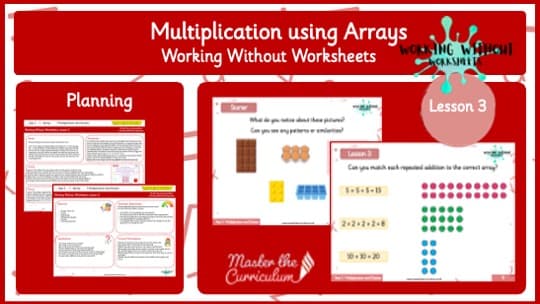
Preview only. The download is a fully editable file.
1 page shown before you download
1CoverThe rest of the pack
Planning, teaching slides and all three worksheet levels come with the download.
A Working Without Worksheets Year 1 lesson on multiplication using arrays . Pupils build, draw, and describe arrays through hands-on, practical maths—no worksheets needed.
Included with membership
Unlock with membershipAlready a member? Sign in and it downloads from this page.
Keep it for later and group it with the rest of the block. No account needed to start.
Introduce children to the concept of arrays with this engaging Working Without Worksheets lesson for Year 1 Multiplication and Division . Designed for classrooms that prioritise hands-on, practical maths , this lesson helps pupils visualise multiplication as repeated addition using organised rows and columns—without a single worksheet. The lesson begins with a recap of previous multiplication learning and a discussion about everyday arrays, such as egg boxes, chocolate bars, and ice cube trays . Pupils spot similarities between these examples, learning that arrays are made up of rows and columns that help us organise groups. The teacher introduces the term array for the first time and models how it shows repeated addition (e.g. 3 rows of 4 = 4 + 4 + 4 = 12). Children practise identifying rows and columns, matching arrays to repeated addition sentences, and exploring how arrays can look different but still have the same total. Using whiteboards, pupils draw arrays to represent objects and describe the groups they’ve made. In the main activity, children work in small groups to build arrays using counters . They roll a dice to decide the number of rows, then choose a number card for the columns, arranging their counters neatly into an array. Pupils record both repeated addition sentences in their maths books and check totals by counting in 2s, 5s, or 10s. The plenary introduces a reasoning challenge using Tia’s problem , where pupils spot why her jumbled counters can’t be counted easily. Together, they correct her mistake by arranging the counters into a proper array and writing the repeated addition that matches. What’s Included in the Pack? ✔ Full teacher planning with objectives, activities, and plenary guidance ✔ Starter: explore arrays in real-life objects (chocolate bars, egg boxes, trays) ✔ Vocabulary focus: array, row, column, group, repeated addition ✔ Teacher modelling: demonstrate how arrays represent multiplication ✔ Practical task: build and draw arrays us
Show lessThe standard small step pack, as her own modules ship it. We do not print page counts here, because her catalogue does not publish them and a guessed number is worse than none.
Her own system, with the star count repeated in every worksheet header so a child can be handed the right sheet without a word.
Working Without Worksheets, Year 110 numbered lessons
Working Without Worksheets
Y1Working Without Worksheets
Y1
Working Without Worksheets
Y1
Working Without Worksheets
Y1
Working Without Worksheets
Y1
One email a week, for the year group you actually teach. Unsubscribe in a click.