
Working Without Worksheets
Y1L6 Spring Missing Number Problems within 20

masterthecurriculum.co.uk
Proposed versionTrusted by primary teachers across the UK · New resources every week
Working Without Worksheets
Y1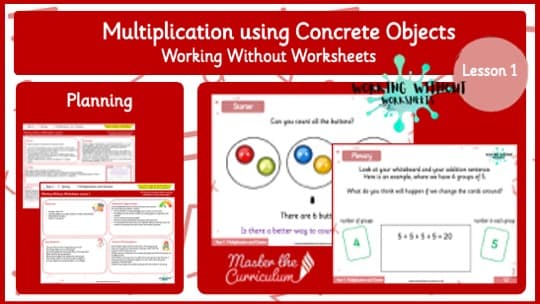
Preview only. The download is a fully editable file.
1 page shown before you download
1CoverThe rest of the pack
Planning, teaching slides and all three worksheet levels come with the download.
Included with membership
Unlock with membershipAlready a member? Sign in and it downloads from this page.
Keep it for later and group it with the rest of the block. No account needed to start.
This engaging, hands-on lesson introduces multiplication as repeated addition , helping Year 1 children build a strong conceptual understanding of what multiplication means — before moving on to symbols and formal methods. In this first lesson of the Year 1 Multiplication unit , children explore how counting in equal groups is a quicker and more efficient way to find a total than counting each object individually. The lesson begins with an animated starter activity showing groups of buttons being counted one at a time. Children quickly realise how time-consuming this is, leading into the key concept — we can count groups instead of individual objects . Using the example of 2 + 2 + 2 = 6, pupils discover that this is called repeated addition and that each group must have the same number of items. During the main introduction , the teacher models how repeated addition represents equal groups — for example, 3 groups of 2 . Using real-life manipulatives such as plates and counters (or classroom blocks), pupils learn that the colour or size of the objects doesn’t matter, as long as the groups are equal. Visuals and physical exploration help them understand that multiplication is a way of combining equal groups efficiently. Children then work through further examples using slides and physical resources to represent and record number sentences like 5 + 5 = 10 or 2 + 2 + 2 = 6 . The main activity is fully practical: children pick two number cards between 1 and 10. One number represents how many groups they need to make, and the other represents how many items in each group . Using counters, cubes, or similar manipulatives, they build equal groups, find the total, and record the matching repeated addition sentence on whiteboards. Throughout the activity, pupils are encouraged to reason and explain their thinking: Are all the groups equal? Why is that important? What happens if you add one more group? How did you work out the total? How does grouping help us to multiply? The
Show lessThe standard small step pack, as her own modules ship it. We do not print page counts here, because her catalogue does not publish them and a guessed number is worse than none.
Her own system, with the star count repeated in every worksheet header so a child can be handed the right sheet without a word.
Working Without Worksheets, Year 110 numbered lessons
Working Without Worksheets
Y1Working Without Worksheets
Y1
Working Without Worksheets
Y1
Working Without Worksheets
Y1
Working Without Worksheets
Y1
One email a week, for the year group you actually teach. Unsubscribe in a click.