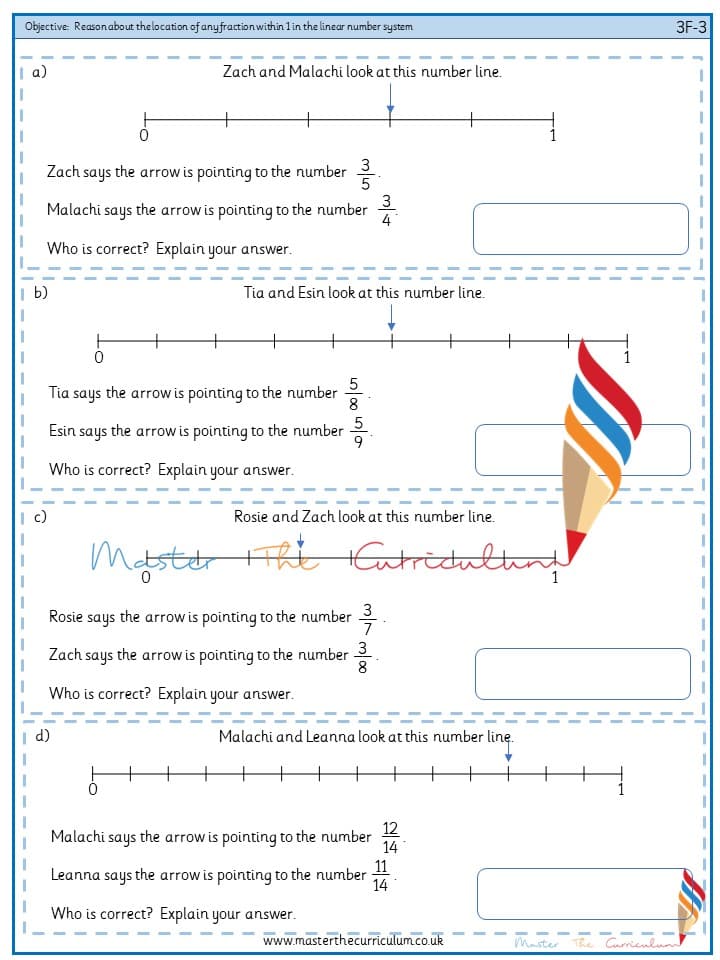
So far (in 3F–1 and 3F–2) pupils will probably have only experienced fractions as operators, for example, 1/3 of this shape, 3/5 of this line, or 1/4 of this quantity. Pupils must also develop an understanding of fractions as numbers, each of which has a place in the linear number system (for example, the number 1/4 in contrast to the operator 1/4 of something). Pupils will already have learnt to place whole numbers on number lines, and now they must learn that other numbers (fractions) lie between these whole numbers, beginning in year 3 with fractions within 1. Pupils should learn to count, forwards and backwards, in multiples of unit fractions, with the support of number lines. Language focus “One fifth, two fifths, three fifths…” “1 one-fifth, 2 one-fifths, 3 one-fifths…” This reinforces the understanding that non-unit fractions are repeated additions of unit fractions. Pupils also need to understand that a fraction with the numerator equal to the denominator is equivalent to 1. Practice should involve counting, for example, both “… three-fifths, four-fifths, five-fifths” and “… three-fifths, four-fifths, one”. Pupils should then learn to label marked number lines, within 1. Identifying points between labelled intervals is an important skill in graphing and measures. A common mistake that pupils make is to count the number of marks between labelled intervals, rather than the number of parts, for example, on the number line below they may count 3 marks and incorrectly deduce that the number line is marked in thirds. Language focus “Each whole-number interval is divided into 4 equal parts, so we count in quarters.” Pupils must also be able to estimate the value or position of fractions on 0 to 1 number lines that do not have fractional marks. Pupils also need to be able to reason, for example, that 1/4 is nearer to 0 than 1/3 is, because 1/4 is smaller than 1/4; they should consider the number of parts the 0 to 1interval is divided into, and understand that the grRead more
So far (in 3F–1 and 3F–2) pupils will probably have only experienced fractions as operators, for example, 1/3 of this shape, 3/5 of this line, or 1/4 of this quantity. Pupils must also develop an understanding of fractions as numbers, each of which has a place in the linear number system (for example, the number 1/4 in contrast to the operator 1/4 of something). Pupils will already have learnt to place whole numbers on number lines, and now they must learn that other numbers (fractions) lie between these whole numbers, beginning in year 3 with fractions within 1. Pupils should learn to count, forwards and backwards, in multiples of unit fractions, with the support of number lines. Language focus “One fifth, two fifths, three fifths…” “1 one-fifth, 2 one-fifths, 3 one-fifths…” This reinforces the understanding that non-unit fractions are repeated additions of unit fractions. Pupils also need to understand that a fraction with the numerator equal to the denominator is equivalent to 1. Practice should involve counting, for example, both “… three-fifths, four-fifths, five-fifths” and “… three-fifths, four-fifths, one”. Pupils should then learn to label marked number lines, within 1. Identifying points between labelled intervals is an important skill in graphing and measures. A common mistake that pupils make is to count the number of marks between labelled intervals, rather than the number of parts, for example, on the number line below they may count 3 marks and incorrectly deduce that the number line is marked in thirds. Language focus “Each whole-number interval is divided into 4 equal parts, so we count in quarters.” Pupils must also be able to estimate the value or position of fractions on 0 to 1 number lines that do not have fractional marks. Pupils also need to be able to reason, for example, that 1/4 is nearer to 0 than 1/3 is, because 1/4 is smaller than 1/4; they should consider the number of parts the 0 to 1interval is divided into, and understand that the gr
Show less