
Fractions
Y4L10 Problem-Solving with Decimals and Fractions

masterthecurriculum.co.uk
Proposed versionTrusted by primary teachers across the UK · New resources every week
Fractions
Y4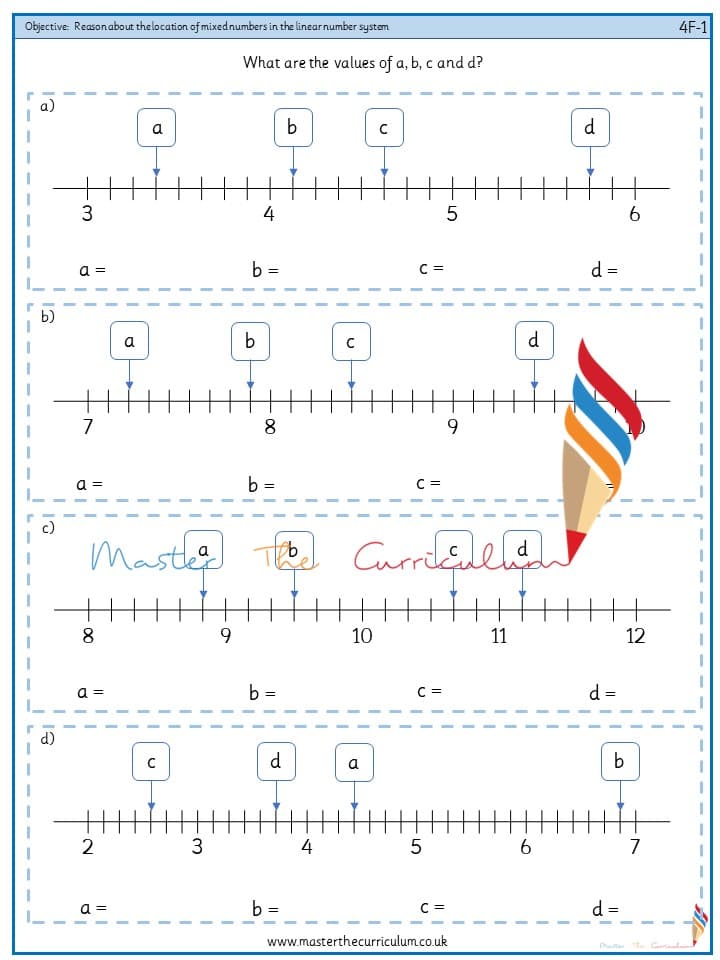
Preview only. The download is a fully editable file.
1 page shown before you download
1CoverThe rest of the pack
Planning, teaching slides and all three worksheet levels come with the download.
Included with membership
Unlock with membershipAlready a member? Sign in and it downloads from this page.
Keep it for later and group it with the rest of the block. No account needed to start.
Sometimes pupils get quite far in their maths education only thinking of a fraction as a part of a whole, rather than as a number in its own right. In year 3, pupils learnt about the location in the linear number system of fractions between 0 and 1 (3F–2). For pupils to be able to add and subtract fractions across 1, or those greater than 1 (4F–3 ), they need to understand how mixed numbers fit into the linear number system. Pupils should develop fluency counting in multiples of unit fractions, using number lines for support. Counting draws attention to the equivalence of, for example, 1 and 2, or 2 and 3. Pupils should practise counting both forwards and backwards. Pupils should then learn to label marked number lines, extending beyond 1. A common mistake that pupils make is to count the number of marks between labelled intervals, rather than the number of parts. For example, on the number line below they may count 3 marks and incorrectly deduce that the number line is marked in thirds. Language focus “Each interval is divided into 4 equal parts, so we count in quarters.” Pupils should also be able to estimate the value or position of mixed numbers on number lines which do not have fractional marks. Pupils must understand that it is not the absolute size of the numerator and denominator which determine the value of the fractional part of the mixed number, but the relationship between the numerator and denominator (whether the numerator is a large or small part of the denominator). Pupils need to be able to reason, for example, that 1 is close to 2, but that 1 is closer to 1. Pupils must also be able to identify the previous and next whole number, and will then be able to round to the nearest whole number, which further supports estimation and approximation. Language focus “1 is between 1 and 2.” “The previous whole number is 1.” “The next whole number is 2.”
Show lessThe standard small step pack, as her own modules ship it. We do not print page counts here, because her catalogue does not publish them and a guessed number is worse than none.
Her own system, with the star count repeated in every worksheet header so a child can be handed the right sheet without a word.
Fractions
Y4Fractions
Y4
Fractions
Y4
Fractions
Y4
Fractions
Y4
One email a week, for the year group you actually teach. Unsubscribe in a click.