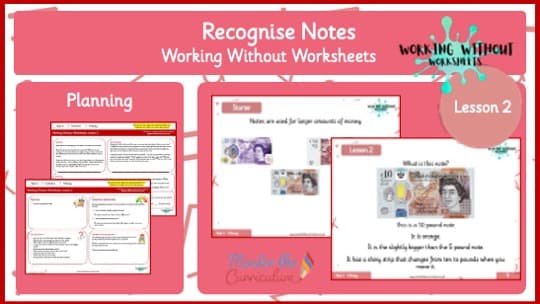
Build on children’s understanding of money with this engaging Working Without Worksheets lesson for Year 1 Measurement – Money . Designed for classrooms that prioritise hands-on exploration over worksheets, this practical session introduces pupils to UK banknotes , helping them recognise, name, and order notes by size, colour, and value. The lesson begins with a recap discussion about money’s purpose — what we use it for and what forms it takes. Pupils revisit coins from the previous lesson, then explore how money also comes as notes , which are worth more than coins . During the introduction, the teacher displays each UK note (£5, £10, £20, and £50) and asks pupils to name and describe them. Together, the class observes the colours, sizes, holograms, and features that make each note unique. Once all notes are introduced, pupils order them from least to greatest value , noticing that as value increases, so does note size . The main activities immerse children in practical, play-based learning: Note Sorting: Pupils sort replica notes by colour, size, or value, answering guided questions such as “Which note is the biggest?” and “Which is worth the least?” Shopping Role Play: Pupils use notes to “buy” items in a classroom shop, naming each note as they hand it over (“Here is a £10 note!”). Note Detective Game: A note is hidden in a mystery box. Pupils use clues about colour, size, and value to guess which note it is, taking turns to be the clue-giver. In the plenary, pupils name and describe a set of notes, matching them to their values. They use stem sentences such as “There are three £5 notes” or “There are two £20 notes” , reinforcing their understanding of value, appearance, and mathematical language. What’s Included in the Pack? ✔ Full teacher planning with objectives, activities, and plenary guidance ✔ Starter: discussion about money and introduction to notes ✔ Vocabulary focus: money, note, pound, value, size, colour, hologram ✔ Teacher modelling: identify and oRead more
Build on children’s understanding of money with this engaging Working Without Worksheets lesson for Year 1 Measurement – Money . Designed for classrooms that prioritise hands-on exploration over worksheets, this practical session introduces pupils to UK banknotes , helping them recognise, name, and order notes by size, colour, and value. The lesson begins with a recap discussion about money’s purpose — what we use it for and what forms it takes. Pupils revisit coins from the previous lesson, then explore how money also comes as notes , which are worth more than coins . During the introduction, the teacher displays each UK note (£5, £10, £20, and £50) and asks pupils to name and describe them. Together, the class observes the colours, sizes, holograms, and features that make each note unique. Once all notes are introduced, pupils order them from least to greatest value , noticing that as value increases, so does note size . The main activities immerse children in practical, play-based learning: Note Sorting: Pupils sort replica notes by colour, size, or value, answering guided questions such as “Which note is the biggest?” and “Which is worth the least?” Shopping Role Play: Pupils use notes to “buy” items in a classroom shop, naming each note as they hand it over (“Here is a £10 note!”). Note Detective Game: A note is hidden in a mystery box. Pupils use clues about colour, size, and value to guess which note it is, taking turns to be the clue-giver. In the plenary, pupils name and describe a set of notes, matching them to their values. They use stem sentences such as “There are three £5 notes” or “There are two £20 notes” , reinforcing their understanding of value, appearance, and mathematical language. What’s Included in the Pack? ✔ Full teacher planning with objectives, activities, and plenary guidance ✔ Starter: discussion about money and introduction to notes ✔ Vocabulary focus: money, note, pound, value, size, colour, hologram ✔ Teacher modelling: identify and o
Show less