Working Without Worksheets
Y1L6 Spring Missing Number Problems within 20

masterthecurriculum.co.uk
Proposed versionTrusted by primary teachers across the UK · New resources every week
Working Without Worksheets
Y1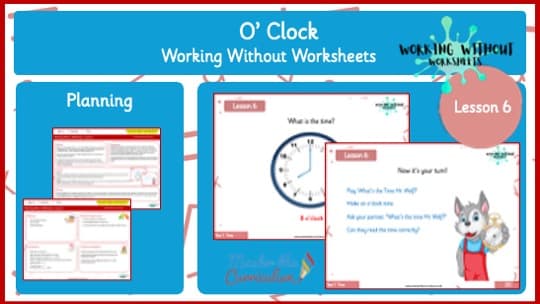
Preview only. The download is a fully editable file.
1 page shown before you download
1CoverThe rest of the pack
Planning, teaching slides and all three worksheet levels come with the download.
A Working Without Worksheets lesson introducing Year 1 pupils to telling the time to the hour . Includes plan, slides, partner games, and interactive activities using real and model clocks.
Included with membership
Unlock with membershipAlready a member? Sign in and it downloads from this page.
Keep it for later and group it with the rest of the block. No account needed to start.
Introduce your Year 1 pupils to telling the time to the hour with this fun, practical, and song-based Working Without Worksheets lesson. Using familiar routines and interactive clock work, children will learn to read, make, and describe o’clock times confidently. The lesson begins with a whole-class discussion to activate prior knowledge. Pupils talk about when they wake up, eat lunch, or go to bed, and start to connect specific times with daily events. The teacher introduces the term o’clock and a catchy time song (to the tune of Twinkle, Twinkle, Little Star ) to reinforce the concept of time to the hour in a memorable, rhythmic way. During the introduction , the teacher demonstrates how to read an analogue clock. Pupils learn that the hour hand is the short hand and the minute hand is the long hand. Using teaching slides, the teacher models how the minute hand pointing to 12 means it is an o’clock time. The hour hand shows the current hour — for example, when the short hand points to 2, the time is 2 o’clock. Children use mini clocks to make times shown on the board, checking their answers and developing fluency through repetition and practical manipulation. In the activity , pupils work with partners to consolidate their understanding. Task 1: Children use the resource sheet to select and make o’clock times, taking turns to be the teacher and the learner. Task 2: Pupils play What’s the Time, Mr Wolf? — a fun, active way to practise telling and reading o’clock times aloud using their own clocks. The plenary brings learning to life as children connect times with real-world routines. They match times to familiar activities (like lunchtime or bedtime) and hold up their clocks to show each time. This interactive review allows for informal assessment of their ability to read and make o’clock times confidently. What’s Included in the Pack ✔ Full lesson plan with objectives, teaching notes, and key questions ✔ Animated teaching slides introducing clock hands and o’clock
Show lessThe standard small step pack, as her own modules ship it. We do not print page counts here, because her catalogue does not publish them and a guessed number is worse than none.
Her own system, with the star count repeated in every worksheet header so a child can be handed the right sheet without a word.
Working Without Worksheets, Year 110 numbered lessons
Working Without Worksheets
Y1Working Without Worksheets
Y1
Working Without Worksheets
Y1
Working Without Worksheets
Y1
Working Without Worksheets
Y1
One email a week, for the year group you actually teach. Unsubscribe in a click.